

3.2 Biochemical Conversion Technologies
77
sludge and industrial wastes can be used to produce biogas by AD for electricity and
heat generation [67].
AD systems operate in three main temperature ranges: 50–60 °C for thermophilic
systems, 30–40 °C for mesophilic systems, 15–25 °C for psychrophilic systems.
Waste digestion in an AD process involves various stages including hydrolysis,
acidogenesis, acetogenesis, and methanogenesis [68, 69]. During the hydrolysis stage
(Eq. 3.1), which is normally the rate-limiting step of AD, both insoluble organic material and high molecular weight compounds such as lipids, proteins, polysaccharides
and nucleic acids are degraded into soluble organic substances (e.g., amino acids
and fatty acids) [69]. In the second stage (acidogenesis), the components formed in
hydrolysis are converted into volatile fatty acids (VFAs) along with NH 3 , CO 2 , H 2
and other by-products by acidogenic (fermentative) bacteria. During the third stage
(acetogenesis, Eq. 3.2), acetogens further digest the higher organic acids and alcohols from the acidogenesis stage to produce mainly acetic acid, CO 2 and H 2 . These
three steps are usually called acid fermentation [70]. In the last stage (methanogenesis), methane is produced by two groups of methanogenic bacteria: The first group
produces methane and CO 2 from the fermentation of acetate (Eq. 3.3) and the second
group (Eq. 3.4) uses hydrogen as electron donor and CO 2 as an acceptor to produce
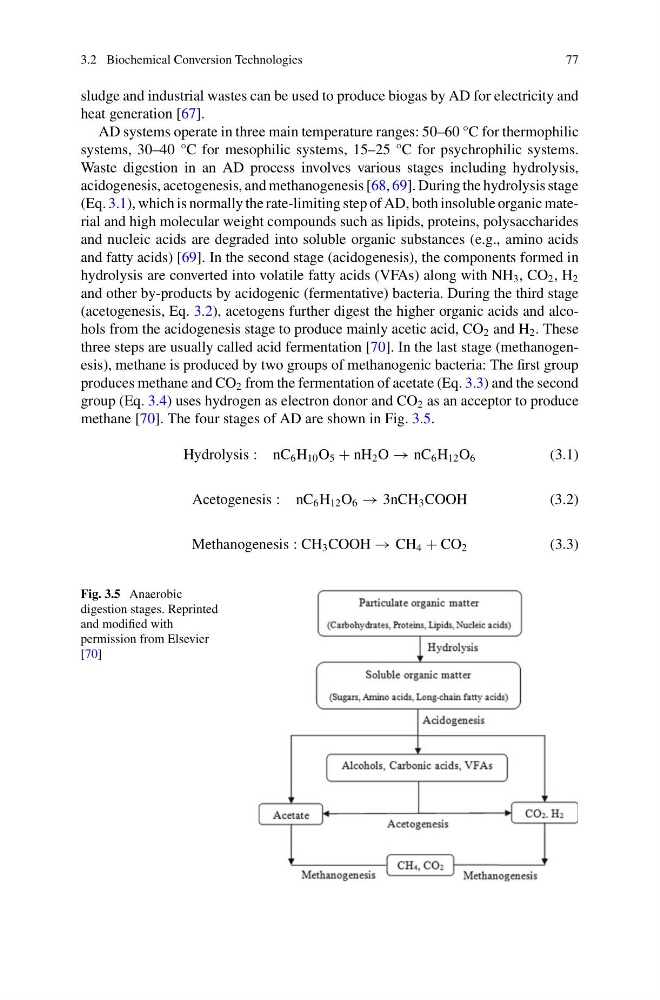
methane [70]. The four stages of AD are shown in Fig. 3.5.
Hydrolysis : nC 6 H 10 O 5 + nH 2 O → nC 6 H 12 O 6
(3.1)
Acetogenesis : nC 6 H 12 O 6 → 3nCH 3 COOH
(3.2)
Methanogenesis : CH 3 COOH → CH 4 + CO 2
(3.3)
Fig. 3.5 Anaerobic
digestion stages. Reprinted
and modified with
permission from Elsevier
[70]
77
sludge and industrial wastes can be used to produce biogas by AD for electricity and
heat generation [67].
AD systems operate in three main temperature ranges: 50–60 °C for thermophilic
systems, 30–40 °C for mesophilic systems, 15–25 °C for psychrophilic systems.
Waste digestion in an AD process involves various stages including hydrolysis,
acidogenesis, acetogenesis, and methanogenesis [68, 69]. During the hydrolysis stage
(Eq. 3.1), which is normally the rate-limiting step of AD, both insoluble organic material and high molecular weight compounds such as lipids, proteins, polysaccharides
and nucleic acids are degraded into soluble organic substances (e.g., amino acids
and fatty acids) [69]. In the second stage (acidogenesis), the components formed in
hydrolysis are converted into volatile fatty acids (VFAs) along with NH 3 , CO 2 , H 2
and other by-products by acidogenic (fermentative) bacteria. During the third stage
(acetogenesis, Eq. 3.2), acetogens further digest the higher organic acids and alcohols from the acidogenesis stage to produce mainly acetic acid, CO 2 and H 2 . These
three steps are usually called acid fermentation [70]. In the last stage (methanogenesis), methane is produced by two groups of methanogenic bacteria: The first group
produces methane and CO 2 from the fermentation of acetate (Eq. 3.3) and the second
group (Eq. 3.4) uses hydrogen as electron donor and CO 2 as an acceptor to produce
methane [70]. The four stages of AD are shown in Fig. 3.5.
Hydrolysis : nC 6 H 10 O 5 + nH 2 O → nC 6 H 12 O 6
(3.1)
Acetogenesis : nC 6 H 12 O 6 → 3nCH 3 COOH
(3.2)
Methanogenesis : CH 3 COOH → CH 4 + CO 2
(3.3)
Fig. 3.5 Anaerobic
digestion stages. Reprinted
and modified with
permission from Elsevier
[70]