

64
3 Advanced Technologies (Biological and Thermochemical) …
– Possibility of becoming energy self-sustaining;
– Ability to convert low-energy-density biomass to valuable liquid fuels with greater
heating values;
– Potential to produce chemicals from bio-based resources.
Whereas, the major challenges of pyrolysis technologies are in the improvement
of the reactor and process reliability, and demonstration of the utilization of pyrolysis
oils, in particular for the production of chemicals and drop-in fuels [33].
Operating parameters such as temperature, residence time, heating rate, type and
composition of feedstock and catalyst can affect the pyrolysis yield and products
[26]. Heating rate and temperature are the most important factors affecting the products yield and distribution. Quick heating rates yield greater gaseous products and
bio-oils, while slower heating rate produces more char. A faster heating rate translates
to a shorter residence time, which leads to the same results. An increase in temperature increases the bio-oil production up to a point after which, further temperature
enhancement results in oil decomposition to form light-end products. The composition of the feedstock can greatly affect the quality and quantity of bio-oil from
pyrolysis. The lipid, protein and carbohydrates contents differ from one biomass to
another, leading to different characteristics of the produced bio-fuels. Particle size
can also affect the yields of the pyrolysis process as it affects the heating rate. Smaller
particles have a higher surface area and can be heated up faster in the process.
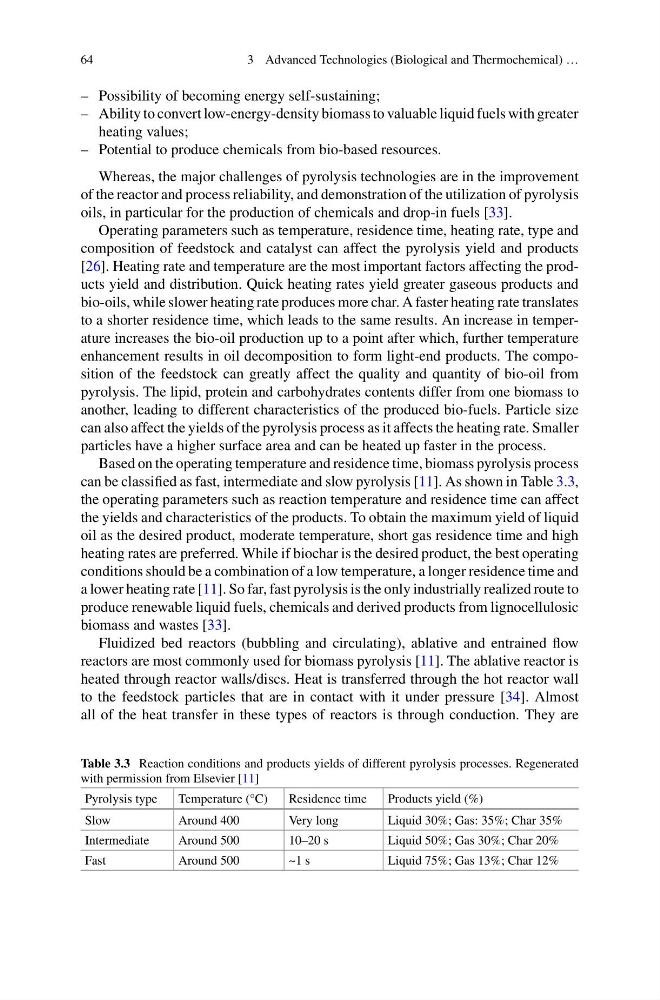
Based on the operating temperature and residence time, biomass pyrolysis process
can be classified as fast, intermediate and slow pyrolysis [11]. As shown in Table 3.3,
the operating parameters such as reaction temperature and residence time can affect
the yields and characteristics of the products. To obtain the maximum yield of liquid
oil as the desired product, moderate temperature, short gas residence time and high
heating rates are preferred. While if biochar is the desired product, the best operating
conditions should be a combination of a low temperature, a longer residence time and
a lower heating rate [11]. So far, fast pyrolysis is the only industrially realized route to
produce renewable liquid fuels, chemicals and derived products from lignocellulosic
biomass and wastes [33].
Fluidized bed reactors (bubbling and circulating), ablative and entrained flow
reactors are most commonly used for biomass pyrolysis [11]. The ablative reactor is
heated through reactor walls/discs. Heat is transferred through the hot reactor wall
to the feedstock particles that are in contact with it under pressure [34]. Almost
all of the heat transfer in these types of reactors is through conduction. They are
Table 3.3 Reaction conditions and products yields of different pyrolysis processes. Regenerated
with permission from Elsevier [11]
Pyrolysis type
Temperature (°C)
Residence time
Products yield (%)
Slow
Around 400
Very long
Liquid 30%; Gas: 35%; Char 35%
Intermediate
Around 500
10–20 s
Liquid 50%; Gas 30%; Char 20%
Fast
Around 500
~1 s
Liquid 75%; Gas 13%; Char 12%
3 Advanced Technologies (Biological and Thermochemical) …
– Possibility of becoming energy self-sustaining;
– Ability to convert low-energy-density biomass to valuable liquid fuels with greater
heating values;
– Potential to produce chemicals from bio-based resources.
Whereas, the major challenges of pyrolysis technologies are in the improvement
of the reactor and process reliability, and demonstration of the utilization of pyrolysis
oils, in particular for the production of chemicals and drop-in fuels [33].
Operating parameters such as temperature, residence time, heating rate, type and
composition of feedstock and catalyst can affect the pyrolysis yield and products
[26]. Heating rate and temperature are the most important factors affecting the products yield and distribution. Quick heating rates yield greater gaseous products and
bio-oils, while slower heating rate produces more char. A faster heating rate translates
to a shorter residence time, which leads to the same results. An increase in temperature increases the bio-oil production up to a point after which, further temperature
enhancement results in oil decomposition to form light-end products. The composition of the feedstock can greatly affect the quality and quantity of bio-oil from
pyrolysis. The lipid, protein and carbohydrates contents differ from one biomass to
another, leading to different characteristics of the produced bio-fuels. Particle size
can also affect the yields of the pyrolysis process as it affects the heating rate. Smaller
particles have a higher surface area and can be heated up faster in the process.
Based on the operating temperature and residence time, biomass pyrolysis process
can be classified as fast, intermediate and slow pyrolysis [11]. As shown in Table 3.3,
the operating parameters such as reaction temperature and residence time can affect
the yields and characteristics of the products. To obtain the maximum yield of liquid
oil as the desired product, moderate temperature, short gas residence time and high
heating rates are preferred. While if biochar is the desired product, the best operating
conditions should be a combination of a low temperature, a longer residence time and
a lower heating rate [11]. So far, fast pyrolysis is the only industrially realized route to
produce renewable liquid fuels, chemicals and derived products from lignocellulosic
biomass and wastes [33].
Fluidized bed reactors (bubbling and circulating), ablative and entrained flow
reactors are most commonly used for biomass pyrolysis [11]. The ablative reactor is
heated through reactor walls/discs. Heat is transferred through the hot reactor wall
to the feedstock particles that are in contact with it under pressure [34]. Almost
all of the heat transfer in these types of reactors is through conduction. They are
Table 3.3 Reaction conditions and products yields of different pyrolysis processes. Regenerated
with permission from Elsevier [11]
Pyrolysis type
Temperature (°C)
Residence time
Products yield (%)
Slow
Around 400
Very long
Liquid 30%; Gas: 35%; Char 35%
Intermediate
Around 500
10–20 s
Liquid 50%; Gas 30%; Char 20%
Fast
Around 500
~1 s
Liquid 75%; Gas 13%; Char 12%