

48
2 Conventional Approaches for Waste Management …
2.4.2 Composting
Composting is a natural biological process carried out at controlled aerobic conditions
to break down the organic waste such as food waste, manure, paper, wood, crop
residue, etc., and convert them into valuable organic fertilizers. Compost is primarily
referred to as a soil conditioner that enhances the soil quality and adds some nutrient
value such as carbon and nitrogen back into the soil. Composting plays an important
role in diverting waste from the landfills and can be used to produce a high-quality
soil amendment with a variety of end uses [19, 36]. Residential organic waste can be
composted by backyard composting and centralized composting, which can reduce
the mass and volume of the wastes by 50% and 80%, respectively [19].
There are three stages of composting namely pre-processing, composting and
post-processing. In the pre-processing stage, the waste goes under some preparation
processes such as debagging, manual inspection, removal of recyclables, particle
size reduction, screening, addition of amendments and mixing [19]. The essential
elements of the composting stage are microorganisms, appropriate level of nutrients,
carbon, nitrogen, oxygen and moisture. The decomposition of organic substrates
during composting is enabled by different types of aerobic microorganisms, including
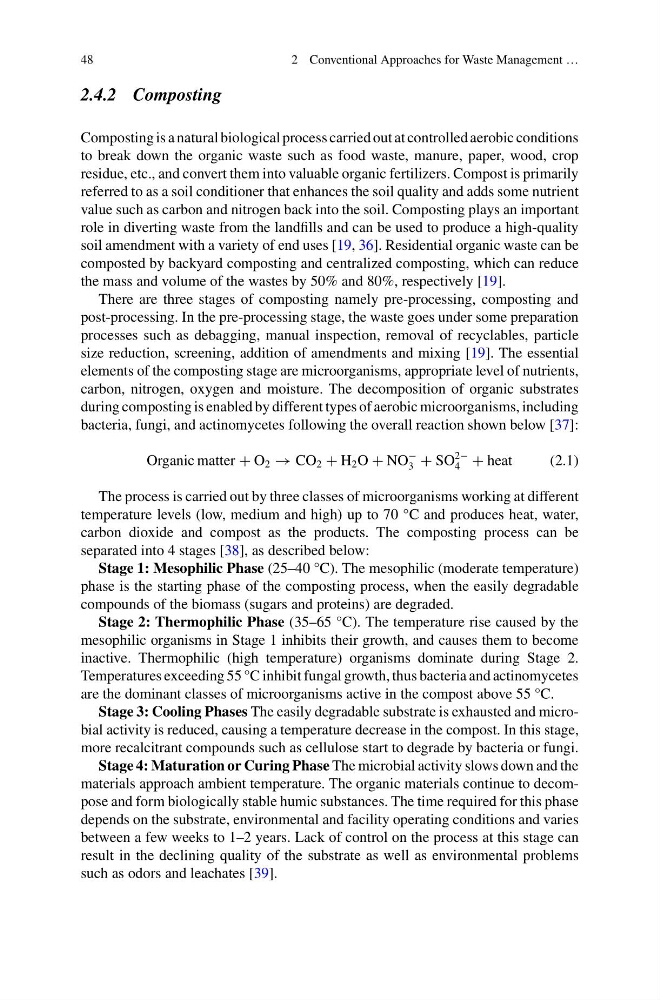
bacteria, fungi, and actinomycetes following the overall reaction shown below [37]:
Organic matter + O 2 → CO 2 + H 2 O + NO
−
3 + SO
2−
4 + heat
(2.1)
The process is carried out by three classes of microorganisms working at different
temperature levels (low, medium and high) up to 70 °C and produces heat, water,
carbon dioxide and compost as the products. The composting process can be
separated into 4 stages [38], as described below:
Stage 1: Mesophilic Phase (25–40 °C). The mesophilic (moderate temperature)
phase is the starting phase of the composting process, when the easily degradable
compounds of the biomass (sugars and proteins) are degraded.
Stage 2: Thermophilic Phase (35–65 °C). The temperature rise caused by the
mesophilic organisms in Stage 1 inhibits their growth, and causes them to become
inactive. Thermophilic (high temperature) organisms dominate during Stage 2.
Temperatures exceeding 55 °C inhibit fungal growth, thus bacteria and actinomycetes
are the dominant classes of microorganisms active in the compost above 55 °C.
Stage 3: Cooling Phases The easily degradable substrate is exhausted and microbial activity is reduced, causing a temperature decrease in the compost. In this stage,
more recalcitrant compounds such as cellulose start to degrade by bacteria or fungi.
Stage 4: Maturation or Curing Phase The microbial activity slows down and the
materials approach ambient temperature. The organic materials continue to decompose and form biologically stable humic substances. The time required for this phase
depends on the substrate, environmental and facility operating conditions and varies
between a few weeks to 1–2 years. Lack of control on the process at this stage can
result in the declining quality of the substrate as well as environmental problems
such as odors and leachates [39].
2 Conventional Approaches for Waste Management …
2.4.2 Composting
Composting is a natural biological process carried out at controlled aerobic conditions
to break down the organic waste such as food waste, manure, paper, wood, crop
residue, etc., and convert them into valuable organic fertilizers. Compost is primarily
referred to as a soil conditioner that enhances the soil quality and adds some nutrient
value such as carbon and nitrogen back into the soil. Composting plays an important
role in diverting waste from the landfills and can be used to produce a high-quality
soil amendment with a variety of end uses [19, 36]. Residential organic waste can be
composted by backyard composting and centralized composting, which can reduce
the mass and volume of the wastes by 50% and 80%, respectively [19].
There are three stages of composting namely pre-processing, composting and
post-processing. In the pre-processing stage, the waste goes under some preparation
processes such as debagging, manual inspection, removal of recyclables, particle
size reduction, screening, addition of amendments and mixing [19]. The essential
elements of the composting stage are microorganisms, appropriate level of nutrients,
carbon, nitrogen, oxygen and moisture. The decomposition of organic substrates
during composting is enabled by different types of aerobic microorganisms, including
bacteria, fungi, and actinomycetes following the overall reaction shown below [37]:
Organic matter + O 2 → CO 2 + H 2 O + NO
−
3 + SO
2−
4 + heat
(2.1)
The process is carried out by three classes of microorganisms working at different
temperature levels (low, medium and high) up to 70 °C and produces heat, water,
carbon dioxide and compost as the products. The composting process can be
separated into 4 stages [38], as described below:
Stage 1: Mesophilic Phase (25–40 °C). The mesophilic (moderate temperature)
phase is the starting phase of the composting process, when the easily degradable
compounds of the biomass (sugars and proteins) are degraded.
Stage 2: Thermophilic Phase (35–65 °C). The temperature rise caused by the
mesophilic organisms in Stage 1 inhibits their growth, and causes them to become
inactive. Thermophilic (high temperature) organisms dominate during Stage 2.
Temperatures exceeding 55 °C inhibit fungal growth, thus bacteria and actinomycetes
are the dominant classes of microorganisms active in the compost above 55 °C.
Stage 3: Cooling Phases The easily degradable substrate is exhausted and microbial activity is reduced, causing a temperature decrease in the compost. In this stage,
more recalcitrant compounds such as cellulose start to degrade by bacteria or fungi.
Stage 4: Maturation or Curing Phase The microbial activity slows down and the
materials approach ambient temperature. The organic materials continue to decompose and form biologically stable humic substances. The time required for this phase
depends on the substrate, environmental and facility operating conditions and varies
between a few weeks to 1–2 years. Lack of control on the process at this stage can
result in the declining quality of the substrate as well as environmental problems
such as odors and leachates [39].