

44
2 Conventional Approaches for Waste Management …
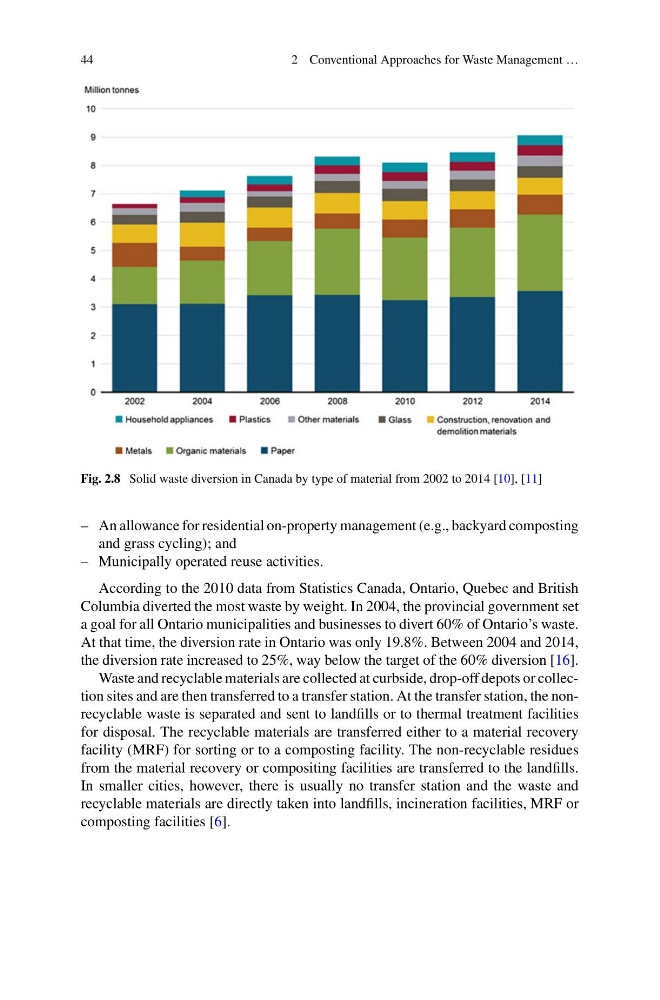
Fig. 2.8 Solid waste diversion in Canada by type of material from 2002 to 2014 [10], [11]
– An allowance for residential on-property management (e.g., backyard composting
and grass cycling); and
– Municipally operated reuse activities.
According to the 2010 data from Statistics Canada, Ontario, Quebec and British
Columbia diverted the most waste by weight. In 2004, the provincial government set
a goal for all Ontario municipalities and businesses to divert 60% of Ontario’s waste.
At that time, the diversion rate in Ontario was only 19.8%. Between 2004 and 2014,
the diversion rate increased to 25%, way below the target of the 60% diversion [16].
Waste and recyclable materials are collected at curbside, drop-off depots or collection sites and are then transferred to a transfer station. At the transfer station, the nonrecyclable waste is separated and sent to landfills or to thermal treatment facilities
for disposal. The recyclable materials are transferred either to a material recovery
facility (MRF) for sorting or to a composting facility. The non-recyclable residues
from the material recovery or compositing facilities are transferred to the landfills.
In smaller cities, however, there is usually no transfer station and the waste and
recyclable materials are directly taken into landfills, incineration facilities, MRF or
composting facilities [6].
2 Conventional Approaches for Waste Management …
Fig. 2.8 Solid waste diversion in Canada by type of material from 2002 to 2014 [10], [11]
– An allowance for residential on-property management (e.g., backyard composting
and grass cycling); and
– Municipally operated reuse activities.
According to the 2010 data from Statistics Canada, Ontario, Quebec and British
Columbia diverted the most waste by weight. In 2004, the provincial government set
a goal for all Ontario municipalities and businesses to divert 60% of Ontario’s waste.
At that time, the diversion rate in Ontario was only 19.8%. Between 2004 and 2014,
the diversion rate increased to 25%, way below the target of the 60% diversion [16].
Waste and recyclable materials are collected at curbside, drop-off depots or collection sites and are then transferred to a transfer station. At the transfer station, the nonrecyclable waste is separated and sent to landfills or to thermal treatment facilities
for disposal. The recyclable materials are transferred either to a material recovery
facility (MRF) for sorting or to a composting facility. The non-recyclable residues
from the material recovery or compositing facilities are transferred to the landfills.
In smaller cities, however, there is usually no transfer station and the waste and
recyclable materials are directly taken into landfills, incineration facilities, MRF or
composting facilities [6].