

22
1 Wastes Generation, Characterization, Management Strategies …
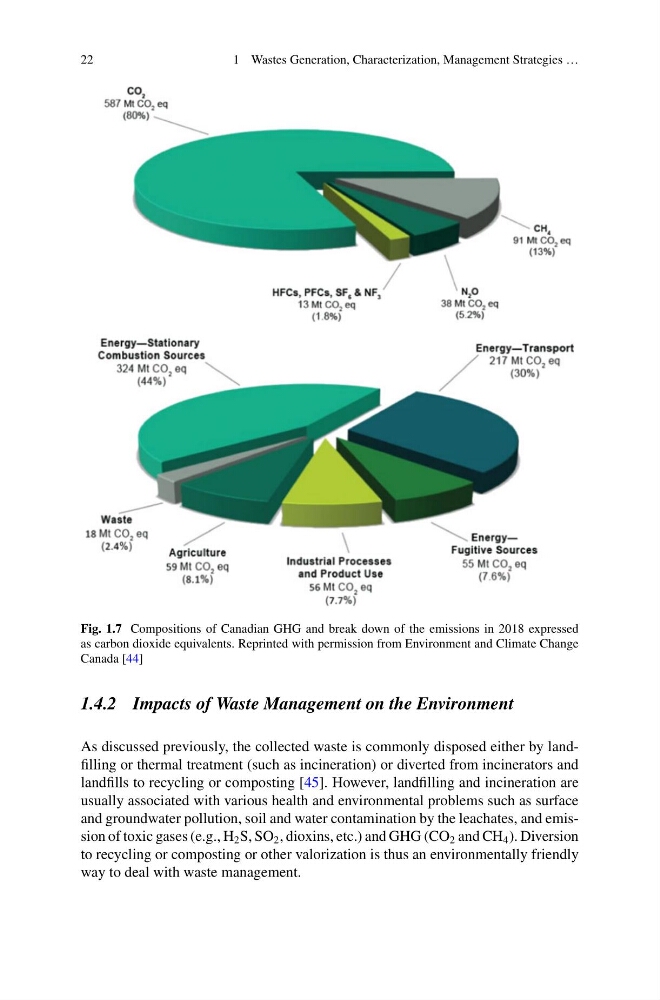
Fig. 1.7 Compositions of Canadian GHG and break down of the emissions in 2018 expressed
as carbon dioxide equivalents. Reprinted with permission from Environment and Climate Change
Canada [44]
1.4.2 Impacts of Waste Management on the Environment
As discussed previously, the collected waste is commonly disposed either by landfilling or thermal treatment (such as incineration) or diverted from incinerators and
landfills to recycling or composting [45]. However, landfilling and incineration are
usually associated with various health and environmental problems such as surface
and groundwater pollution, soil and water contamination by the leachates, and emission of toxic gases (e.g., H 2 S, SO 2 , dioxins, etc.) and GHG (CO 2 and CH 4 ). Diversion
to recycling or composting or other valorization is thus an environmentally friendly
way to deal with waste management.
1 Wastes Generation, Characterization, Management Strategies …
Fig. 1.7 Compositions of Canadian GHG and break down of the emissions in 2018 expressed
as carbon dioxide equivalents. Reprinted with permission from Environment and Climate Change
Canada [44]
1.4.2 Impacts of Waste Management on the Environment
As discussed previously, the collected waste is commonly disposed either by landfilling or thermal treatment (such as incineration) or diverted from incinerators and
landfills to recycling or composting [45]. However, landfilling and incineration are
usually associated with various health and environmental problems such as surface
and groundwater pollution, soil and water contamination by the leachates, and emission of toxic gases (e.g., H 2 S, SO 2 , dioxins, etc.) and GHG (CO 2 and CH 4 ). Diversion
to recycling or composting or other valorization is thus an environmentally friendly
way to deal with waste management.