

16
1 Wastes Generation, Characterization, Management Strategies …
Heavy metals: Heavy metals are metallic elements that have a high atomic weight
and a density of at least five times greater than that of water [37]. High amounts
of heavy metals can be introduced to the environment through multiple industrial,
agriculture, domestic and medical applications, as well as usage of wastes or fertilizers. Chromium (Cr), arsenic (As), cadmium (Cd), mercury (Hg) and lead (Pb) are
the main types of heavy metals that are toxic to human health, and they are widely
distributed in the environment [38]. For instance, Cr (VI) in drinking water has been
found to cause cancer in the oral cavity and small intestine. It can also cause irritation or ulcers in the stomach and intestines, and toxicity in the liver. In the U.S.,
the OSHA Permissible Exposure Limit (PEL) for airborne exposures to Cr (VI) is
5 µg/m
3 (0.005 mg/m
3 ). The above five elements have a strong affinity for sulfur; in
the human body they usually bind, via thiol groups (–SH), to enzymes responsible
for controlling the speed of metabolic reactions. The resulting sulfur-metal bonds
inhibit the proper functioning of the enzymes involved; human health deteriorates,
sometimes fatally [38]. Cr (VI) and As are carcinogens; Cd causes a degenerative
bone disease; and Hg and Pb damage the central nervous system. Lead is the most
prevalent heavy metal contaminant [39]. Other heavy metals noted for their potentially hazardous nature, usually as toxic environmental pollutants, include manganese
(central nervous system damage), nickel (carcinogens), copper/zinc/silver (endocrine
disruption, congenital disorders, or general toxic effects in fish, plants, birds or other
aquatic organisms). As such, the WHO has a strict drinking water standard to give
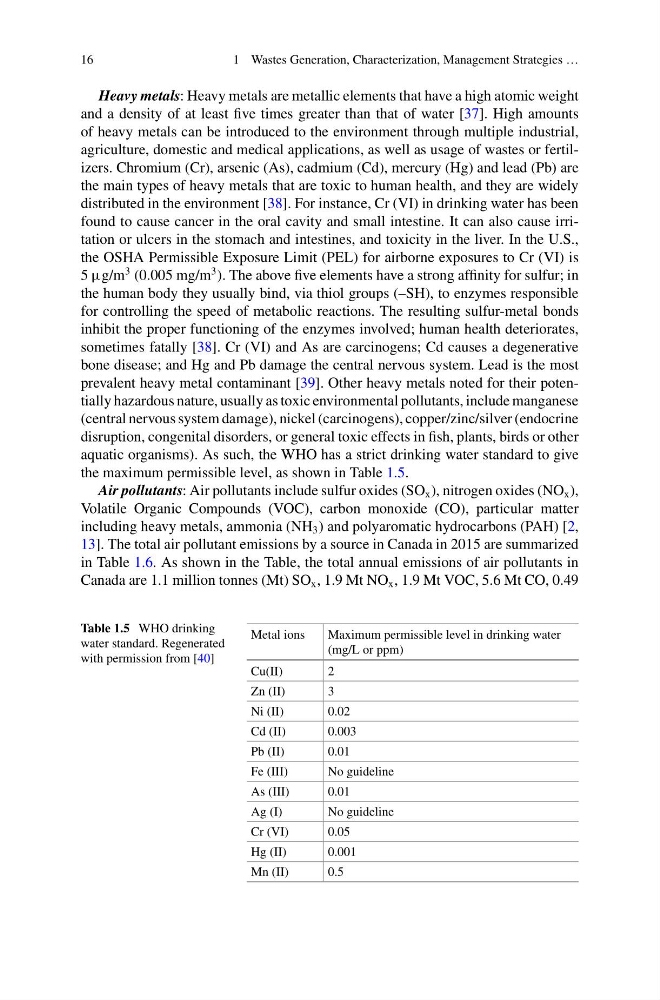
the maximum permissible level, as shown in Table 1.5.
Air pollutants: Air pollutants include sulfur oxides (SO x ), nitrogen oxides (NO x ),
Volatile Organic Compounds (VOC), carbon monoxide (CO), particular matter
including heavy metals, ammonia (NH 3 ) and polyaromatic hydrocarbons (PAH) [2,
13]. The total air pollutant emissions by a source in Canada in 2015 are summarized
in Table 1.6. As shown in the Table, the total annual emissions of air pollutants in
Canada are 1.1 million tonnes (Mt) SO x , 1.9 Mt NO x , 1.9 Mt VOC, 5.6 Mt CO, 0.49
Table 1.5 WHO drinking
water standard. Regenerated
with permission from [40]
Metal ions
Maximum permissible level in drinking water
(mg/L or ppm)
Cu(II)
2
Zn (II)
3
Ni (II)
0.02
Cd (II)
0.003
Pb (II)
0.01
Fe (III)
No guideline
As (III)
0.01
Ag (I)
No guideline
Cr (VI)
0.05
Hg (II)
0.001
Mn (II)
0.5
1 Wastes Generation, Characterization, Management Strategies …
Heavy metals: Heavy metals are metallic elements that have a high atomic weight
and a density of at least five times greater than that of water [37]. High amounts
of heavy metals can be introduced to the environment through multiple industrial,
agriculture, domestic and medical applications, as well as usage of wastes or fertilizers. Chromium (Cr), arsenic (As), cadmium (Cd), mercury (Hg) and lead (Pb) are
the main types of heavy metals that are toxic to human health, and they are widely
distributed in the environment [38]. For instance, Cr (VI) in drinking water has been
found to cause cancer in the oral cavity and small intestine. It can also cause irritation or ulcers in the stomach and intestines, and toxicity in the liver. In the U.S.,
the OSHA Permissible Exposure Limit (PEL) for airborne exposures to Cr (VI) is
5 µg/m
3 (0.005 mg/m
3 ). The above five elements have a strong affinity for sulfur; in
the human body they usually bind, via thiol groups (–SH), to enzymes responsible
for controlling the speed of metabolic reactions. The resulting sulfur-metal bonds
inhibit the proper functioning of the enzymes involved; human health deteriorates,
sometimes fatally [38]. Cr (VI) and As are carcinogens; Cd causes a degenerative
bone disease; and Hg and Pb damage the central nervous system. Lead is the most
prevalent heavy metal contaminant [39]. Other heavy metals noted for their potentially hazardous nature, usually as toxic environmental pollutants, include manganese
(central nervous system damage), nickel (carcinogens), copper/zinc/silver (endocrine
disruption, congenital disorders, or general toxic effects in fish, plants, birds or other
aquatic organisms). As such, the WHO has a strict drinking water standard to give
the maximum permissible level, as shown in Table 1.5.
Air pollutants: Air pollutants include sulfur oxides (SO x ), nitrogen oxides (NO x ),
Volatile Organic Compounds (VOC), carbon monoxide (CO), particular matter
including heavy metals, ammonia (NH 3 ) and polyaromatic hydrocarbons (PAH) [2,
13]. The total air pollutant emissions by a source in Canada in 2015 are summarized
in Table 1.6. As shown in the Table, the total annual emissions of air pollutants in
Canada are 1.1 million tonnes (Mt) SO x , 1.9 Mt NO x , 1.9 Mt VOC, 5.6 Mt CO, 0.49
Table 1.5 WHO drinking
water standard. Regenerated
with permission from [40]
Metal ions
Maximum permissible level in drinking water
(mg/L or ppm)
Cu(II)
2
Zn (II)
3
Ni (II)
0.02
Cd (II)
0.003
Pb (II)
0.01
Fe (III)
No guideline
As (III)
0.01
Ag (I)
No guideline
Cr (VI)
0.05
Hg (II)
0.001
Mn (II)
0.5