

190
7 Resource Utilization of Agricultural/Forestry Residues …
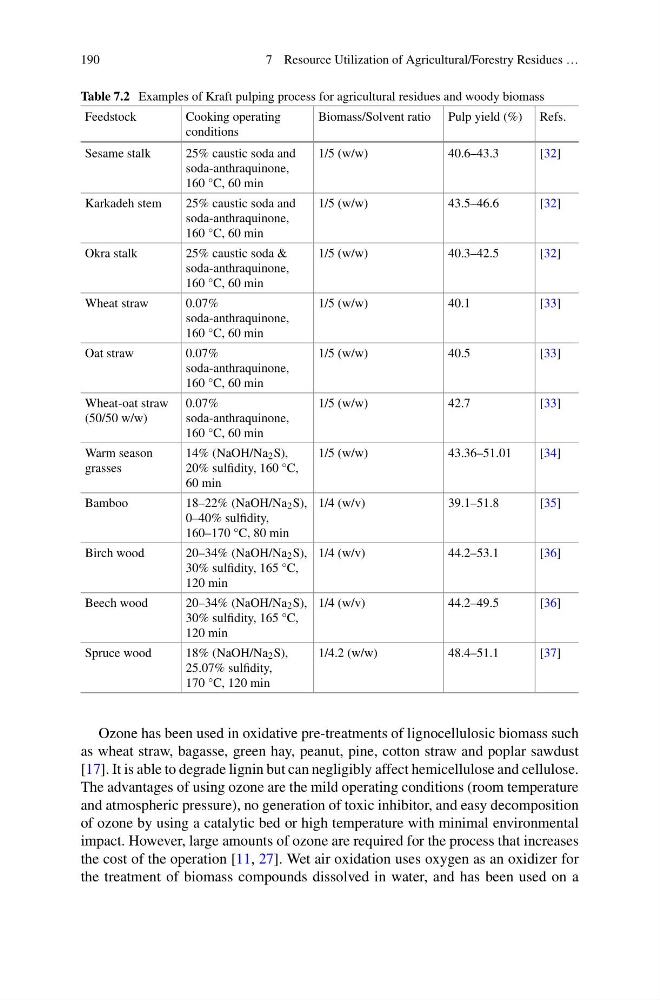
Table 7.2 Examples of Kraft pulping process for agricultural residues and woody biomass
Feedstock
Cooking operating
conditions
Biomass/Solvent ratio Pulp yield (%) Refs.
Sesame stalk
25% caustic soda and
soda-anthraquinone,
160 °C, 60 min
1/5 (w/w)
40.6–43.3
[32]
Karkadeh stem
25% caustic soda and
soda-anthraquinone,
160 °C, 60 min
1/5 (w/w)
43.5–46.6
[32]
Okra stalk
25% caustic soda &
soda-anthraquinone,
160 °C, 60 min
1/5 (w/w)
40.3–42.5
[32]
Wheat straw
0.07%
soda-anthraquinone,
160 °C, 60 min
1/5 (w/w)
40.1
[33]
Oat straw
0.07%
soda-anthraquinone,
160 °C, 60 min
1/5 (w/w)
40.5
[33]
Wheat-oat straw
(50/50 w/w)
0.07%
soda-anthraquinone,
160 °C, 60 min
1/5 (w/w)
42.7
[33]
Warm season
grasses
14% (NaOH/Na 2 S),
20% sulfidity, 160 °C,
60 min
1/5 (w/w)
43.36–51.01
[34]
Bamboo
18–22% (NaOH/Na 2 S),
0–40% sulfidity,
160–170 °C, 80 min
1/4 (w/v)
39.1–51.8
[35]
Birch wood
20–34% (NaOH/Na 2 S),
30% sulfidity, 165 °C,
120 min
1/4 (w/v)
44.2–53.1
[36]
Beech wood
20–34% (NaOH/Na 2 S),
30% sulfidity, 165 °C,
120 min
1/4 (w/v)
44.2–49.5
[36]
Spruce wood
18% (NaOH/Na 2 S),
25.07% sulfidity,
170 °C, 120 min
1/4.2 (w/w)
48.4–51.1
[37]
Ozone has been used in oxidative pre-treatments of lignocellulosic biomass such
as wheat straw, bagasse, green hay, peanut, pine, cotton straw and poplar sawdust
[17]. It is able to degrade lignin but can negligibly affect hemicellulose and cellulose.
The advantages of using ozone are the mild operating conditions (room temperature
and atmospheric pressure), no generation of toxic inhibitor, and easy decomposition
of ozone by using a catalytic bed or high temperature with minimal environmental
impact. However, large amounts of ozone are required for the process that increases
the cost of the operation [11, 27]. Wet air oxidation uses oxygen as an oxidizer for
the treatment of biomass compounds dissolved in water, and has been used on a
7 Resource Utilization of Agricultural/Forestry Residues …
Table 7.2 Examples of Kraft pulping process for agricultural residues and woody biomass
Feedstock
Cooking operating
conditions
Biomass/Solvent ratio Pulp yield (%) Refs.
Sesame stalk
25% caustic soda and
soda-anthraquinone,
160 °C, 60 min
1/5 (w/w)
40.6–43.3
[32]
Karkadeh stem
25% caustic soda and
soda-anthraquinone,
160 °C, 60 min
1/5 (w/w)
43.5–46.6
[32]
Okra stalk
25% caustic soda &
soda-anthraquinone,
160 °C, 60 min
1/5 (w/w)
40.3–42.5
[32]
Wheat straw
0.07%
soda-anthraquinone,
160 °C, 60 min
1/5 (w/w)
40.1
[33]
Oat straw
0.07%
soda-anthraquinone,
160 °C, 60 min
1/5 (w/w)
40.5
[33]
Wheat-oat straw
(50/50 w/w)
0.07%
soda-anthraquinone,
160 °C, 60 min
1/5 (w/w)
42.7
[33]
Warm season
grasses
14% (NaOH/Na 2 S),
20% sulfidity, 160 °C,
60 min
1/5 (w/w)
43.36–51.01
[34]
Bamboo
18–22% (NaOH/Na 2 S),
0–40% sulfidity,
160–170 °C, 80 min
1/4 (w/v)
39.1–51.8
[35]
Birch wood
20–34% (NaOH/Na 2 S),
30% sulfidity, 165 °C,
120 min
1/4 (w/v)
44.2–53.1
[36]
Beech wood
20–34% (NaOH/Na 2 S),
30% sulfidity, 165 °C,
120 min
1/4 (w/v)
44.2–49.5
[36]
Spruce wood
18% (NaOH/Na 2 S),
25.07% sulfidity,
170 °C, 120 min
1/4.2 (w/w)
48.4–51.1
[37]
Ozone has been used in oxidative pre-treatments of lignocellulosic biomass such
as wheat straw, bagasse, green hay, peanut, pine, cotton straw and poplar sawdust
[17]. It is able to degrade lignin but can negligibly affect hemicellulose and cellulose.
The advantages of using ozone are the mild operating conditions (room temperature
and atmospheric pressure), no generation of toxic inhibitor, and easy decomposition
of ozone by using a catalytic bed or high temperature with minimal environmental
impact. However, large amounts of ozone are required for the process that increases
the cost of the operation [11, 27]. Wet air oxidation uses oxygen as an oxidizer for
the treatment of biomass compounds dissolved in water, and has been used on a