

188
7 Resource Utilization of Agricultural/Forestry Residues …
On the other hand, dilute acid treatments have high reaction rates for hemicellulose
and cellulose hydrolysis and lead to the limited formation of inhibitors, while maintaining high processing efficiency [18, 20]. Dilute sulfuric acid is the most widely
used acid for pre-treatment of lignocellulosic biomass. It has been commercially
used on different types of biomass such as switchgrass, corn stover, spruce (softwood) and poplar. When dilute sulfuric acid is used, most of the hemicellulose was
recovered in the form of dissolved sugars and cellulose hydrolysis could improve at
a higher temperature [17, 26]. Since acid pre-treatments are able to remove hemicellulose from biomass, they are also used in the fractionation process to recover
hemicellulose-derived sugars followed by alkali pre-treatment (to recover degraded
lignin), resulting in relatively pure cellulose production [26].
Acid pre-treatments are the most widely used method on an industrial scale,
in which acids hydrolyze the biomass to yield fermentable sugars, so a subsequent
enzymatic hydrolysis step is usually not required. However, the use of corrosive acids
would result in a higher cost for construction materials. In addition, neutralization
and conditioning of the hydrolysate are also required prior to the biological steps,
which lead to additional operation costs. Moreover, the production of fermentation
inhibitors such as HMF and furfurals is another disadvantage of acidic pre-treatments
[17, 20, 26, 27].
7.4.2 Alkaline and Kraft Pulping Pre-treatment
Kraft pulping process is the most common pulping process in the pulp/paper industry,
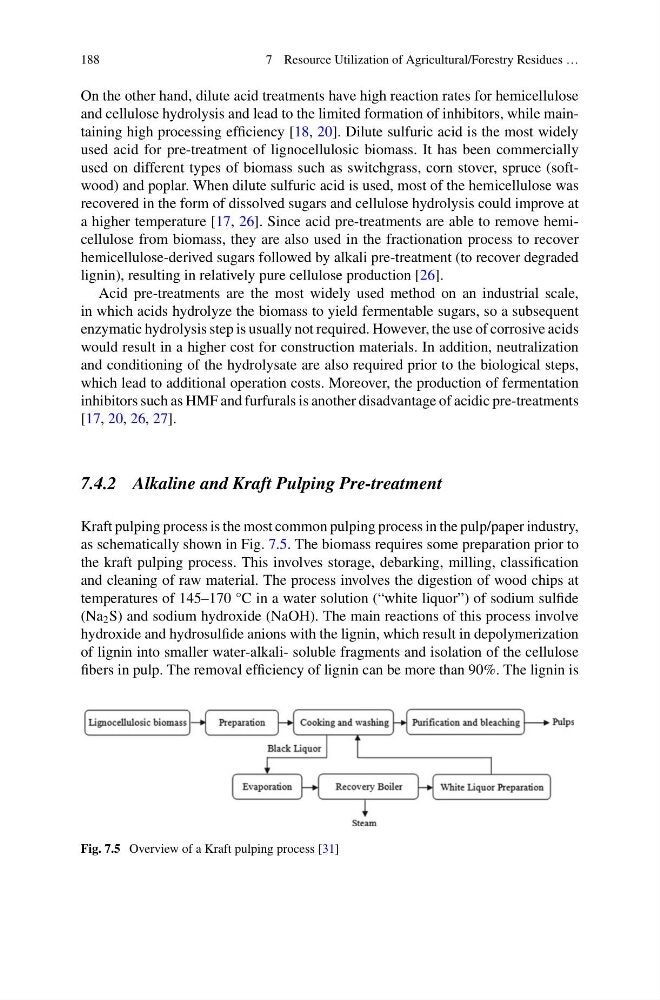
as schematically shown in Fig. 7.5. The biomass requires some preparation prior to
the kraft pulping process. This involves storage, debarking, milling, classification
and cleaning of raw material. The process involves the digestion of wood chips at
temperatures of 145–170 °C in a water solution (“white liquor”) of sodium sulfide
(Na 2 S) and sodium hydroxide (NaOH). The main reactions of this process involve
hydroxide and hydrosulfide anions with the lignin, which result in depolymerization
of lignin into smaller water-alkali- soluble fragments and isolation of the cellulose
fibers in pulp. The removal efficiency of lignin can be more than 90%. The lignin is
Fig. 7.5 Overview of a Kraft pulping process [31]
7 Resource Utilization of Agricultural/Forestry Residues …
On the other hand, dilute acid treatments have high reaction rates for hemicellulose
and cellulose hydrolysis and lead to the limited formation of inhibitors, while maintaining high processing efficiency [18, 20]. Dilute sulfuric acid is the most widely
used acid for pre-treatment of lignocellulosic biomass. It has been commercially
used on different types of biomass such as switchgrass, corn stover, spruce (softwood) and poplar. When dilute sulfuric acid is used, most of the hemicellulose was
recovered in the form of dissolved sugars and cellulose hydrolysis could improve at
a higher temperature [17, 26]. Since acid pre-treatments are able to remove hemicellulose from biomass, they are also used in the fractionation process to recover
hemicellulose-derived sugars followed by alkali pre-treatment (to recover degraded
lignin), resulting in relatively pure cellulose production [26].
Acid pre-treatments are the most widely used method on an industrial scale,
in which acids hydrolyze the biomass to yield fermentable sugars, so a subsequent
enzymatic hydrolysis step is usually not required. However, the use of corrosive acids
would result in a higher cost for construction materials. In addition, neutralization
and conditioning of the hydrolysate are also required prior to the biological steps,
which lead to additional operation costs. Moreover, the production of fermentation
inhibitors such as HMF and furfurals is another disadvantage of acidic pre-treatments
[17, 20, 26, 27].
7.4.2 Alkaline and Kraft Pulping Pre-treatment
Kraft pulping process is the most common pulping process in the pulp/paper industry,
as schematically shown in Fig. 7.5. The biomass requires some preparation prior to
the kraft pulping process. This involves storage, debarking, milling, classification
and cleaning of raw material. The process involves the digestion of wood chips at
temperatures of 145–170 °C in a water solution (“white liquor”) of sodium sulfide
(Na 2 S) and sodium hydroxide (NaOH). The main reactions of this process involve
hydroxide and hydrosulfide anions with the lignin, which result in depolymerization
of lignin into smaller water-alkali- soluble fragments and isolation of the cellulose
fibers in pulp. The removal efficiency of lignin can be more than 90%. The lignin is
Fig. 7.5 Overview of a Kraft pulping process [31]