

180
7 Resource Utilization of Agricultural/Forestry Residues …
pre-treatment · Organosolv fractionation · Kraft pulping · Ionic liquids ·
Cellulose · Hemicellulose · Lignin · High-value bioproducts
The increasing global energy demand and the environmental concerns over the use
of fossil fuels have intensified the interest in renewable bioresources for energy,
fuels and chemicals. As discussed previously in Chap. 3, bioresources are organic
substances naturally synthesized by photosynthesis, mainly including lignocellulosic biomass (plants, crops, and agricultural/forestry residues), municipal/industrial
solid wastes, and algae, etc. [1, 2]. Agricultural/forestry residues are immense waste
streams generated in the respective sectors, which are currently used mainly for
low-value applications e.g., heat/power generation and soil amendment purposes.
Resource utilization of agricultural/forestry residues for high-value products, e.g.,
liquid fuels, chemicals and polymeric materials is more promising than simple energy
utilization of these waste streams. However, conversion of agricultural/forestry
residues––typical lignocellulosic biomass, either biologically or thermochemically,
into fuels and chemicals is a very challenging process due to the non-homogeneous
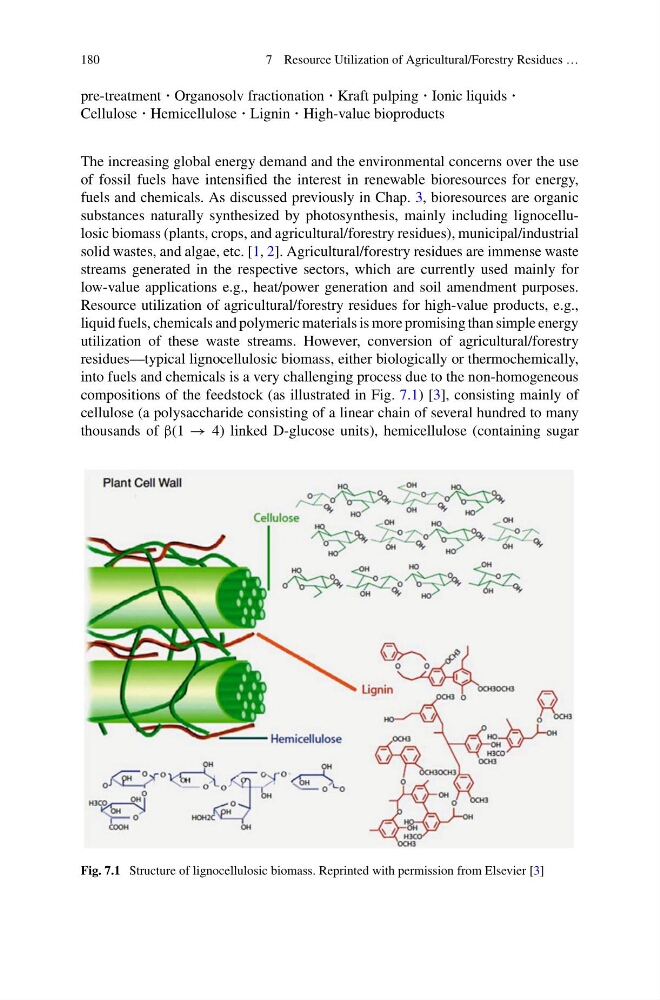
compositions of the feedstock (as illustrated in Fig. 7.1) [3], consisting mainly of
cellulose (a polysaccharide consisting of a linear chain of several hundred to many
thousands of β(1 → 4) linked D-glucose units), hemicellulose (containing sugar
Fig. 7.1 Structure of lignocellulosic biomass. Reprinted with permission from Elsevier [3]
7 Resource Utilization of Agricultural/Forestry Residues …
pre-treatment · Organosolv fractionation · Kraft pulping · Ionic liquids ·
Cellulose · Hemicellulose · Lignin · High-value bioproducts
The increasing global energy demand and the environmental concerns over the use
of fossil fuels have intensified the interest in renewable bioresources for energy,
fuels and chemicals. As discussed previously in Chap. 3, bioresources are organic
substances naturally synthesized by photosynthesis, mainly including lignocellulosic biomass (plants, crops, and agricultural/forestry residues), municipal/industrial
solid wastes, and algae, etc. [1, 2]. Agricultural/forestry residues are immense waste
streams generated in the respective sectors, which are currently used mainly for
low-value applications e.g., heat/power generation and soil amendment purposes.
Resource utilization of agricultural/forestry residues for high-value products, e.g.,
liquid fuels, chemicals and polymeric materials is more promising than simple energy
utilization of these waste streams. However, conversion of agricultural/forestry
residues––typical lignocellulosic biomass, either biologically or thermochemically,
into fuels and chemicals is a very challenging process due to the non-homogeneous
compositions of the feedstock (as illustrated in Fig. 7.1) [3], consisting mainly of
cellulose (a polysaccharide consisting of a linear chain of several hundred to many
thousands of β(1 → 4) linked D-glucose units), hemicellulose (containing sugar
Fig. 7.1 Structure of lignocellulosic biomass. Reprinted with permission from Elsevier [3]