

6.4 Conversion of Waste Plastics and Resins into Liquid Fuels and Carbon Materials
171
the system is generated by the decomposition gases or external pressurization and
the hydrothermal decomposition in which the pressure is generated by water vapor.
Direct carbonization can be performed with or without catalysts. In the absence
of catalysts, addition of a functional component to the plastics could produce
carbon spheres. For example, the addition of PTE to PE was found to be effective in the production of carbon spheres [28]. Employing catalysts such as Ni, iron
hydroxide, ferrocene, and stainless steel in the pressure carbonization process led to
the conversion of plastics into carbon nanomaterials [26].
Hydrothermal carbonization (HTC) involves a hot-compressed aqueous solution
as the reaction medium at temperatures higher than 100 °C and pressures higher
than 0.1 MPa. This process can be performed both at low temperatures (up to 250
°C) and high temperatures (higher than 250 °C). HTC at high temperatures could
produce high-value carbon materials such as activated carbon, carbon nanotubes and
graphite, while HTC at lower temperatures can also be used for the production of
carbon materials from PVC or PP [26].
The main disadvantage of pressure carbonization is associated with the highpressure operation condition, which requires special pressure-rated reactors and leads
to higher operational costs.
6.4.2.2 Activation
Charcoal produced by carbonization can be activated to enhance the pore structures
and specific surface area. The activation process can be performed by two different
methods: physical activation (steam activation) and chemical activation [25].
Physical activation is a process of activating the produced charcoal without using
any chemical reagent, but using oxidizing hot gases such as oxygen, carbon dioxide
or steam at 500–1000 °C in order to upgrade and enhance the pore structures. The
process includes the transport of the oxidizing gases to the sample surface, diffusion
of the gases into the pores, adsorption on the pore surface, reaction with carbon,
desorption of the products and their diffusion into the atmosphere. During the process,
the previously inaccessible pores are opened, new pores are formed and the existing
pores are broadened [25, 29]. Steam activation is the most common type of physical
activation. Steam activation of PVC-charcoal has been reported to produce activated
carbons with surface areas as high as 1000–2000 m
2 /g [24, 30]. The reactions that
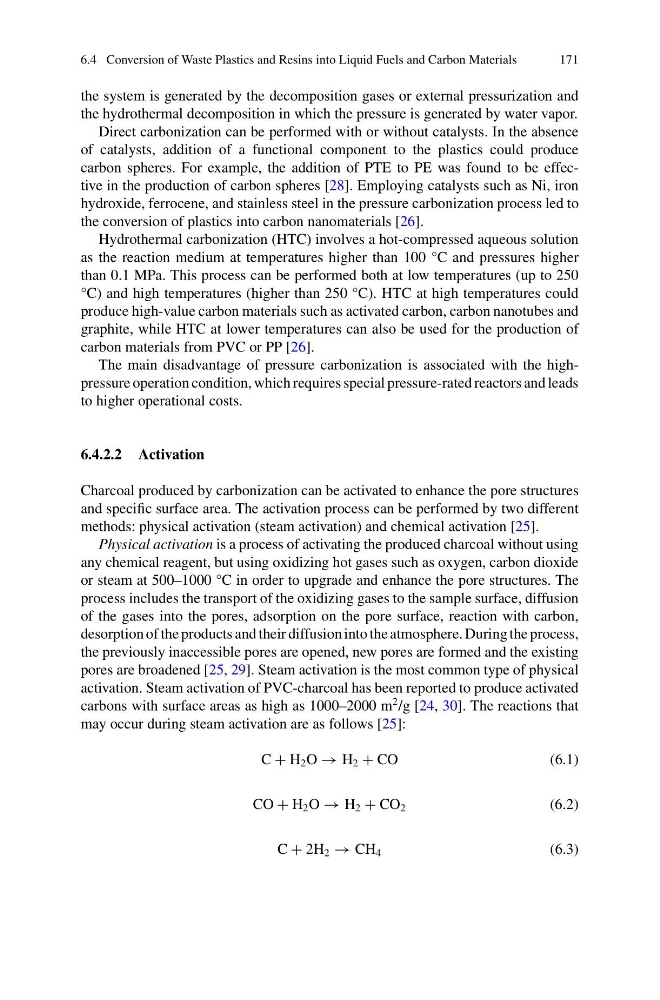
may occur during steam activation are as follows [25]:
C + H 2 O → H 2 + CO
(6.1)
CO + H 2 O → H 2 + CO 2
(6.2)
C + 2H 2 → CH 4
(6.3)
171
the system is generated by the decomposition gases or external pressurization and
the hydrothermal decomposition in which the pressure is generated by water vapor.
Direct carbonization can be performed with or without catalysts. In the absence
of catalysts, addition of a functional component to the plastics could produce
carbon spheres. For example, the addition of PTE to PE was found to be effective in the production of carbon spheres [28]. Employing catalysts such as Ni, iron
hydroxide, ferrocene, and stainless steel in the pressure carbonization process led to
the conversion of plastics into carbon nanomaterials [26].
Hydrothermal carbonization (HTC) involves a hot-compressed aqueous solution
as the reaction medium at temperatures higher than 100 °C and pressures higher
than 0.1 MPa. This process can be performed both at low temperatures (up to 250
°C) and high temperatures (higher than 250 °C). HTC at high temperatures could
produce high-value carbon materials such as activated carbon, carbon nanotubes and
graphite, while HTC at lower temperatures can also be used for the production of
carbon materials from PVC or PP [26].
The main disadvantage of pressure carbonization is associated with the highpressure operation condition, which requires special pressure-rated reactors and leads
to higher operational costs.
6.4.2.2 Activation
Charcoal produced by carbonization can be activated to enhance the pore structures
and specific surface area. The activation process can be performed by two different
methods: physical activation (steam activation) and chemical activation [25].
Physical activation is a process of activating the produced charcoal without using
any chemical reagent, but using oxidizing hot gases such as oxygen, carbon dioxide
or steam at 500–1000 °C in order to upgrade and enhance the pore structures. The
process includes the transport of the oxidizing gases to the sample surface, diffusion
of the gases into the pores, adsorption on the pore surface, reaction with carbon,
desorption of the products and their diffusion into the atmosphere. During the process,
the previously inaccessible pores are opened, new pores are formed and the existing
pores are broadened [25, 29]. Steam activation is the most common type of physical
activation. Steam activation of PVC-charcoal has been reported to produce activated
carbons with surface areas as high as 1000–2000 m
2 /g [24, 30]. The reactions that
may occur during steam activation are as follows [25]:
C + H 2 O → H 2 + CO
(6.1)
CO + H 2 O → H 2 + CO 2
(6.2)
C + 2H 2 → CH 4
(6.3)