

162
6 Waste Plastics Management and Conversion into Liquid …
(6) Polystyrene (PS): mostly used in single-use food and drink containers and plastic
utensils. This type of plastic is the major challenge in waste management and
has been linked to adverse health effects in humans. Since it is lightweight, it
can be easily blown along the streets and pollute the water streams such as rivers
and oceans. Polystyrene is technically recyclable but has a very low recycling
rate and also a very slow biodegradation rate. It has been considered a serious
threat to the terrestrial and aquatic ecosystems.
6.3 Waste Plastics Generation and Disposal
Waste plastics are mostly disposed of in dumpsites, landfills or are openly burned,
which results in contamination of the environment and creates various environmental,
economic and social impacts. Waste plastics have been found in ocean basins, freshwater and terrestrial habitats. In 2010, around 4–12 million metric tons (Mt) of waste
plastics entered the marine environment and this is expected to increase by an order of
magnitude by 2025 [5, 7]. The marine pollution comes from different sources such as
land littering on coastal areas, blown plastics from open dumpsites, leached sewage
effluents or spills during transport or accidents at the sea. Based on their particle
size, plastics can be divided into macroplastics (particle size >5 mm), microplastics
(particle size 50 µm–5 mm) and nanoplastics (particle size <100 nm). The most
common ocean pollution is by the microplastics due to their larger quantities and
small particle sizes [7]. All three sizes of plastics can be consumed by animals such as
birds, turtles, fish larvae and marine mammals that results in suffocation or blocking
of the digestive tract and cause death [7].
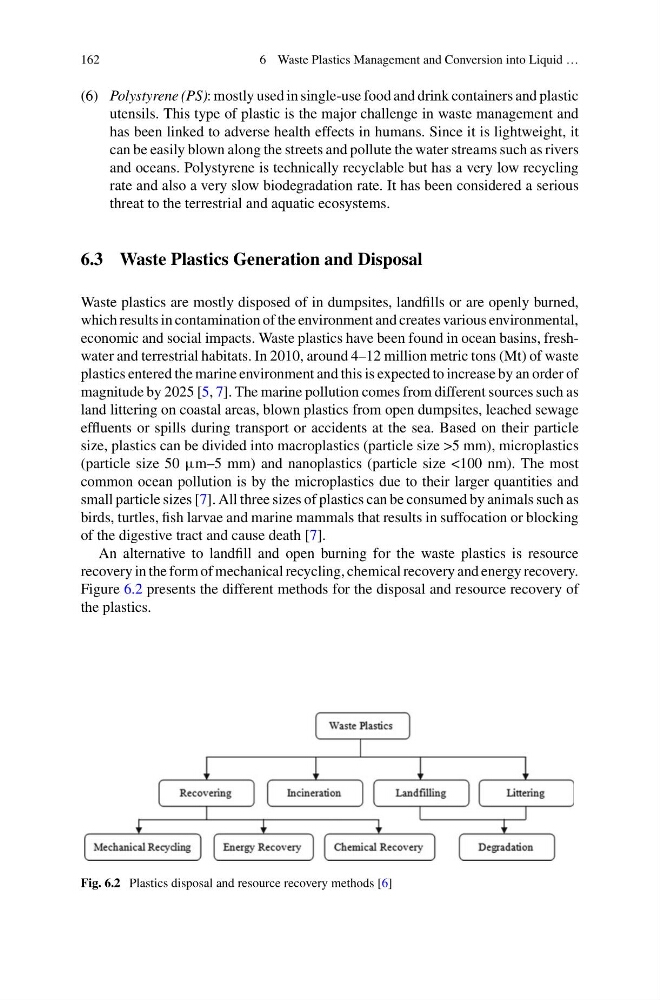
An alternative to landfill and open burning for the waste plastics is resource
recovery in the form of mechanical recycling, chemical recovery and energy recovery.
Figure 6.2 presents the different methods for the disposal and resource recovery of
the plastics.
Fig. 6.2 Plastics disposal and resource recovery methods [6]
6 Waste Plastics Management and Conversion into Liquid …
(6) Polystyrene (PS): mostly used in single-use food and drink containers and plastic
utensils. This type of plastic is the major challenge in waste management and
has been linked to adverse health effects in humans. Since it is lightweight, it
can be easily blown along the streets and pollute the water streams such as rivers
and oceans. Polystyrene is technically recyclable but has a very low recycling
rate and also a very slow biodegradation rate. It has been considered a serious
threat to the terrestrial and aquatic ecosystems.
6.3 Waste Plastics Generation and Disposal
Waste plastics are mostly disposed of in dumpsites, landfills or are openly burned,
which results in contamination of the environment and creates various environmental,
economic and social impacts. Waste plastics have been found in ocean basins, freshwater and terrestrial habitats. In 2010, around 4–12 million metric tons (Mt) of waste
plastics entered the marine environment and this is expected to increase by an order of
magnitude by 2025 [5, 7]. The marine pollution comes from different sources such as
land littering on coastal areas, blown plastics from open dumpsites, leached sewage
effluents or spills during transport or accidents at the sea. Based on their particle
size, plastics can be divided into macroplastics (particle size >5 mm), microplastics
(particle size 50 µm–5 mm) and nanoplastics (particle size <100 nm). The most
common ocean pollution is by the microplastics due to their larger quantities and
small particle sizes [7]. All three sizes of plastics can be consumed by animals such as
birds, turtles, fish larvae and marine mammals that results in suffocation or blocking
of the digestive tract and cause death [7].
An alternative to landfill and open burning for the waste plastics is resource
recovery in the form of mechanical recycling, chemical recovery and energy recovery.
Figure 6.2 presents the different methods for the disposal and resource recovery of
the plastics.
Fig. 6.2 Plastics disposal and resource recovery methods [6]