

6.1 Plastics Components
159
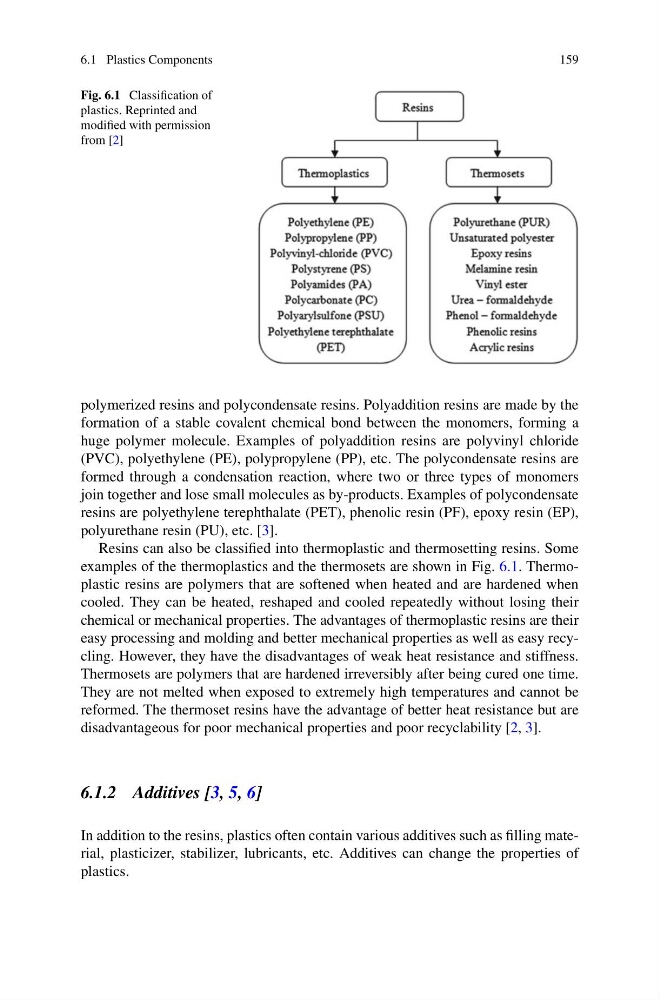
Fig. 6.1 Classification of
plastics. Reprinted and
modified with permission
from [2]
polymerized resins and polycondensate resins. Polyaddition resins are made by the
formation of a stable covalent chemical bond between the monomers, forming a
huge polymer molecule. Examples of polyaddition resins are polyvinyl chloride
(PVC), polyethylene (PE), polypropylene (PP), etc. The polycondensate resins are
formed through a condensation reaction, where two or three types of monomers
join together and lose small molecules as by-products. Examples of polycondensate
resins are polyethylene terephthalate (PET), phenolic resin (PF), epoxy resin (EP),
polyurethane resin (PU), etc. [3].
Resins can also be classified into thermoplastic and thermosetting resins. Some
examples of the thermoplastics and the thermosets are shown in Fig. 6.1. Thermoplastic resins are polymers that are softened when heated and are hardened when
cooled. They can be heated, reshaped and cooled repeatedly without losing their
chemical or mechanical properties. The advantages of thermoplastic resins are their
easy processing and molding and better mechanical properties as well as easy recycling. However, they have the disadvantages of weak heat resistance and stiffness.
Thermosets are polymers that are hardened irreversibly after being cured one time.
They are not melted when exposed to extremely high temperatures and cannot be
reformed. The thermoset resins have the advantage of better heat resistance but are
disadvantageous for poor mechanical properties and poor recyclability [2, 3].
6.1.2 Additives [3, 5, 6]
In addition to the resins, plastics often contain various additives such as filling material, plasticizer, stabilizer, lubricants, etc. Additives can change the properties of
plastics.
159
Fig. 6.1 Classification of
plastics. Reprinted and
modified with permission
from [2]
polymerized resins and polycondensate resins. Polyaddition resins are made by the
formation of a stable covalent chemical bond between the monomers, forming a
huge polymer molecule. Examples of polyaddition resins are polyvinyl chloride
(PVC), polyethylene (PE), polypropylene (PP), etc. The polycondensate resins are
formed through a condensation reaction, where two or three types of monomers
join together and lose small molecules as by-products. Examples of polycondensate
resins are polyethylene terephthalate (PET), phenolic resin (PF), epoxy resin (EP),
polyurethane resin (PU), etc. [3].
Resins can also be classified into thermoplastic and thermosetting resins. Some
examples of the thermoplastics and the thermosets are shown in Fig. 6.1. Thermoplastic resins are polymers that are softened when heated and are hardened when
cooled. They can be heated, reshaped and cooled repeatedly without losing their
chemical or mechanical properties. The advantages of thermoplastic resins are their
easy processing and molding and better mechanical properties as well as easy recycling. However, they have the disadvantages of weak heat resistance and stiffness.
Thermosets are polymers that are hardened irreversibly after being cured one time.
They are not melted when exposed to extremely high temperatures and cannot be
reformed. The thermoset resins have the advantage of better heat resistance but are
disadvantageous for poor mechanical properties and poor recyclability [2, 3].
6.1.2 Additives [3, 5, 6]
In addition to the resins, plastics often contain various additives such as filling material, plasticizer, stabilizer, lubricants, etc. Additives can change the properties of
plastics.