

5.8 Metallurgical Methods for Metals Recovery
145
process needs to be optimized, since the conventional electrodeposition is not very
efficient. The advantages of electrodeposition include high selectivity and efficiency,
low operating cost, less use of chemical reagents, no sludge production, less use
of auxiliary materials and low environmental impacts. However, this method can
result in the formation of dendrites and loose deposits due to the deposition rate
and composition of the solution. There are also common competing reactions of
dioxygen reduction or conversion of H
+ ions to hydrogen gas at the cathode. For
higher efficiency of the process, these interferences have to be minimized [25, 27].
5.8.3.4 Ion Exchange Methods
Ion Exchange (IEX) is defined as the exchange of ions between the substrate and its
surrounding medium. The reactions are normally reversible where the ion exchanger
can be reused many times. Ion exchange resins are insoluble in most aqueous and
organic solutions and can be used for the recovery of precious metals from e-waste.
The IEX resins consist of a cross-linked matrix or support structure in the form
of small microbeads that provide a physical medium to facilitate the IEX reactions. Charged functional groups are attached to the matrix and form complexes
with metals and provide selective recovery of desired ion or complex. Depending on
their functional groups for ion exchange, the ion exchangers can be categorized as
strongly acidic, weakly acidic, strongly basic and weakly basic. Resins are characterized based on their selectivity ratio, matrix geometry and cross-linking, porosity
and functional groups. The efficiency of an IEX resin is determined as the exchange
capacity or equilibrium loading capacity [25, 28]. They have been used to recover
different precious metals in solutions such as the recovery of palladium group metals
in hydrochloric acid, recovery of gold in cyanide and thiosulfate solutions, recovery
of silver in thiosulfate and metal chloride solutions, copper in cyanide solutions,
nickel from ferrous solutions, lead, cadmium, chromium, and zinc in solutions [25].
The highest recovery of gold and silver was achieved using strong base resins [20].
Using IEX resins for the recovery of precious metals provides simple operation, no
reagent loss, economic viability for low metals concentration, and environmental
safety.
5.8.3.5 Adsorption
Adsorption is defined as the removal of a soluble substance from a solution on solid
adsorbents (usually porous solids such as activated carbon). The most commonly used
adsorption process in the recovery of precious metals from e-waste is the recovery of
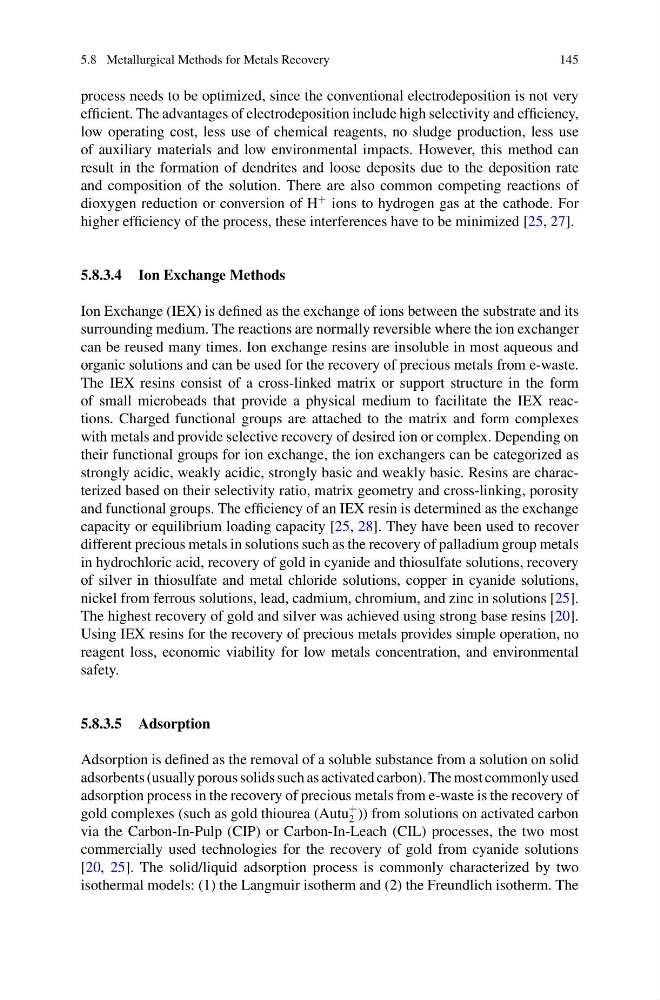
gold complexes (such as gold thiourea (Autu
+
2 )) from solutions on activated carbon
via the Carbon-In-Pulp (CIP) or Carbon-In-Leach (CIL) processes, the two most
commercially used technologies for the recovery of gold from cyanide solutions
[20, 25]. The solid/liquid adsorption process is commonly characterized by two
isothermal models: (1) the Langmuir isotherm and (2) the Freundlich isotherm. The
145
process needs to be optimized, since the conventional electrodeposition is not very
efficient. The advantages of electrodeposition include high selectivity and efficiency,
low operating cost, less use of chemical reagents, no sludge production, less use
of auxiliary materials and low environmental impacts. However, this method can
result in the formation of dendrites and loose deposits due to the deposition rate
and composition of the solution. There are also common competing reactions of
dioxygen reduction or conversion of H
+ ions to hydrogen gas at the cathode. For
higher efficiency of the process, these interferences have to be minimized [25, 27].
5.8.3.4 Ion Exchange Methods
Ion Exchange (IEX) is defined as the exchange of ions between the substrate and its
surrounding medium. The reactions are normally reversible where the ion exchanger
can be reused many times. Ion exchange resins are insoluble in most aqueous and
organic solutions and can be used for the recovery of precious metals from e-waste.
The IEX resins consist of a cross-linked matrix or support structure in the form
of small microbeads that provide a physical medium to facilitate the IEX reactions. Charged functional groups are attached to the matrix and form complexes
with metals and provide selective recovery of desired ion or complex. Depending on
their functional groups for ion exchange, the ion exchangers can be categorized as
strongly acidic, weakly acidic, strongly basic and weakly basic. Resins are characterized based on their selectivity ratio, matrix geometry and cross-linking, porosity
and functional groups. The efficiency of an IEX resin is determined as the exchange
capacity or equilibrium loading capacity [25, 28]. They have been used to recover
different precious metals in solutions such as the recovery of palladium group metals
in hydrochloric acid, recovery of gold in cyanide and thiosulfate solutions, recovery
of silver in thiosulfate and metal chloride solutions, copper in cyanide solutions,
nickel from ferrous solutions, lead, cadmium, chromium, and zinc in solutions [25].
The highest recovery of gold and silver was achieved using strong base resins [20].
Using IEX resins for the recovery of precious metals provides simple operation, no
reagent loss, economic viability for low metals concentration, and environmental
safety.
5.8.3.5 Adsorption
Adsorption is defined as the removal of a soluble substance from a solution on solid
adsorbents (usually porous solids such as activated carbon). The most commonly used
adsorption process in the recovery of precious metals from e-waste is the recovery of
gold complexes (such as gold thiourea (Autu
+
2 )) from solutions on activated carbon
via the Carbon-In-Pulp (CIP) or Carbon-In-Leach (CIL) processes, the two most
commercially used technologies for the recovery of gold from cyanide solutions
[20, 25]. The solid/liquid adsorption process is commonly characterized by two
isothermal models: (1) the Langmuir isotherm and (2) the Freundlich isotherm. The