

132
5 Recovery of Metals from Electronic Waste
Table 5.1 Concentration of metals in some of the electronic devices, Regenerated with permission
from the De La Salle University Publishing House and Columbia University, Earth Engineering
Center [11, 13]
Electronic
devices
Plastics
(wt%)
Copper (Cu)
(wt%)
Aluminum
(Al) (wt%)
Silver
(Ag)
(ppm)
Gold
(Au)
(ppm)
Palladium
(Pd) (ppm)
TV board
28
10
10
280
20
10
PC board
23
20
5
1000
250
110
Cell phones
56
13
2
3500
340
130
DVD-player
24
5
2
115
15
4
Calculator
61
3
5
260
50
5
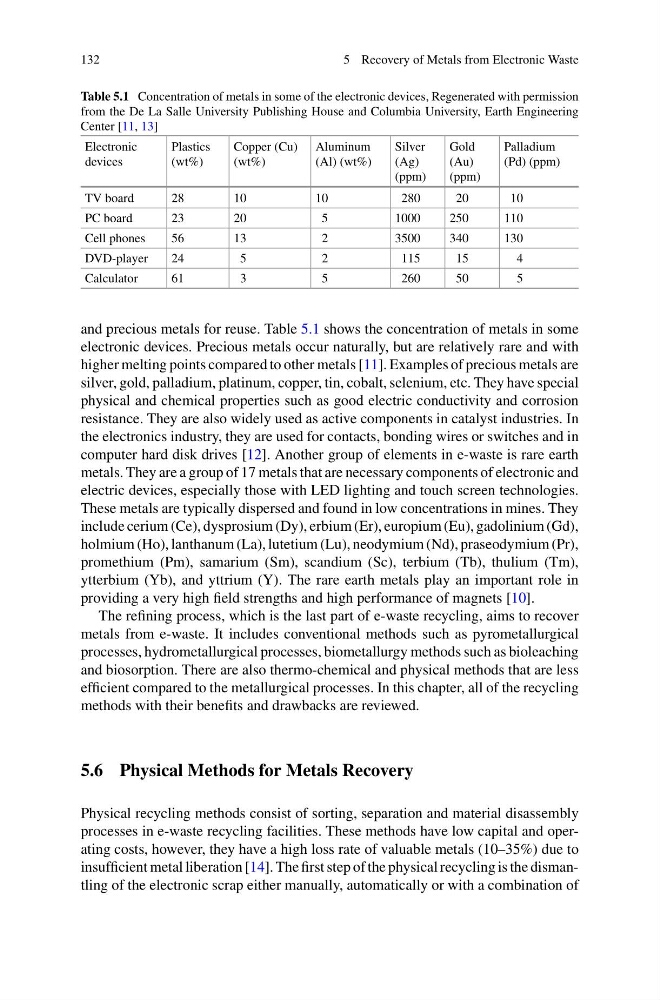
and precious metals for reuse. Table 5.1 shows the concentration of metals in some
electronic devices. Precious metals occur naturally, but are relatively rare and with
higher melting points compared to other metals [11]. Examples of precious metals are
silver, gold, palladium, platinum, copper, tin, cobalt, selenium, etc. They have special
physical and chemical properties such as good electric conductivity and corrosion
resistance. They are also widely used as active components in catalyst industries. In
the electronics industry, they are used for contacts, bonding wires or switches and in
computer hard disk drives [12]. Another group of elements in e-waste is rare earth
metals. They are a group of 17 metals that are necessary components of electronic and
electric devices, especially those with LED lighting and touch screen technologies.
These metals are typically dispersed and found in low concentrations in mines. They
include cerium (Ce), dysprosium (Dy), erbium (Er), europium (Eu), gadolinium (Gd),
holmium (Ho), lanthanum (La), lutetium (Lu), neodymium (Nd), praseodymium (Pr),
promethium (Pm), samarium (Sm), scandium (Sc), terbium (Tb), thulium (Tm),
ytterbium (Yb), and yttrium (Y). The rare earth metals play an important role in
providing a very high field strengths and high performance of magnets [10].
The refining process, which is the last part of e-waste recycling, aims to recover
metals from e-waste. It includes conventional methods such as pyrometallurgical
processes, hydrometallurgical processes, biometallurgy methods such as bioleaching
and biosorption. There are also thermo-chemical and physical methods that are less
efficient compared to the metallurgical processes. In this chapter, all of the recycling
methods with their benefits and drawbacks are reviewed.
5.6 Physical Methods for Metals Recovery
Physical recycling methods consist of sorting, separation and material disassembly
processes in e-waste recycling facilities. These methods have low capital and operating costs, however, they have a high loss rate of valuable metals (10–35%) due to
insufficient metal liberation [14]. The first step of the physical recycling is the dismantling of the electronic scrap either manually, automatically or with a combination of
5 Recovery of Metals from Electronic Waste
Table 5.1 Concentration of metals in some of the electronic devices, Regenerated with permission
from the De La Salle University Publishing House and Columbia University, Earth Engineering
Center [11, 13]
Electronic
devices
Plastics
(wt%)
Copper (Cu)
(wt%)
Aluminum
(Al) (wt%)
Silver
(Ag)
(ppm)
Gold
(Au)
(ppm)
Palladium
(Pd) (ppm)
TV board
28
10
10
280
20
10
PC board
23
20
5
1000
250
110
Cell phones
56
13
2
3500
340
130
DVD-player
24
5
2
115
15
4
Calculator
61
3
5
260
50
5
and precious metals for reuse. Table 5.1 shows the concentration of metals in some
electronic devices. Precious metals occur naturally, but are relatively rare and with
higher melting points compared to other metals [11]. Examples of precious metals are
silver, gold, palladium, platinum, copper, tin, cobalt, selenium, etc. They have special
physical and chemical properties such as good electric conductivity and corrosion
resistance. They are also widely used as active components in catalyst industries. In
the electronics industry, they are used for contacts, bonding wires or switches and in
computer hard disk drives [12]. Another group of elements in e-waste is rare earth
metals. They are a group of 17 metals that are necessary components of electronic and
electric devices, especially those with LED lighting and touch screen technologies.
These metals are typically dispersed and found in low concentrations in mines. They
include cerium (Ce), dysprosium (Dy), erbium (Er), europium (Eu), gadolinium (Gd),
holmium (Ho), lanthanum (La), lutetium (Lu), neodymium (Nd), praseodymium (Pr),
promethium (Pm), samarium (Sm), scandium (Sc), terbium (Tb), thulium (Tm),
ytterbium (Yb), and yttrium (Y). The rare earth metals play an important role in
providing a very high field strengths and high performance of magnets [10].
The refining process, which is the last part of e-waste recycling, aims to recover
metals from e-waste. It includes conventional methods such as pyrometallurgical
processes, hydrometallurgical processes, biometallurgy methods such as bioleaching
and biosorption. There are also thermo-chemical and physical methods that are less
efficient compared to the metallurgical processes. In this chapter, all of the recycling
methods with their benefits and drawbacks are reviewed.
5.6 Physical Methods for Metals Recovery
Physical recycling methods consist of sorting, separation and material disassembly
processes in e-waste recycling facilities. These methods have low capital and operating costs, however, they have a high loss rate of valuable metals (10–35%) due to
insufficient metal liberation [14]. The first step of the physical recycling is the dismantling of the electronic scrap either manually, automatically or with a combination of