

110
4 Nitrogen and Phosphorous Recovery from Municipal Wastewater …
important role in the P removal from wastewater. The optimum pH range for the most
efficient P removal was found to be 5–7 with alum and 6.5–7.5 with iron, respectively
[34].
The mechanism of chemical precipitation involves the interaction of the reagent
ions with the soluble salts of the orthophosphoric acid that creates highly dispersed
colloidal phosphate sediments. The added chemical also reacts with the organic bases
in water and produces large-flake sediments, which also initiates the coagulation and
suspension of the highly dispersed colloids. The resulting precipitates are removed
from the system either by filtration or settling under gravity [36]. The reactions of
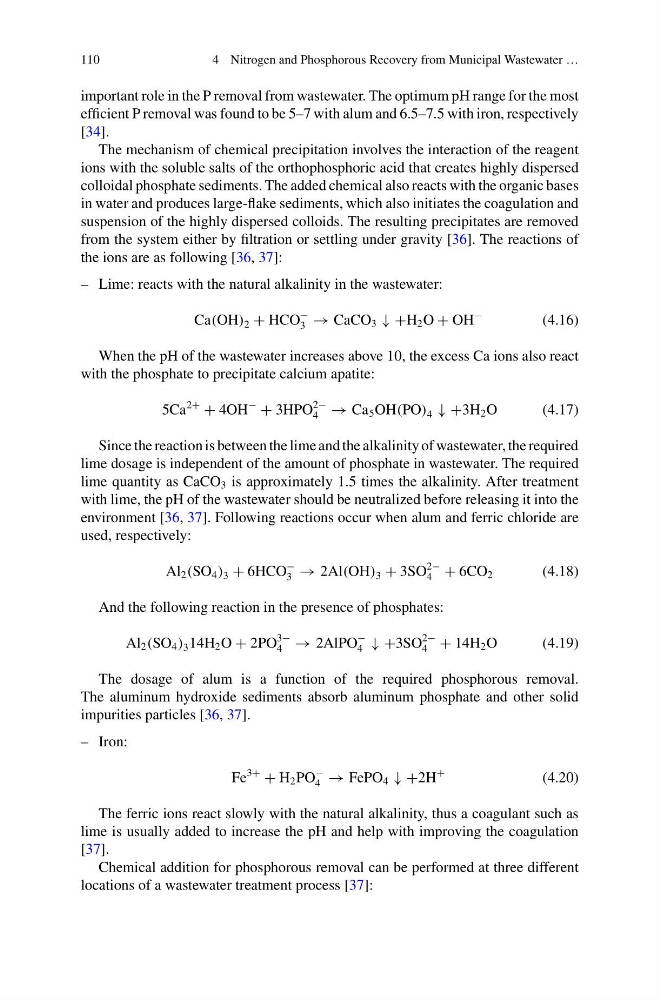
the ions are as following [36, 37]:
– Lime: reacts with the natural alkalinity in the wastewater:
Ca(OH) 2 + HCO
−
3 → CaCO 3 ↓ +H 2 O + OH
−
(4.16)
When the pH of the wastewater increases above 10, the excess Ca ions also react
with the phosphate to precipitate calcium apatite:
5Ca
2+
+ 4OH
−
+ 3HPO
2−
4 → Ca 5 OH(PO) 4 ↓ +3H 2 O
(4.17)
Since the reaction is between the lime and the alkalinity of wastewater, the required
lime dosage is independent of the amount of phosphate in wastewater. The required
lime quantity as CaCO 3 is approximately 1.5 times the alkalinity. After treatment
with lime, the pH of the wastewater should be neutralized before releasing it into the
environment [36, 37]. Following reactions occur when alum and ferric chloride are
used, respectively:
Al 2 (SO 4 ) 3 + 6HCO
−
3 → 2Al(OH) 3 + 3SO
2−
4 + 6CO 2
(4.18)
And the following reaction in the presence of phosphates:
Al 2 (SO 4 ) 3 14H 2 O + 2PO
3−
4 → 2AlPO
−
4 ↓ +3SO
2−
4 + 14H 2 O
(4.19)
The dosage of alum is a function of the required phosphorous removal.
The aluminum hydroxide sediments absorb aluminum phosphate and other solid
impurities particles [36, 37].
– Iron:
Fe
3+
+ H 2 PO
−
4 → FePO 4 ↓ +2H
+
(4.20)
The ferric ions react slowly with the natural alkalinity, thus a coagulant such as
lime is usually added to increase the pH and help with improving the coagulation
[37].
Chemical addition for phosphorous removal can be performed at three different
locations of a wastewater treatment process [37]:
4 Nitrogen and Phosphorous Recovery from Municipal Wastewater …
important role in the P removal from wastewater. The optimum pH range for the most
efficient P removal was found to be 5–7 with alum and 6.5–7.5 with iron, respectively
[34].
The mechanism of chemical precipitation involves the interaction of the reagent
ions with the soluble salts of the orthophosphoric acid that creates highly dispersed
colloidal phosphate sediments. The added chemical also reacts with the organic bases
in water and produces large-flake sediments, which also initiates the coagulation and
suspension of the highly dispersed colloids. The resulting precipitates are removed
from the system either by filtration or settling under gravity [36]. The reactions of
the ions are as following [36, 37]:
– Lime: reacts with the natural alkalinity in the wastewater:
Ca(OH) 2 + HCO
−
3 → CaCO 3 ↓ +H 2 O + OH
−
(4.16)
When the pH of the wastewater increases above 10, the excess Ca ions also react
with the phosphate to precipitate calcium apatite:
5Ca
2+
+ 4OH
−
+ 3HPO
2−
4 → Ca 5 OH(PO) 4 ↓ +3H 2 O
(4.17)
Since the reaction is between the lime and the alkalinity of wastewater, the required
lime dosage is independent of the amount of phosphate in wastewater. The required
lime quantity as CaCO 3 is approximately 1.5 times the alkalinity. After treatment
with lime, the pH of the wastewater should be neutralized before releasing it into the
environment [36, 37]. Following reactions occur when alum and ferric chloride are
used, respectively:
Al 2 (SO 4 ) 3 + 6HCO
−
3 → 2Al(OH) 3 + 3SO
2−
4 + 6CO 2
(4.18)
And the following reaction in the presence of phosphates:
Al 2 (SO 4 ) 3 14H 2 O + 2PO
3−
4 → 2AlPO
−
4 ↓ +3SO
2−
4 + 14H 2 O
(4.19)
The dosage of alum is a function of the required phosphorous removal.
The aluminum hydroxide sediments absorb aluminum phosphate and other solid
impurities particles [36, 37].
– Iron:
Fe
3+
+ H 2 PO
−
4 → FePO 4 ↓ +2H
+
(4.20)
The ferric ions react slowly with the natural alkalinity, thus a coagulant such as
lime is usually added to increase the pH and help with improving the coagulation
[37].
Chemical addition for phosphorous removal can be performed at three different
locations of a wastewater treatment process [37]: