

Fiche 63 • Composition à l’équilibre
159
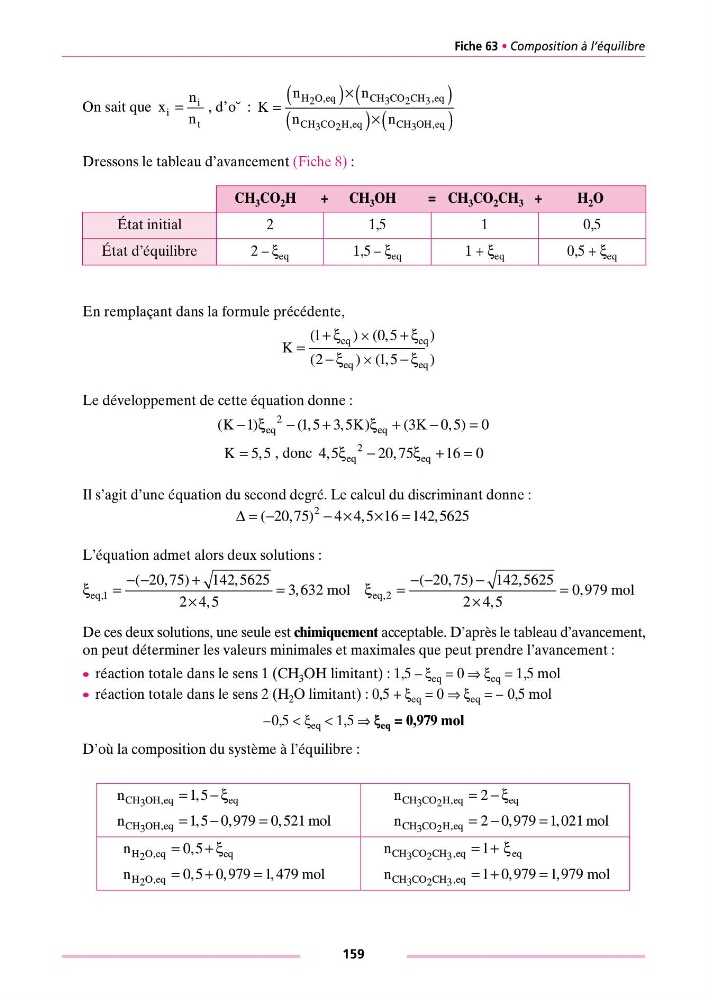
Dressons le tableau d’avancement (Fiche 8) :
De ces deux solutions, une seule est chimiquement acceptable. D’après le tableau d’avancement,
on peut déterminer les valeurs minimales et maximales que peut prendre l’avancement :
c réaction totale dans le sens 1 (CH 3 OH limitant) : 1,5 – x eq = 0 fi x eq = 1,5 mol
c réaction totale dans le sens 2 (H 2 O limitant) : 0,5 + x eq = 0 fi x eq = – 0,5 mol
–0,5 < x eq < 1,5 fi x eq = 0,979 mol
D’où la composition du système à l’équilibre :
CH 3 CO 2 H
+ CH 3 OH
= CH 3 CO 2 CH 3 +
H 2 O
État initial
2
1,5
1
0,5
État d’équilibre
2 – ξ eq
1,5 – ξ eq
1 + ξ eq
0,5 + ξ eq
On sait que
i
i
t
n
x
n
=
, d’o˘ :
(
) (
)
(
) (
)
H O,eq
CH CO CH ,eq
2
3 2
CH CO H,eq
CH OH,eq
3 2
3
n
n
K
n
n
×
=
×
3
eq
eq
eq
eq
(1
) ¥ (0,5
)
K
(2
) ¥ (1, 5
)
+ ξ
+ ξ
= − ξ
− ξ
Le développement de cette équation donne :
En remplaçant dans la formule précédente,
2
eq
eq
(K 1)
(1,5 3,5K)
(3K 0,5) 0
− ξ −
+
ξ +
−
=
K 5,5
=
, donc
2
eq
eq
4,5
20, 75
16 0
ξ −
ξ + =
Il s’agit d’une équation du second degré. Le calcul du discriminant donne :
2
( 20,75) 4 4,5 16 142,5625
∆ = −
− ×
× =
L’équation admet alors deux solutions :
eq,1
eq,2
( 20, 75) 142, 5625
( 20, 75) 142,5625
3, 632 mol
0,979 mol
2 4,5
2 4,5
− −
+
− −
−
ξ
=
=
ξ
=
=
×
×
CH OH,eq
eq
3
CH OH,eq
3
n
1 , 5
n
1,5 0,979 0,521 mol
=
−ξ
=
−
=
CH CO H,eq
eq
3 2
CH CO H,eq
3 2
n
2
n
2 0,979 1, 021 mol
= −ξ
= −
=
H O,eq
eq
2
H O,eq
2
n
0 ,5
n
0,5 0,979 1, 479 mol
=
+ξ
=
+
=
CH CO CH ,eq
eq
3 2 3
CH CO CH ,eq
3 2 3
n
1
n
1 0,979 1,979 mol
= + ξ
= +
=
9782100562862-Verchier.fm Page 159 Jeudi, 17. mars 2011 12:11 12
159
Dressons le tableau d’avancement (Fiche 8) :
De ces deux solutions, une seule est chimiquement acceptable. D’après le tableau d’avancement,
on peut déterminer les valeurs minimales et maximales que peut prendre l’avancement :
c réaction totale dans le sens 1 (CH 3 OH limitant) : 1,5 – x eq = 0 fi x eq = 1,5 mol
c réaction totale dans le sens 2 (H 2 O limitant) : 0,5 + x eq = 0 fi x eq = – 0,5 mol
–0,5 < x eq < 1,5 fi x eq = 0,979 mol
D’où la composition du système à l’équilibre :
CH 3 CO 2 H
+ CH 3 OH
= CH 3 CO 2 CH 3 +
H 2 O
État initial
2
1,5
1
0,5
État d’équilibre
2 – ξ eq
1,5 – ξ eq
1 + ξ eq
0,5 + ξ eq
On sait que
i
i
t
n
x
n
=
, d’o˘ :
(
) (
)
(
) (
)
H O,eq
CH CO CH ,eq
2
3 2
CH CO H,eq
CH OH,eq
3 2
3
n
n
K
n
n
×
=
×
3
eq
eq
eq
eq
(1
) ¥ (0,5
)
K
(2
) ¥ (1, 5
)
+ ξ
+ ξ
= − ξ
− ξ
Le développement de cette équation donne :
En remplaçant dans la formule précédente,
2
eq
eq
(K 1)
(1,5 3,5K)
(3K 0,5) 0
− ξ −
+
ξ +
−
=
K 5,5
=
, donc
2
eq
eq
4,5
20, 75
16 0
ξ −
ξ + =
Il s’agit d’une équation du second degré. Le calcul du discriminant donne :
2
( 20,75) 4 4,5 16 142,5625
∆ = −
− ×
× =
L’équation admet alors deux solutions :
eq,1
eq,2
( 20, 75) 142, 5625
( 20, 75) 142,5625
3, 632 mol
0,979 mol
2 4,5
2 4,5
− −
+
− −
−
ξ
=
=
ξ
=
=
×
×
CH OH,eq
eq
3
CH OH,eq
3
n
1 , 5
n
1,5 0,979 0,521 mol
=
−ξ
=
−
=
CH CO H,eq
eq
3 2
CH CO H,eq
3 2
n
2
n
2 0,979 1, 021 mol
= −ξ
= −
=
H O,eq
eq
2
H O,eq
2
n
0 ,5
n
0,5 0,979 1, 479 mol
=
+ξ
=
+
=
CH CO CH ,eq
eq
3 2 3
CH CO CH ,eq
3 2 3
n
1
n
1 0,979 1,979 mol
= + ξ
= +
=
9782100562862-Verchier.fm Page 159 Jeudi, 17. mars 2011 12:11 12