

m-toluate. The rhizosphere of oriental goat’s rue Galega orientalis grown on these
polluted sites showed predominant population of m-toluate degraders Pseudomonas
spp., Rhodococcus, Arthrobacter, Bacillus, and Nocardia (Jussila et al. 2006).
2.8 Mechanisms and Enzymes Involved in Pesticide
Degradation
The remarkable variety and complexity of different pesticide structures and diversity
of pesticide degrading microorganisms belonging to all physiological types indicated that a wide variety of transformation reactions are catalyzed by various
microorganisms in the pesticide degradation. Pesticides and other organic pollutants
in soil and water can be degraded by photolytic, chemical, and biological mechanism. Photolytic degradation can occur when a pesticide molecule is irradiated by
sunlight. Chemical degradation occurs when the molecule is chemically unstable in
the conditions of its environment, whereas biodegradation refers to the transformation of pesticides by living microorganisms. In nature, biological and non-biological
processes work together to degrade pesticide compounds.
Soil pesticides can be degraded in a variety of ways; traditional methods include
physical, chemical, and physico-chemical degradation, which primarily causes secondary pollution (Qu et al. 2015; Kaur et al. 2016; Zhang et al. 2017). Recently,
microbial degradation was regularly used as microbes decomposed pesticides into
some smaller molecules, such as CO 2 and H 2 O (Chen et al. 2011; Tang 2018).
Pesticide degradation follows different metabolic pathways depending on the
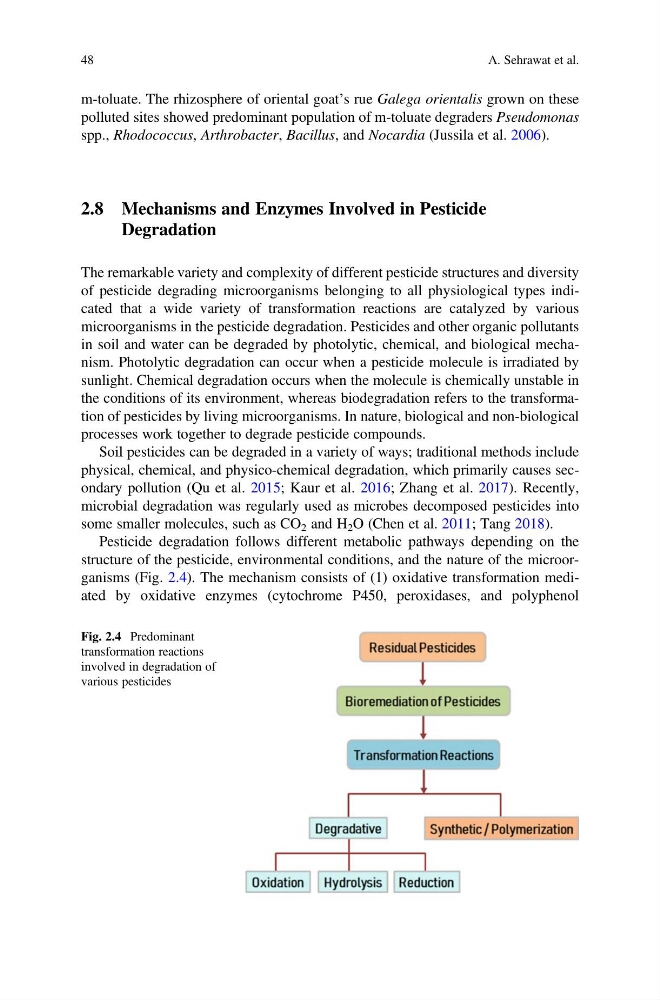
structure of the pesticide, environmental conditions, and the nature of the microorganisms (Fig. 2.4). The mechanism consists of (1) oxidative transformation mediated by oxidative enzymes (cytochrome P450, peroxidases, and polyphenol
Fig. 2.4 Predominant
transformation reactions
involved in degradation of
various pesticides
48
A. Sehrawat et al.
polluted sites showed predominant population of m-toluate degraders Pseudomonas
spp., Rhodococcus, Arthrobacter, Bacillus, and Nocardia (Jussila et al. 2006).
2.8 Mechanisms and Enzymes Involved in Pesticide
Degradation
The remarkable variety and complexity of different pesticide structures and diversity
of pesticide degrading microorganisms belonging to all physiological types indicated that a wide variety of transformation reactions are catalyzed by various
microorganisms in the pesticide degradation. Pesticides and other organic pollutants
in soil and water can be degraded by photolytic, chemical, and biological mechanism. Photolytic degradation can occur when a pesticide molecule is irradiated by
sunlight. Chemical degradation occurs when the molecule is chemically unstable in
the conditions of its environment, whereas biodegradation refers to the transformation of pesticides by living microorganisms. In nature, biological and non-biological
processes work together to degrade pesticide compounds.
Soil pesticides can be degraded in a variety of ways; traditional methods include
physical, chemical, and physico-chemical degradation, which primarily causes secondary pollution (Qu et al. 2015; Kaur et al. 2016; Zhang et al. 2017). Recently,
microbial degradation was regularly used as microbes decomposed pesticides into
some smaller molecules, such as CO 2 and H 2 O (Chen et al. 2011; Tang 2018).
Pesticide degradation follows different metabolic pathways depending on the
structure of the pesticide, environmental conditions, and the nature of the microorganisms (Fig. 2.4). The mechanism consists of (1) oxidative transformation mediated by oxidative enzymes (cytochrome P450, peroxidases, and polyphenol
Fig. 2.4 Predominant
transformation reactions
involved in degradation of
various pesticides
48
A. Sehrawat et al.