

Host plants improve their nutritional status with the help of arbuscular mycorrhizal fungi by absorbing phosphorus, essential nutrients, and water. AM fungi secrete
different types of proteins called glomalin which bind with toxic heavy metal to form
a complex, and this complex binds with plant cell wall (Wright et al. 1996; Gadkar
and Rillig 2006; Rillig and Mummey 2006; Gonzalez Chavez et al. 2004; Cornejo
et al. 2008; Meier et al. 2012). Further heavy metal complexes are transported in the
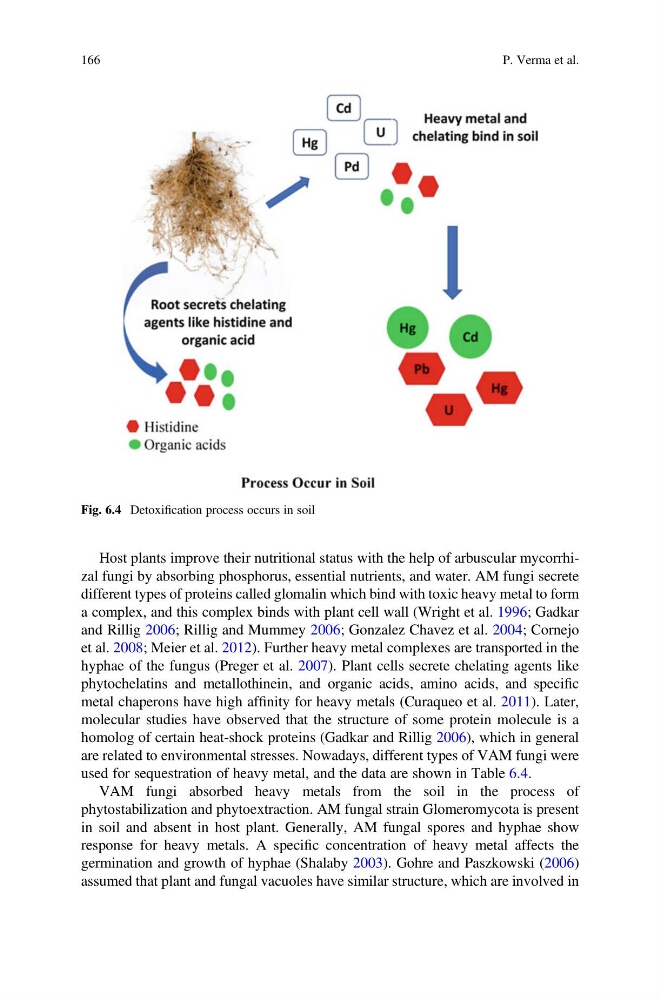
hyphae of the fungus (Preger et al. 2007). Plant cells secrete chelating agents like
phytochelatins and metallothinein, and organic acids, amino acids, and specific
metal chaperons have high affinity for heavy metals (Curaqueo et al. 2011). Later,
molecular studies have observed that the structure of some protein molecule is a
homolog of certain heat-shock proteins (Gadkar and Rillig 2006), which in general
are related to environmental stresses. Nowadays, different types of VAM fungi were
used for sequestration of heavy metal, and the data are shown in Table 6.4.
VAM fungi absorbed heavy metals from the soil in the process of
phytostabilization and phytoextraction. AM fungal strain Glomeromycota is present
in soil and absent in host plant. Generally, AM fungal spores and hyphae show
response for heavy metals. A specific concentration of heavy metal affects the
germination and growth of hyphae (Shalaby 2003). Gohre and Paszkowski (2006)
assumed that plant and fungal vacuoles have similar structure, which are involved in
Fig. 6.4 Detoxification process occurs in soil
166
P. Verma et al.
different types of proteins called glomalin which bind with toxic heavy metal to form
a complex, and this complex binds with plant cell wall (Wright et al. 1996; Gadkar
and Rillig 2006; Rillig and Mummey 2006; Gonzalez Chavez et al. 2004; Cornejo
et al. 2008; Meier et al. 2012). Further heavy metal complexes are transported in the
hyphae of the fungus (Preger et al. 2007). Plant cells secrete chelating agents like
phytochelatins and metallothinein, and organic acids, amino acids, and specific
metal chaperons have high affinity for heavy metals (Curaqueo et al. 2011). Later,
molecular studies have observed that the structure of some protein molecule is a
homolog of certain heat-shock proteins (Gadkar and Rillig 2006), which in general
are related to environmental stresses. Nowadays, different types of VAM fungi were
used for sequestration of heavy metal, and the data are shown in Table 6.4.
VAM fungi absorbed heavy metals from the soil in the process of
phytostabilization and phytoextraction. AM fungal strain Glomeromycota is present
in soil and absent in host plant. Generally, AM fungal spores and hyphae show
response for heavy metals. A specific concentration of heavy metal affects the
germination and growth of hyphae (Shalaby 2003). Gohre and Paszkowski (2006)
assumed that plant and fungal vacuoles have similar structure, which are involved in
Fig. 6.4 Detoxification process occurs in soil
166
P. Verma et al.