

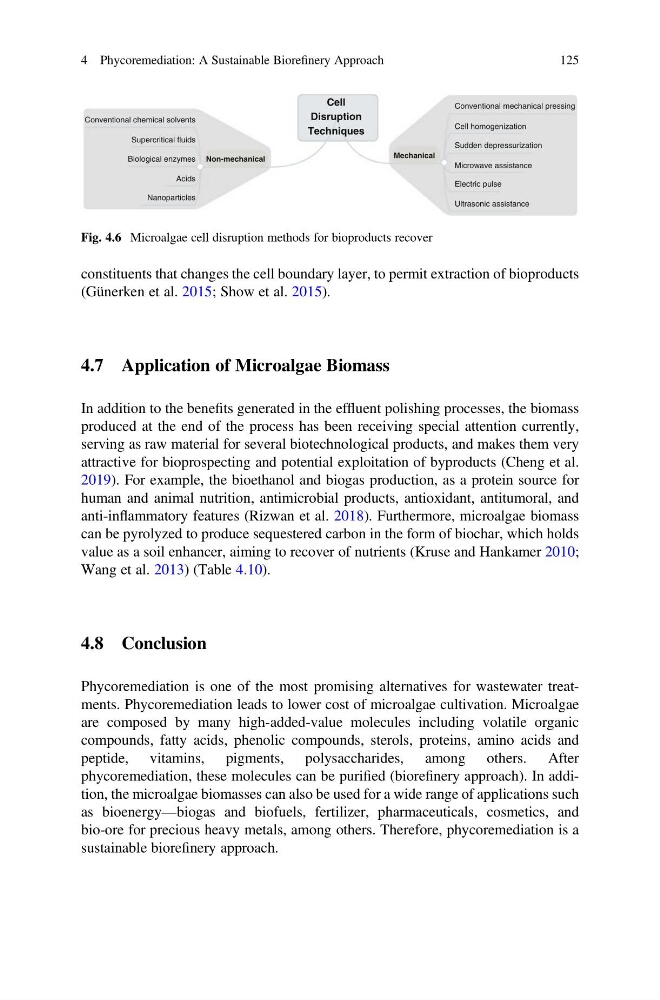
constituents that changes the cell boundary layer, to permit extraction of bioproducts
(Günerken et al. 2015; Show et al. 2015).
4.7 Application of Microalgae Biomass
In addition to the benefits generated in the effluent polishing processes, the biomass
produced at the end of the process has been receiving special attention currently,
serving as raw material for several biotechnological products, and makes them very
attractive for bioprospecting and potential exploitation of byproducts (Cheng et al.
2019). For example, the bioethanol and biogas production, as a protein source for
human and animal nutrition, antimicrobial products, antioxidant, antitumoral, and
anti-inflammatory features (Rizwan et al. 2018). Furthermore, microalgae biomass
can be pyrolyzed to produce sequestered carbon in the form of biochar, which holds
value as a soil enhancer, aiming to recover of nutrients (Kruse and Hankamer 2010;
Wang et al. 2013) (Table 4.10).
4.8 Conclusion
Phycoremediation is one of the most promising alternatives for wastewater treatments. Phycoremediation leads to lower cost of microalgae cultivation. Microalgae
are composed by many high-added-value molecules including volatile organic
compounds, fatty acids, phenolic compounds, sterols, proteins, amino acids and
peptide, vitamins, pigments, polysaccharides, among others. After
phycoremediation, these molecules can be purified (biorefinery approach). In addition, the microalgae biomasses can also be used for a wide range of applications such
as bioenergy—biogas and biofuels, fertilizer, pharmaceuticals, cosmetics, and
bio-ore for precious heavy metals, among others. Therefore, phycoremediation is a
sustainable biorefinery approach.
Conventional chemical solvents
Conventional mechanical pressing
Cell homogenization
Sudden depressurization
Microwave assistance
Electric pulse
Ultrasonic assistance
Supercritical fluids
Biological enzymes
Acids
Nanoparticles
Non-mechanical
Mechanical
Cell
Disruption
Techniques
Fig. 4.6 Microalgae cell disruption methods for bioproducts recover
4 Phycoremediation: A Sustainable Biorefinery Approach
125
(Günerken et al. 2015; Show et al. 2015).
4.7 Application of Microalgae Biomass
In addition to the benefits generated in the effluent polishing processes, the biomass
produced at the end of the process has been receiving special attention currently,
serving as raw material for several biotechnological products, and makes them very
attractive for bioprospecting and potential exploitation of byproducts (Cheng et al.
2019). For example, the bioethanol and biogas production, as a protein source for
human and animal nutrition, antimicrobial products, antioxidant, antitumoral, and
anti-inflammatory features (Rizwan et al. 2018). Furthermore, microalgae biomass
can be pyrolyzed to produce sequestered carbon in the form of biochar, which holds
value as a soil enhancer, aiming to recover of nutrients (Kruse and Hankamer 2010;
Wang et al. 2013) (Table 4.10).
4.8 Conclusion
Phycoremediation is one of the most promising alternatives for wastewater treatments. Phycoremediation leads to lower cost of microalgae cultivation. Microalgae
are composed by many high-added-value molecules including volatile organic
compounds, fatty acids, phenolic compounds, sterols, proteins, amino acids and
peptide, vitamins, pigments, polysaccharides, among others. After
phycoremediation, these molecules can be purified (biorefinery approach). In addition, the microalgae biomasses can also be used for a wide range of applications such
as bioenergy—biogas and biofuels, fertilizer, pharmaceuticals, cosmetics, and
bio-ore for precious heavy metals, among others. Therefore, phycoremediation is a
sustainable biorefinery approach.
Conventional chemical solvents
Conventional mechanical pressing
Cell homogenization
Sudden depressurization
Microwave assistance
Electric pulse
Ultrasonic assistance
Supercritical fluids
Biological enzymes
Acids
Nanoparticles
Non-mechanical
Mechanical
Cell
Disruption
Techniques
Fig. 4.6 Microalgae cell disruption methods for bioproducts recover
4 Phycoremediation: A Sustainable Biorefinery Approach
125