

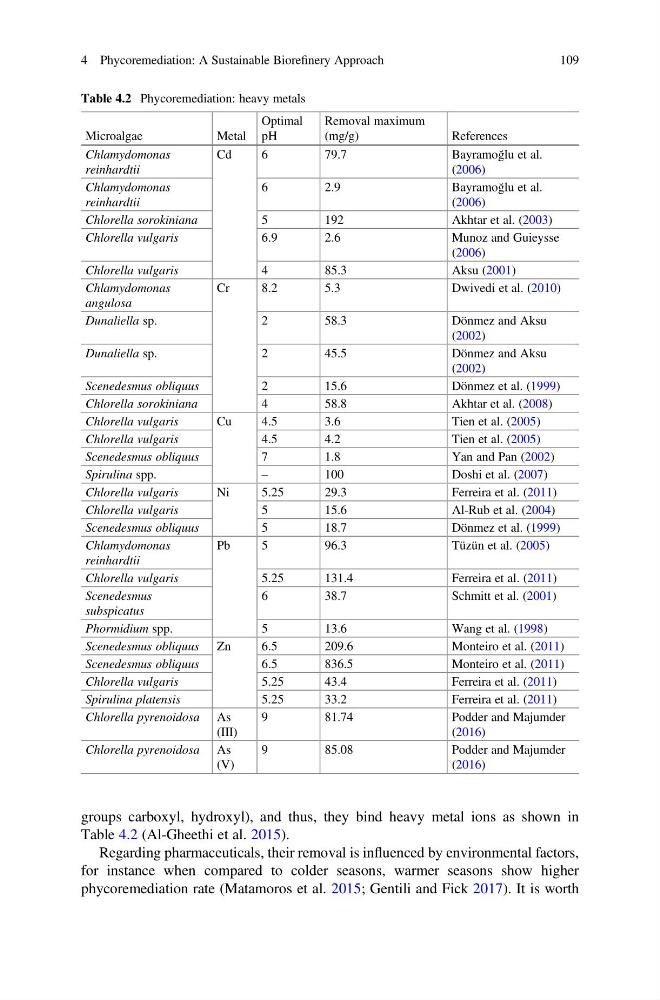
groups carboxyl, hydroxyl), and thus, they bind heavy metal ions as shown in
Table 4.2 (Al-Gheethi et al. 2015).
Regarding pharmaceuticals, their removal is influenced by environmental factors,
for instance when compared to colder seasons, warmer seasons show higher
phycoremediation rate (Matamoros et al. 2015; Gentili and Fick 2017). It is worth
Table 4.2 Phycoremediation: heavy metals
Microalgae
Metal
Optimal
pH
Removal maximum
(mg/g)
References
Chlamydomonas
reinhardtii
Cd
6
79.7
Bayramoğlu et al.
(2006)
Chlamydomonas
reinhardtii
6
2.9
Bayramoğlu et al.
(2006)
Chlorella sorokiniana
5
192
Akhtar et al. (2003)
Chlorella vulgaris
6.9
2.6
Munoz and Guieysse
(2006)
Chlorella vulgaris
4
85.3
Aksu (2001)
Chlamydomonas
angulosa
Cr
8.2
5.3
Dwivedi et al. (2010)
Dunaliella sp.
2
58.3
Dönmez and Aksu
(2002)
Dunaliella sp.
2
45.5
Dönmez and Aksu
(2002)
Scenedesmus obliquus
2
15.6
Dönmez et al. (1999)
Chlorella sorokiniana
4
58.8
Akhtar et al. (2008)
Chlorella vulgaris
Cu
4.5
3.6
Tien et al. (2005)
Chlorella vulgaris
4.5
4.2
Tien et al. (2005)
Scenedesmus obliquus
7
1.8
Yan and Pan (2002)
Spirulina spp.
–
100
Doshi et al. (2007)
Chlorella vulgaris
Ni
5.25
29.3
Ferreira et al. (2011)
Chlorella vulgaris
5
15.6
Al-Rub et al. (2004)
Scenedesmus obliquus
5
18.7
Dönmez et al. (1999)
Chlamydomonas
reinhardtii
Pb
5
96.3
Tüzün et al. (2005)
Chlorella vulgaris
5.25
131.4
Ferreira et al. (2011)
Scenedesmus
subspicatus
6
38.7
Schmitt et al. (2001)
Phormidium spp.
5
13.6
Wang et al. (1998)
Scenedesmus obliquus Zn
6.5
209.6
Monteiro et al. (2011)
Scenedesmus obliquus
6.5
836.5
Monteiro et al. (2011)
Chlorella vulgaris
5.25
43.4
Ferreira et al. (2011)
Spirulina platensis
5.25
33.2
Ferreira et al. (2011)
Chlorella pyrenoidosa As
(III)
9
81.74
Podder and Majumder
(2016)
Chlorella pyrenoidosa As
(V)
9
85.08
Podder and Majumder
(2016)
4 Phycoremediation: A Sustainable Biorefinery Approach
109
Table 4.2 (Al-Gheethi et al. 2015).
Regarding pharmaceuticals, their removal is influenced by environmental factors,
for instance when compared to colder seasons, warmer seasons show higher
phycoremediation rate (Matamoros et al. 2015; Gentili and Fick 2017). It is worth
Table 4.2 Phycoremediation: heavy metals
Microalgae
Metal
Optimal
pH
Removal maximum
(mg/g)
References
Chlamydomonas
reinhardtii
Cd
6
79.7
Bayramoğlu et al.
(2006)
Chlamydomonas
reinhardtii
6
2.9
Bayramoğlu et al.
(2006)
Chlorella sorokiniana
5
192
Akhtar et al. (2003)
Chlorella vulgaris
6.9
2.6
Munoz and Guieysse
(2006)
Chlorella vulgaris
4
85.3
Aksu (2001)
Chlamydomonas
angulosa
Cr
8.2
5.3
Dwivedi et al. (2010)
Dunaliella sp.
2
58.3
Dönmez and Aksu
(2002)
Dunaliella sp.
2
45.5
Dönmez and Aksu
(2002)
Scenedesmus obliquus
2
15.6
Dönmez et al. (1999)
Chlorella sorokiniana
4
58.8
Akhtar et al. (2008)
Chlorella vulgaris
Cu
4.5
3.6
Tien et al. (2005)
Chlorella vulgaris
4.5
4.2
Tien et al. (2005)
Scenedesmus obliquus
7
1.8
Yan and Pan (2002)
Spirulina spp.
–
100
Doshi et al. (2007)
Chlorella vulgaris
Ni
5.25
29.3
Ferreira et al. (2011)
Chlorella vulgaris
5
15.6
Al-Rub et al. (2004)
Scenedesmus obliquus
5
18.7
Dönmez et al. (1999)
Chlamydomonas
reinhardtii
Pb
5
96.3
Tüzün et al. (2005)
Chlorella vulgaris
5.25
131.4
Ferreira et al. (2011)
Scenedesmus
subspicatus
6
38.7
Schmitt et al. (2001)
Phormidium spp.
5
13.6
Wang et al. (1998)
Scenedesmus obliquus Zn
6.5
209.6
Monteiro et al. (2011)
Scenedesmus obliquus
6.5
836.5
Monteiro et al. (2011)
Chlorella vulgaris
5.25
43.4
Ferreira et al. (2011)
Spirulina platensis
5.25
33.2
Ferreira et al. (2011)
Chlorella pyrenoidosa As
(III)
9
81.74
Podder and Majumder
(2016)
Chlorella pyrenoidosa As
(V)
9
85.08
Podder and Majumder
(2016)
4 Phycoremediation: A Sustainable Biorefinery Approach
109