

2.5 Enthalpy
77
P 2
P 1
V 1
V 2
γ
(2.5-16b)
T 2
T 1
P 2
P 1
1−1/γ
(2.5-16c)
Exercise 2.23
Verify Eq. (2.5-16).
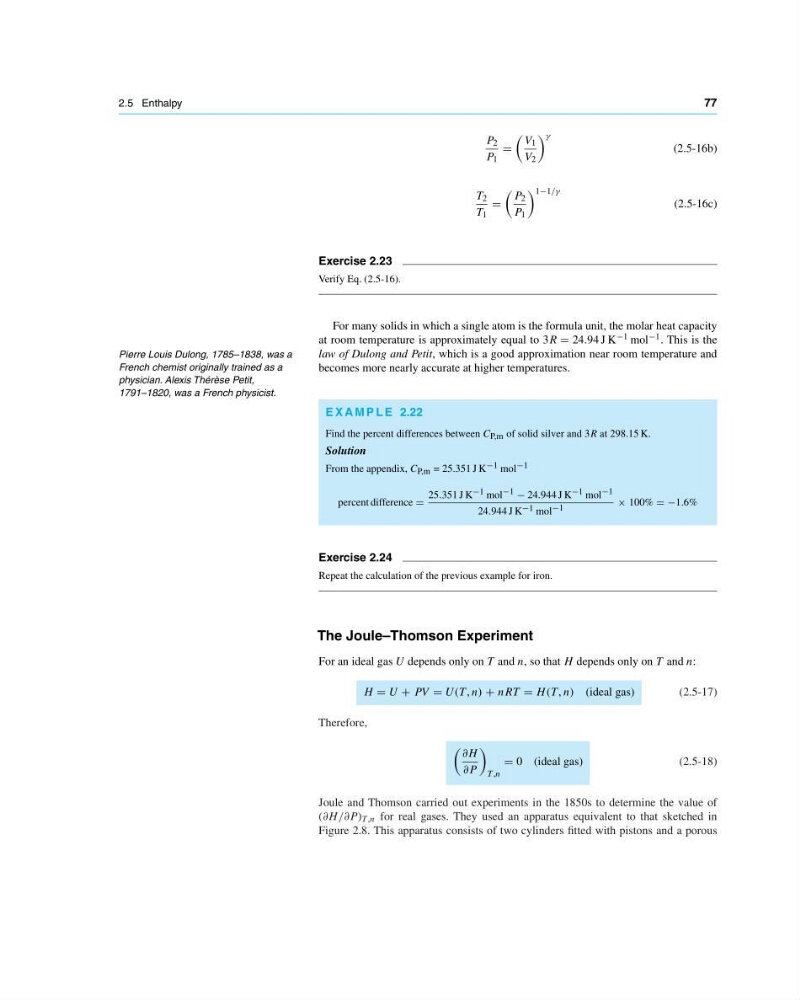
For many solids in which a single atom is the formula unit, the molar heat capacity
at room temperature is approximately equal to 3R 24.94 J K −1 mol −1 . This is the
law of Dulong and Petit, which is a good approximation near room temperature and
becomes more nearly accurate at higher temperatures.
Pierre Louis Dulong, 1785–1838, was a
French chemist originally trained as a
physician. Alexis Thérèse Petit,
1791–1820, was a French physicist.
E X A M P L E 2.22
Find the percent differences between C P,m of solid silver and 3R at 298.15 K.
Solution
From the appendix, C P,m = 25.351 J K −1 mol −1
percent difference
25.351 J K −1 mol −1 − 24.944 J K −1 mol −1
24.944 J K −1 mol −1
× 100% −1.6%
Exercise 2.24
Repeat the calculation of the previous example for iron.
The Joule–Thomson Experiment
For an ideal gas U depends only on T and n, so that H depends only on T and n:
H U + PV U(T , n) + nRT H(T , n) (ideal gas)
(2.5-17)
Therefore,
∂H
∂P
T ,n
0 (ideal gas)
(2.5-18)
Joule and Thomson carried out experiments in the 1850s to determine the value of
(∂H/∂P) T ,n for real gases. They used an apparatus equivalent to that sketched in
Figure 2.8. This apparatus consists of two cylinders fitted with pistons and a porous
77
P 2
P 1
V 1
V 2
γ
(2.5-16b)
T 2
T 1
P 2
P 1
1−1/γ
(2.5-16c)
Exercise 2.23
Verify Eq. (2.5-16).
For many solids in which a single atom is the formula unit, the molar heat capacity
at room temperature is approximately equal to 3R 24.94 J K −1 mol −1 . This is the
law of Dulong and Petit, which is a good approximation near room temperature and
becomes more nearly accurate at higher temperatures.
Pierre Louis Dulong, 1785–1838, was a
French chemist originally trained as a
physician. Alexis Thérèse Petit,
1791–1820, was a French physicist.
E X A M P L E 2.22
Find the percent differences between C P,m of solid silver and 3R at 298.15 K.
Solution
From the appendix, C P,m = 25.351 J K −1 mol −1
percent difference
25.351 J K −1 mol −1 − 24.944 J K −1 mol −1
24.944 J K −1 mol −1
× 100% −1.6%
Exercise 2.24
Repeat the calculation of the previous example for iron.
The Joule–Thomson Experiment
For an ideal gas U depends only on T and n, so that H depends only on T and n:
H U + PV U(T , n) + nRT H(T , n) (ideal gas)
(2.5-17)
Therefore,
∂H
∂P
T ,n
0 (ideal gas)
(2.5-18)
Joule and Thomson carried out experiments in the 1850s to determine the value of
(∂H/∂P) T ,n for real gases. They used an apparatus equivalent to that sketched in
Figure 2.8. This apparatus consists of two cylinders fitted with pistons and a porous