

2.5 Enthalpy
75
The Heat Capacity at Constant Pressure
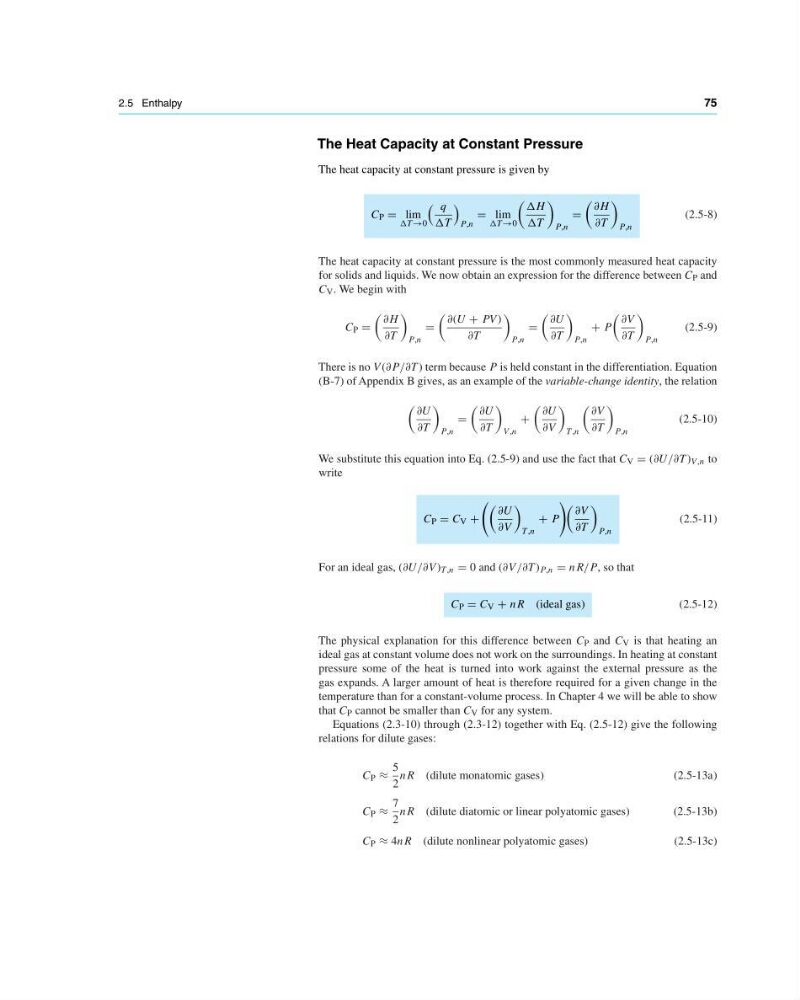
The heat capacity at constant pressure is given by
C P lim
∆T →0
q
∆T
P,n
lim
∆T →0
∆H
∆T
P,n
∂H
∂T
P,n
(2.5-8)
The heat capacity at constant pressure is the most commonly measured heat capacity
for solids and liquids. We now obtain an expression for the difference between C P and
C V . We begin with
C P
∂H
∂T
P,n
∂(U + PV )
∂T
P,n
∂U
∂T
P,n
+ P
∂V
∂T
P,n
(2.5-9)
There is no V (∂P/∂T ) term because P is held constant in the differentiation. Equation
(B-7) of Appendix B gives, as an example of the variable-change identity, the relation
∂U
∂T
P,n
∂U
∂T
V ,n
+
∂U
∂V
T ,n
∂V
∂T
P,n
(2.5-10)
We substitute this equation into Eq. (2.5-9) and use the fact that C V (∂U/∂T ) V ,n to
write
C P C V +
∂U
∂V
T ,n
+ P
∂V
∂T
P,n
(2.5-11)
For an ideal gas, (∂U/∂V ) T ,n 0 and (∂V /∂T ) P,n nR/P, so that
C P C V + nR (ideal gas)
(2.5-12)
The physical explanation for this difference between C P and C V is that heating an
ideal gas at constant volume does not work on the surroundings. In heating at constant
pressure some of the heat is turned into work against the external pressure as the
gas expands. A larger amount of heat is therefore required for a given change in the
temperature than for a constant-volume process. In Chapter 4 we will be able to show
that C P cannot be smaller than C V for any system.
Equations (2.3-10) through (2.3-12) together with Eq. (2.5-12) give the following
relations for dilute gases:
C P ≈
5
2
nR (dilute monatomic gases)
(2.5-13a)
C P ≈
7
2
nR (dilute diatomic or linear polyatomic gases)
(2.5-13b)
C P ≈ 4nR (dilute nonlinear polyatomic gases)
(2.5-13c)
75
The Heat Capacity at Constant Pressure
The heat capacity at constant pressure is given by
C P lim
∆T →0
q
∆T
P,n
lim
∆T →0
∆H
∆T
P,n
∂H
∂T
P,n
(2.5-8)
The heat capacity at constant pressure is the most commonly measured heat capacity
for solids and liquids. We now obtain an expression for the difference between C P and
C V . We begin with
C P
∂H
∂T
P,n
∂(U + PV )
∂T
P,n
∂U
∂T
P,n
+ P
∂V
∂T
P,n
(2.5-9)
There is no V (∂P/∂T ) term because P is held constant in the differentiation. Equation
(B-7) of Appendix B gives, as an example of the variable-change identity, the relation
∂U
∂T
P,n
∂U
∂T
V ,n
+
∂U
∂V
T ,n
∂V
∂T
P,n
(2.5-10)
We substitute this equation into Eq. (2.5-9) and use the fact that C V (∂U/∂T ) V ,n to
write
C P C V +
∂U
∂V
T ,n
+ P
∂V
∂T
P,n
(2.5-11)
For an ideal gas, (∂U/∂V ) T ,n 0 and (∂V /∂T ) P,n nR/P, so that
C P C V + nR (ideal gas)
(2.5-12)
The physical explanation for this difference between C P and C V is that heating an
ideal gas at constant volume does not work on the surroundings. In heating at constant
pressure some of the heat is turned into work against the external pressure as the
gas expands. A larger amount of heat is therefore required for a given change in the
temperature than for a constant-volume process. In Chapter 4 we will be able to show
that C P cannot be smaller than C V for any system.
Equations (2.3-10) through (2.3-12) together with Eq. (2.5-12) give the following
relations for dilute gases:
C P ≈
5
2
nR (dilute monatomic gases)
(2.5-13a)
C P ≈
7
2
nR (dilute diatomic or linear polyatomic gases)
(2.5-13b)
C P ≈ 4nR (dilute nonlinear polyatomic gases)
(2.5-13c)