

70
2 Work, Heat, and Energy: The First Law of Thermodynamics
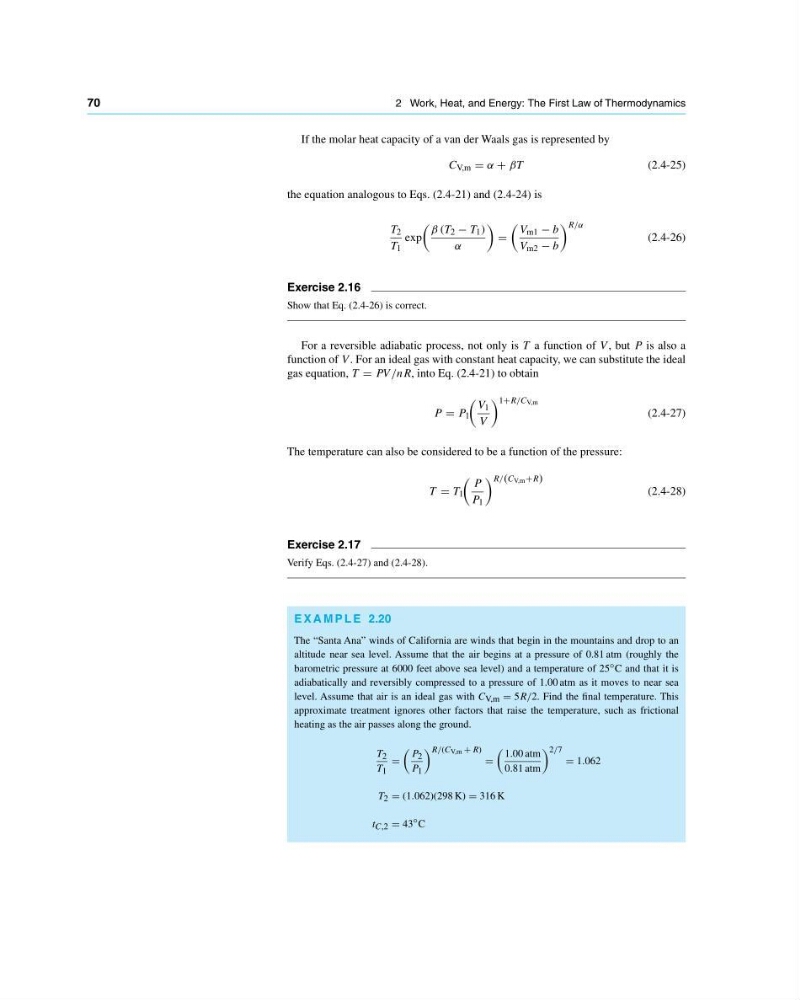
If the molar heat capacity of a van der Waals gas is represented by
C V,m α + βT
(2.4-25)
the equation analogous to Eqs. (2.4-21) and (2.4-24) is
T 2
T 1
exp
β (T 2 − T 1 )
α
V m1 − b
V m2 − b
R/α
(2.4-26)
Exercise 2.16
Show that Eq. (2.4-26) is correct.
For a reversible adiabatic process, not only is T a function of V , but P is also a
function of V . For an ideal gas with constant heat capacity, we can substitute the ideal
gas equation, T PV /nR, into Eq. (2.4-21) to obtain
P P 1
V 1
V
1+R/C V,m
(2.4-27)
The temperature can also be considered to be a function of the pressure:
T T 1
P
P 1
R/(C V,m +R)
(2.4-28)
Exercise 2.17
Verify Eqs. (2.4-27) and (2.4-28).
E X A M P L E 2.20
The “Santa Ana” winds of California are winds that begin in the mountains and drop to an
altitude near sea level. Assume that the air begins at a pressure of 0.81 atm (roughly the
barometric pressure at 6000 feet above sea level) and a temperature of 25 ◦ C and that it is
adiabatically and reversibly compressed to a pressure of 1.00 atm as it moves to near sea
level. Assume that air is an ideal gas with C V,m 5R/2. Find the final temperature. This
approximate treatment ignores other factors that raise the temperature, such as frictional
heating as the air passes along the ground.
T 2
T 1
P 2
P 1
R/(C V,m + R)
1.00 atm
0.81 atm
2/7
1.062
T 2 (1.062)(298 K) 316 K
t C,2 43 ◦ C
2 Work, Heat, and Energy: The First Law of Thermodynamics
If the molar heat capacity of a van der Waals gas is represented by
C V,m α + βT
(2.4-25)
the equation analogous to Eqs. (2.4-21) and (2.4-24) is
T 2
T 1
exp
β (T 2 − T 1 )
α
V m1 − b
V m2 − b
R/α
(2.4-26)
Exercise 2.16
Show that Eq. (2.4-26) is correct.
For a reversible adiabatic process, not only is T a function of V , but P is also a
function of V . For an ideal gas with constant heat capacity, we can substitute the ideal
gas equation, T PV /nR, into Eq. (2.4-21) to obtain
P P 1
V 1
V
1+R/C V,m
(2.4-27)
The temperature can also be considered to be a function of the pressure:
T T 1
P
P 1
R/(C V,m +R)
(2.4-28)
Exercise 2.17
Verify Eqs. (2.4-27) and (2.4-28).
E X A M P L E 2.20
The “Santa Ana” winds of California are winds that begin in the mountains and drop to an
altitude near sea level. Assume that the air begins at a pressure of 0.81 atm (roughly the
barometric pressure at 6000 feet above sea level) and a temperature of 25 ◦ C and that it is
adiabatically and reversibly compressed to a pressure of 1.00 atm as it moves to near sea
level. Assume that air is an ideal gas with C V,m 5R/2. Find the final temperature. This
approximate treatment ignores other factors that raise the temperature, such as frictional
heating as the air passes along the ground.
T 2
T 1
P 2
P 1
R/(C V,m + R)
1.00 atm
0.81 atm
2/7
1.062
T 2 (1.062)(298 K) 316 K
t C,2 43 ◦ C