

62
2 Work, Heat, and Energy: The First Law of Thermodynamics
C V ≈ 3nR (nonlinear polyatomic dilute gas)
(2.4-9)
This ascribes the internal energy to the translational energy and rotational energy of the
molecules. Equations (2.4-8) and (2.4-9) are usable approximations for some substances
near room temperature.
Amounts of Heat Transferred to an Ideal Gas
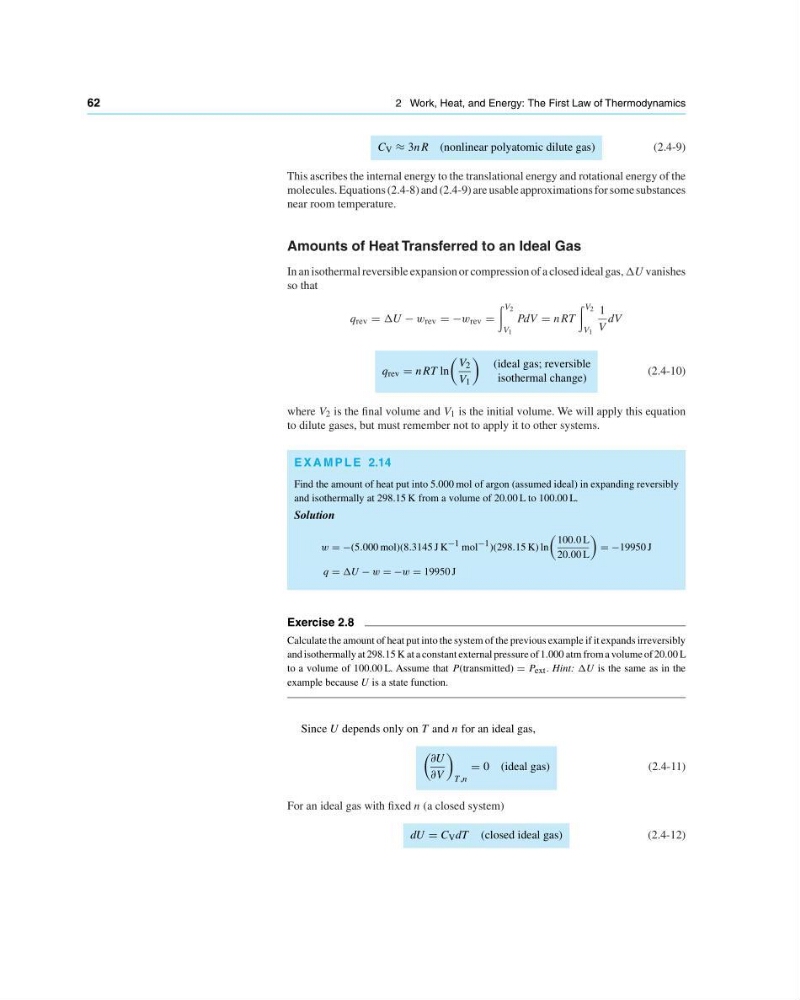
In an isothermal reversible expansion or compression of a closed ideal gas, ∆U vanishes
so that
q rev ∆U − w rev −w rev
V 2
V 1
PdV nRT
V 2
V 1
1
V
dV
q rev nRT ln
V 2
V 1
(ideal gas; reversible
isothermal change)
(2.4-10)
where V 2 is the final volume and V 1 is the initial volume. We will apply this equation
to dilute gases, but must remember not to apply it to other systems.
E X A M P L E 2.14
Find the amount of heat put into 5.000 mol of argon (assumed ideal) in expanding reversibly
and isothermally at 298.15 K from a volume of 20.00 L to 100.00 L.
Solution
w −(5.000 mol)(8.3145 J K −1 mol −1 )(298.15 K) ln
100.0 L
20.00 L
−19950 J
q ∆U − w −w 19950 J
Exercise 2.8
Calculate the amount of heat put into the system of the previous example if it expands irreversibly
and isothermally at 298.15 K at a constant external pressure of 1.000 atm from a volume of 20.00 L
to a volume of 100.00 L. Assume that P(transmitted) P ext . Hint: ∆U is the same as in the
example because U is a state function.
Since U depends only on T and n for an ideal gas,
∂U
∂V
T ,n
0 (ideal gas)
(2.4-11)
For an ideal gas with fixed n (a closed system)
dU C V dT (closed ideal gas)
(2.4-12)
2 Work, Heat, and Energy: The First Law of Thermodynamics
C V ≈ 3nR (nonlinear polyatomic dilute gas)
(2.4-9)
This ascribes the internal energy to the translational energy and rotational energy of the
molecules. Equations (2.4-8) and (2.4-9) are usable approximations for some substances
near room temperature.
Amounts of Heat Transferred to an Ideal Gas
In an isothermal reversible expansion or compression of a closed ideal gas, ∆U vanishes
so that
q rev ∆U − w rev −w rev
V 2
V 1
PdV nRT
V 2
V 1
1
V
dV
q rev nRT ln
V 2
V 1
(ideal gas; reversible
isothermal change)
(2.4-10)
where V 2 is the final volume and V 1 is the initial volume. We will apply this equation
to dilute gases, but must remember not to apply it to other systems.
E X A M P L E 2.14
Find the amount of heat put into 5.000 mol of argon (assumed ideal) in expanding reversibly
and isothermally at 298.15 K from a volume of 20.00 L to 100.00 L.
Solution
w −(5.000 mol)(8.3145 J K −1 mol −1 )(298.15 K) ln
100.0 L
20.00 L
−19950 J
q ∆U − w −w 19950 J
Exercise 2.8
Calculate the amount of heat put into the system of the previous example if it expands irreversibly
and isothermally at 298.15 K at a constant external pressure of 1.000 atm from a volume of 20.00 L
to a volume of 100.00 L. Assume that P(transmitted) P ext . Hint: ∆U is the same as in the
example because U is a state function.
Since U depends only on T and n for an ideal gas,
∂U
∂V
T ,n
0 (ideal gas)
(2.4-11)
For an ideal gas with fixed n (a closed system)
dU C V dT (closed ideal gas)
(2.4-12)