

52
2 Work, Heat, and Energy: The First Law of Thermodynamics
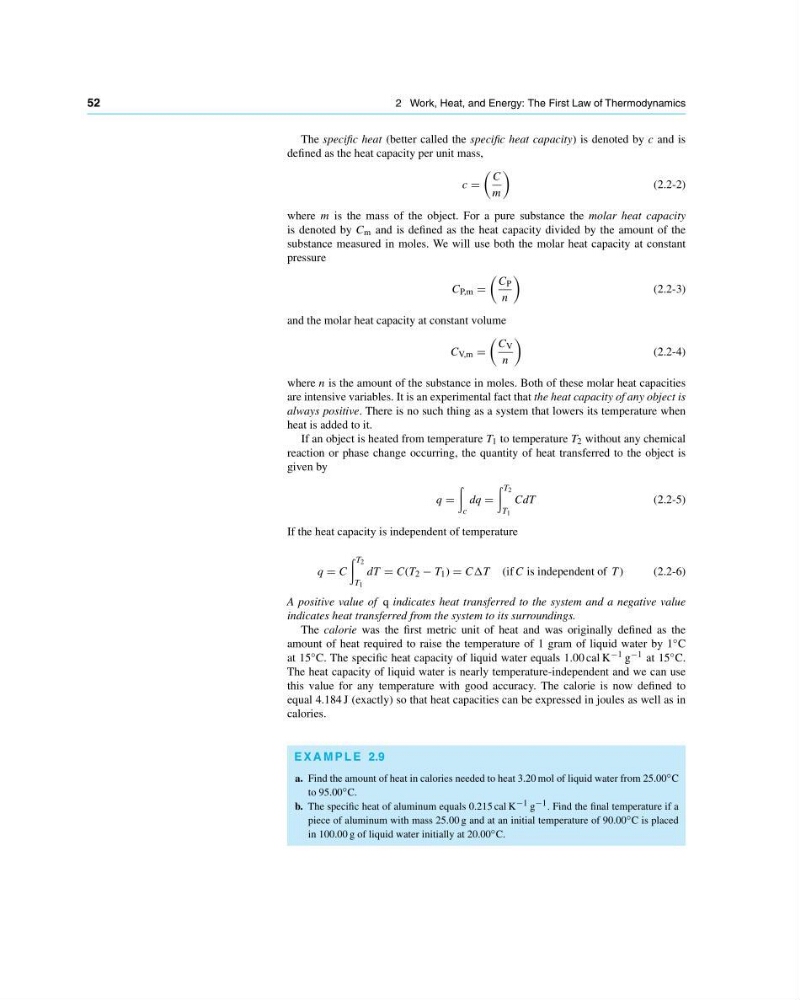
The specific heat (better called the specific heat capacity) is denoted by c and is
defined as the heat capacity per unit mass,
c
C
m
(2.2-2)
where m is the mass of the object. For a pure substance the molar heat capacity
is denoted by C m and is defined as the heat capacity divided by the amount of the
substance measured in moles. We will use both the molar heat capacity at constant
pressure
C P,m
C P
n
(2.2-3)
and the molar heat capacity at constant volume
C V,m
C V
n
(2.2-4)
where n is the amount of the substance in moles. Both of these molar heat capacities
are intensive variables. It is an experimental fact that the heat capacity of any object is
always positive. There is no such thing as a system that lowers its temperature when
heat is added to it.
If an object is heated from temperature T 1 to temperature T 2 without any chemical
reaction or phase change occurring, the quantity of heat transferred to the object is
given by
q
c
dq
T 2
T 1
CdT
(2.2-5)
If the heat capacity is independent of temperature
q C
T 2
T 1
dT C(T 2 − T 1 ) C∆T (if C is independent of T )
(2.2-6)
A positive value of q indicates heat transferred to the system and a negative value
indicates heat transferred from the system to its surroundings.
The calorie was the first metric unit of heat and was originally defined as the
amount of heat required to raise the temperature of 1 gram of liquid water by 1 ◦ C
at 15 ◦ C. The specific heat capacity of liquid water equals 1.00 cal K −1 g −1 at 15 ◦ C.
The heat capacity of liquid water is nearly temperature-independent and we can use
this value for any temperature with good accuracy. The calorie is now defined to
equal 4.184 J (exactly) so that heat capacities can be expressed in joules as well as in
calories.
E X A M P L E 2.9
a. Find the amount of heat in calories needed to heat 3.20 mol of liquid water from 25.00 ◦ C
to 95.00 ◦ C.
b. The specific heat of aluminum equals 0.215 cal K −1 g −1 . Find the final temperature if a
piece of aluminum with mass 25.00 g and at an initial temperature of 90.00 ◦ C is placed
in 100.00 g of liquid water initially at 20.00 ◦ C.
2 Work, Heat, and Energy: The First Law of Thermodynamics
The specific heat (better called the specific heat capacity) is denoted by c and is
defined as the heat capacity per unit mass,
c
C
m
(2.2-2)
where m is the mass of the object. For a pure substance the molar heat capacity
is denoted by C m and is defined as the heat capacity divided by the amount of the
substance measured in moles. We will use both the molar heat capacity at constant
pressure
C P,m
C P
n
(2.2-3)
and the molar heat capacity at constant volume
C V,m
C V
n
(2.2-4)
where n is the amount of the substance in moles. Both of these molar heat capacities
are intensive variables. It is an experimental fact that the heat capacity of any object is
always positive. There is no such thing as a system that lowers its temperature when
heat is added to it.
If an object is heated from temperature T 1 to temperature T 2 without any chemical
reaction or phase change occurring, the quantity of heat transferred to the object is
given by
q
c
dq
T 2
T 1
CdT
(2.2-5)
If the heat capacity is independent of temperature
q C
T 2
T 1
dT C(T 2 − T 1 ) C∆T (if C is independent of T )
(2.2-6)
A positive value of q indicates heat transferred to the system and a negative value
indicates heat transferred from the system to its surroundings.
The calorie was the first metric unit of heat and was originally defined as the
amount of heat required to raise the temperature of 1 gram of liquid water by 1 ◦ C
at 15 ◦ C. The specific heat capacity of liquid water equals 1.00 cal K −1 g −1 at 15 ◦ C.
The heat capacity of liquid water is nearly temperature-independent and we can use
this value for any temperature with good accuracy. The calorie is now defined to
equal 4.184 J (exactly) so that heat capacities can be expressed in joules as well as in
calories.
E X A M P L E 2.9
a. Find the amount of heat in calories needed to heat 3.20 mol of liquid water from 25.00 ◦ C
to 95.00 ◦ C.
b. The specific heat of aluminum equals 0.215 cal K −1 g −1 . Find the final temperature if a
piece of aluminum with mass 25.00 g and at an initial temperature of 90.00 ◦ C is placed
in 100.00 g of liquid water initially at 20.00 ◦ C.