

678
15 The Principles of Quantum Mechanics. I. De Broglie Waves and the Schrödinger Equation
23
0
1
Energy/h
n
or wave function (arbitrary units)
2
3
4
22 21
0
1
2
3
a z
ŒW
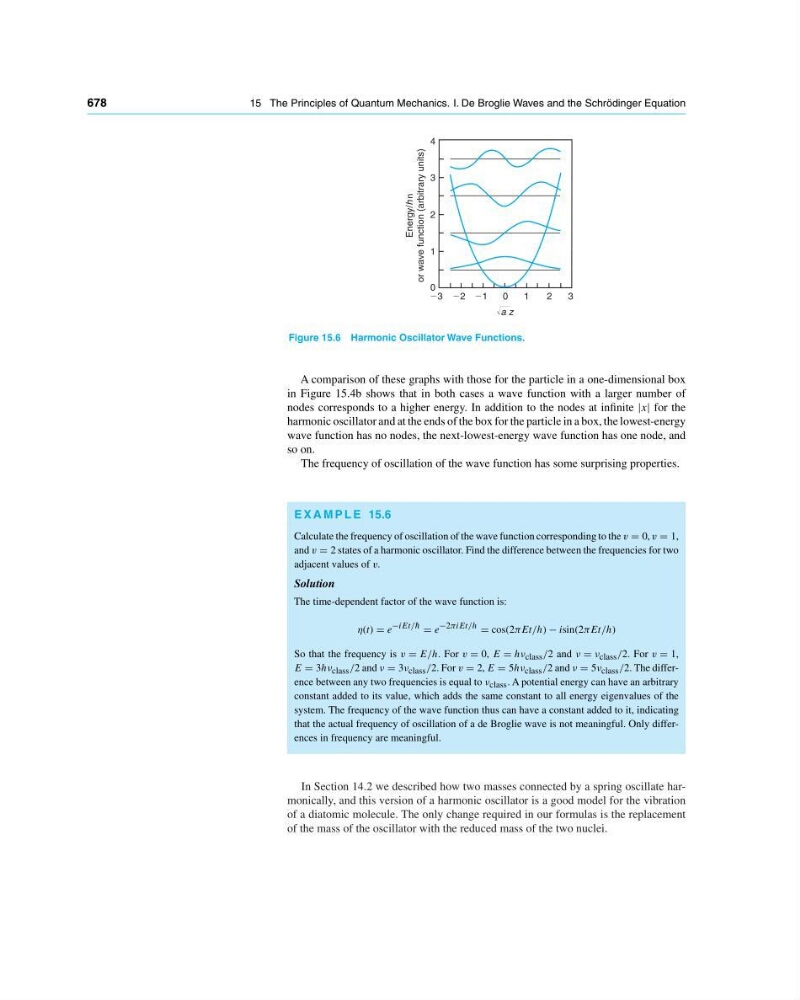
Figure 15.6 Harmonic Oscillator Wave Functions.
A comparison of these graphs with those for the particle in a one-dimensional box
in Figure 15.4b shows that in both cases a wave function with a larger number of
nodes corresponds to a higher energy. In addition to the nodes at infinite |x| for the
harmonic oscillator and at the ends of the box for the particle in a box, the lowest-energy
wave function has no nodes, the next-lowest-energy wave function has one node, and
so on.
The frequency of oscillation of the wave function has some surprising properties.
E X A M P L E 15.6
Calculate the frequency of oscillation of the wave function corresponding to the v 0, v 1,
and v 2 states of a harmonic oscillator. Find the difference between the frequencies for two
adjacent values of v.
Solution
The time-dependent factor of the wave function is:
η(t) e −iEt/¯ h e −2πiEt/h cos(2πEt/h) − isin(2πEt/h)
So that the frequency is v E/h. For v 0, E hν class /2 and ν ν class /2. For v 1,
E 3hν class /2 and ν 3ν class /2. For v 2, E 5hν class /2 and ν 5ν class /2. The difference between any two frequencies is equal to ν class . A potential energy can have an arbitrary
constant added to its value, which adds the same constant to all energy eigenvalues of the
system. The frequency of the wave function thus can have a constant added to it, indicating
that the actual frequency of oscillation of a de Broglie wave is not meaningful. Only differences in frequency are meaningful.
In Section 14.2 we described how two masses connected by a spring oscillate harmonically, and this version of a harmonic oscillator is a good model for the vibration
of a diatomic molecule. The only change required in our formulas is the replacement
of the mass of the oscillator with the reduced mass of the two nuclei.