

50
2 Work, Heat, and Energy: The First Law of Thermodynamics
dP
nR
V 1
T 2
T 1
dT − nRT 2
V 2
V 1
1
V 2 +
nR
V 2
T 1
T 2
dT
nR
V 1
(T 2 − T 1 ) + nRT 2
1
V 2
−
1
V 1
+
nR
V 2
(T 1 − T 2 )
(1.2516 mol)(8.3145 J K −1 mol −1 )
−98.15 K
0.00500 m 3
+ (1.2516 mol)(8.3145 J K −1 mol −1 )(200.00 K)
1
0.0100 m 3 −
1
0.0050 m 3
+ (1.2516 mol)(8.3145 J K −1 mol −1 )
98.15 K
0.01000 m 3
−2.0428 × 10 5 J m 3 − 2.0813 × 10 5 J m 3 + 1.0214 × 10 5 J m 3
−3.103 × 10 5 J m 3 3.062 atm
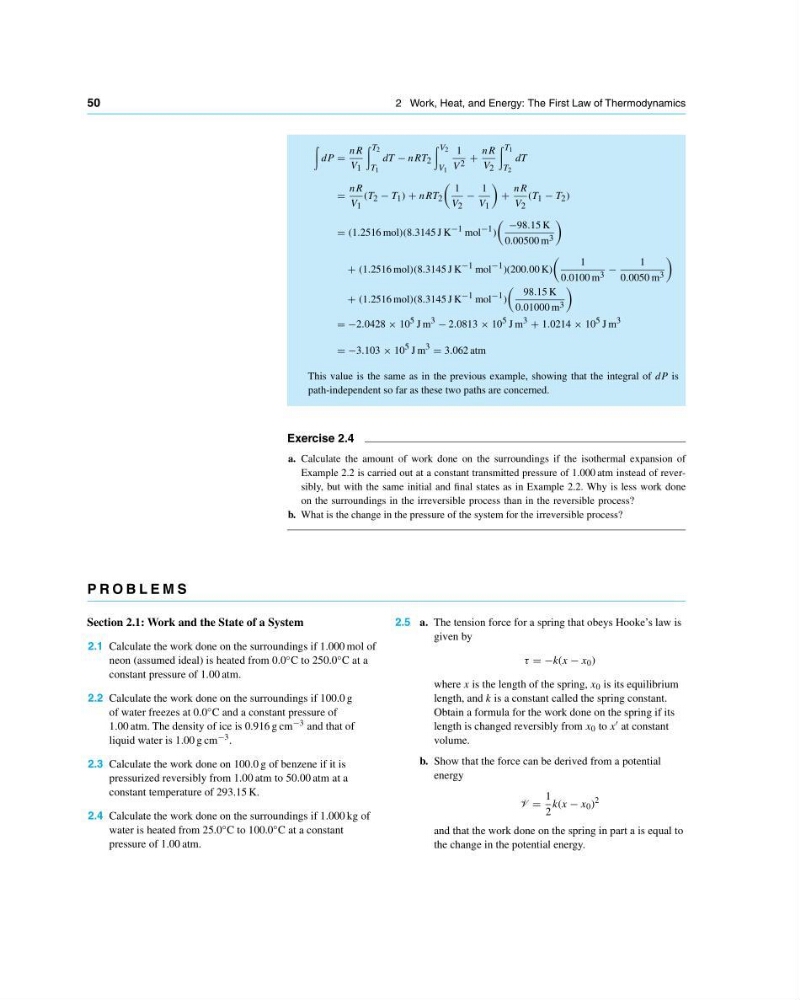
This value is the same as in the previous example, showing that the integral of dP is
path-independent so far as these two paths are concerned.
Exercise 2.4
a. Calculate the amount of work done on the surroundings if the isothermal expansion of
Example 2.2 is carried out at a constant transmitted pressure of 1.000 atm instead of reversibly, but with the same initial and final states as in Example 2.2. Why is less work done
on the surroundings in the irreversible process than in the reversible process?
b. What is the change in the pressure of the system for the irreversible process?
P R O B L E M S
Section 2.1: Work and the State of a System
2.1 Calculate the work done on the surroundings if 1.000 mol of
neon (assumed ideal) is heated from 0.0 ◦ C to 250.0 ◦ C at a
constant pressure of 1.00 atm.
2.2 Calculate the work done on the surroundings if 100.0 g
of water freezes at 0.0 ◦ C and a constant pressure of
1.00 atm. The density of ice is 0.916 g cm −3 and that of
liquid water is 1.00 g cm −3 .
2.3 Calculate the work done on 100.0 g of benzene if it is
pressurized reversibly from 1.00 atm to 50.00 atm at a
constant temperature of 293.15 K.
2.4 Calculate the work done on the surroundings if 1.000 kg of
water is heated from 25.0 ◦ C to 100.0 ◦ C at a constant
pressure of 1.00 atm.
2.5 a. The tension force for a spring that obeys Hooke’s law is
given by
τ −k(x − x 0 )
where x is the length of the spring, x 0 is its equilibrium
length, and k is a constant called the spring constant.
Obtain a formula for the work done on the spring if its
length is changed reversibly from x 0 to x at constant
volume.
b. Show that the force can be derived from a potential
energy
V
1
2
k(x − x 0 )
2
and that the work done on the spring in part a is equal to
the change in the potential energy.
2 Work, Heat, and Energy: The First Law of Thermodynamics
dP
nR
V 1
T 2
T 1
dT − nRT 2
V 2
V 1
1
V 2 +
nR
V 2
T 1
T 2
dT
nR
V 1
(T 2 − T 1 ) + nRT 2
1
V 2
−
1
V 1
+
nR
V 2
(T 1 − T 2 )
(1.2516 mol)(8.3145 J K −1 mol −1 )
−98.15 K
0.00500 m 3
+ (1.2516 mol)(8.3145 J K −1 mol −1 )(200.00 K)
1
0.0100 m 3 −
1
0.0050 m 3
+ (1.2516 mol)(8.3145 J K −1 mol −1 )
98.15 K
0.01000 m 3
−2.0428 × 10 5 J m 3 − 2.0813 × 10 5 J m 3 + 1.0214 × 10 5 J m 3
−3.103 × 10 5 J m 3 3.062 atm
This value is the same as in the previous example, showing that the integral of dP is
path-independent so far as these two paths are concerned.
Exercise 2.4
a. Calculate the amount of work done on the surroundings if the isothermal expansion of
Example 2.2 is carried out at a constant transmitted pressure of 1.000 atm instead of reversibly, but with the same initial and final states as in Example 2.2. Why is less work done
on the surroundings in the irreversible process than in the reversible process?
b. What is the change in the pressure of the system for the irreversible process?
P R O B L E M S
Section 2.1: Work and the State of a System
2.1 Calculate the work done on the surroundings if 1.000 mol of
neon (assumed ideal) is heated from 0.0 ◦ C to 250.0 ◦ C at a
constant pressure of 1.00 atm.
2.2 Calculate the work done on the surroundings if 100.0 g
of water freezes at 0.0 ◦ C and a constant pressure of
1.00 atm. The density of ice is 0.916 g cm −3 and that of
liquid water is 1.00 g cm −3 .
2.3 Calculate the work done on 100.0 g of benzene if it is
pressurized reversibly from 1.00 atm to 50.00 atm at a
constant temperature of 293.15 K.
2.4 Calculate the work done on the surroundings if 1.000 kg of
water is heated from 25.0 ◦ C to 100.0 ◦ C at a constant
pressure of 1.00 atm.
2.5 a. The tension force for a spring that obeys Hooke’s law is
given by
τ −k(x − x 0 )
where x is the length of the spring, x 0 is its equilibrium
length, and k is a constant called the spring constant.
Obtain a formula for the work done on the spring if its
length is changed reversibly from x 0 to x at constant
volume.
b. Show that the force can be derived from a potential
energy
V
1
2
k(x − x 0 )
2
and that the work done on the spring in part a is equal to
the change in the potential energy.