

15.3 The Particle in a Box and the Free Particle
669
For example, when a photon is absorbed or emitted by a molecule, the initial and
final molecule states correspond to energy eigenfunctions.
2. The wave function is some function other than a product of an energy eigenfunction
and a time-dependent factor. The wave function is not proportional to a factor that
obeys the time-independent Schrödinger equation, but it must still obey the timedependent Schrödinger equation.
E X A M P L E 15.3
Show that the following linear combination obeys the time-dependent Schrödinger equation:
Ψ(x, t)
∞
n1
A n ψ n (x)e −iE n t/¯ h
(15.3-20)
where A 1 , A 2 , . . . are a set of constants and where ψ 1 , ψ 2 , . . . represent energy eigenfunctions
of the system.
Solution
HΨ
H
∞
n1
A n ψ n e −iE n t/¯ h
∞
n1
A n E n ψ n e −iE n t/¯ h
ih
∂Ψ
∂t
i ¯
h
∂
∂t
∞
n1
A n ψ n e −iE n t/¯ h
∞
n1
A n E n ψ n e −iE n t/¯ h
It is apparent that Ψ does not obey the time-independent Schrödinger equation, since
HΨ
does not equal a single constant times Ψ.
Equation (15.3-20) expresses the principle of superposition, which means that an
arbitrary wave function can be represented by a linear combination of energy eigenfunctions.
The Particle in a Three-Dimensional Box
The principal application of this model system is to represent the translational motion
of a gas molecule, and we will discuss this application in Chapters 22 and 26. We
assume our three-dimensional box is rectangular and we place the box with its lower
left rear corner at the origin of coordinates and its walls perpendicular to the coordinate
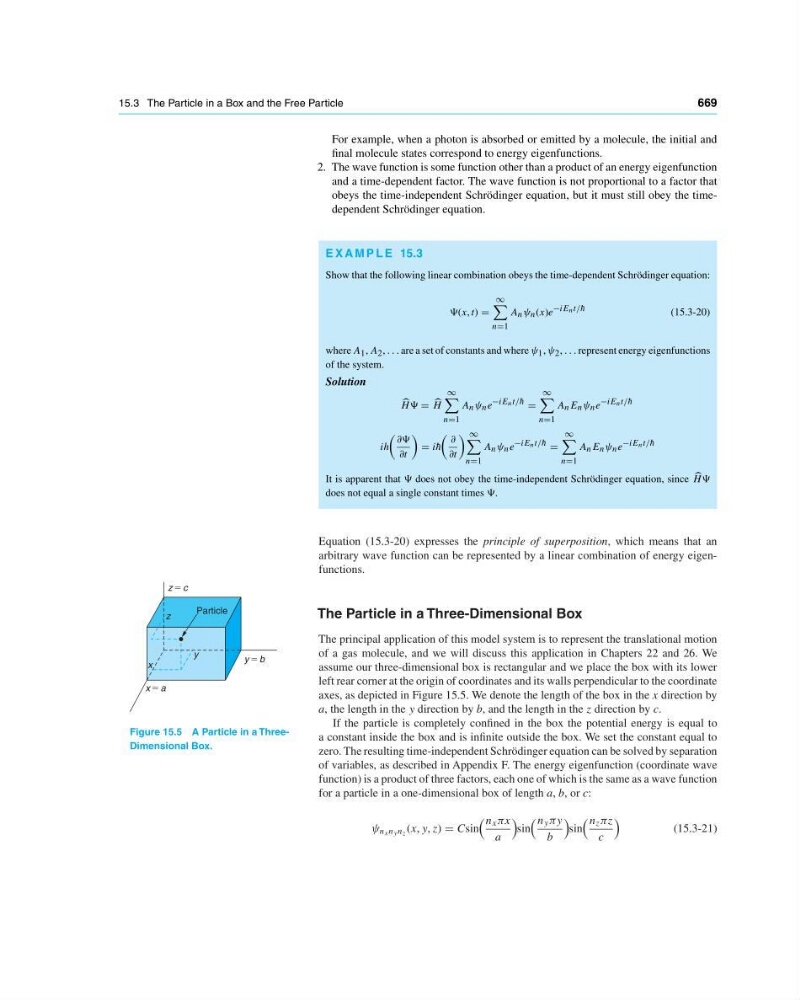
axes, as depicted in Figure 15.5. We denote the length of the box in the x direction by
a, the length in the y direction by b, and the length in the z direction by c.
Particle
z 5 c
z
x
y
y 5 b
x 5 a
Figure 15.5 A Particle in a ThreeDimensional Box.
If the particle is completely confined in the box the potential energy is equal to
a constant inside the box and is infinite outside the box. We set the constant equal to
zero. The resulting time-independent Schrödinger equation can be solved by separation
of variables, as described in Appendix F. The energy eigenfunction (coordinate wave
function) is a product of three factors, each one of which is the same as a wave function
for a particle in a one-dimensional box of length a, b, or c:
ψ n x n y n z (x, y, z) Csin
n x πx
a
sin
n y πy
b
sin
n z πz
c
(15.3-21)