

658
15 The Principles of Quantum Mechanics. I. De Broglie Waves and the Schrödinger Equation
Nonrigorous Derivation of the Time-Independent
Schrödinger Equation
In the formal theory of quantum mechanics, the Schrödinger wave equation is taken
as a postulate (fundamental hypothesis). In order to demonstrate a relationship with
the classical wave equation, we obtain the time-independent Schrödinger equation
nonrigorously for the case of a particle that moves parallel to the x axis. For a standing
wave along the x axis, the classical coordinate wave equation of Eq. (14.3-10) is
d 2 ψ
dx 2 +
4π 2
λ 2 ψ 0
(15.2-1)
where we have used Eq. (14.3-21) to replace the constant κ in terms of the wavelength
λ and where we use the letter ψ instead of ϕ for the coordinate factor. Use of the
de Broglie relation, Eq. (15.1-3), to replace λ gives
d 2 ψ
dx 2 +
4π 2
h 2 m
2 v
2 ψ 0
(15.2-2)
We eliminate the speed v from our equation by using the relation
E K + V
1
2
mv
2
+ V (x)
(15.2-3a)
which is the same as
m
2 v
2
2m[E − V (x)]
(15.2-3b)
where K is the kinetic energy, V is the potential energy, and E is the total energy. Use
of Eq. (15.2-3b) in Eq. (15.2-2) gives the time-independent Schrödinger equation for
de Broglie waves moving parallel to the x axis:
h 2
8π 2 m
d 2 ψ
dx 2 + V (x)ψ Eψ
(15.2-4)
We introduce the symbol ¯
h (“h-bar”):
¯
h
h
2π
(15.2-5)
and rewrite the equation:
−
¯
h
2
2m
d 2 ψ
dx 2 + V (x)ψ Eψ
(15.2-6)
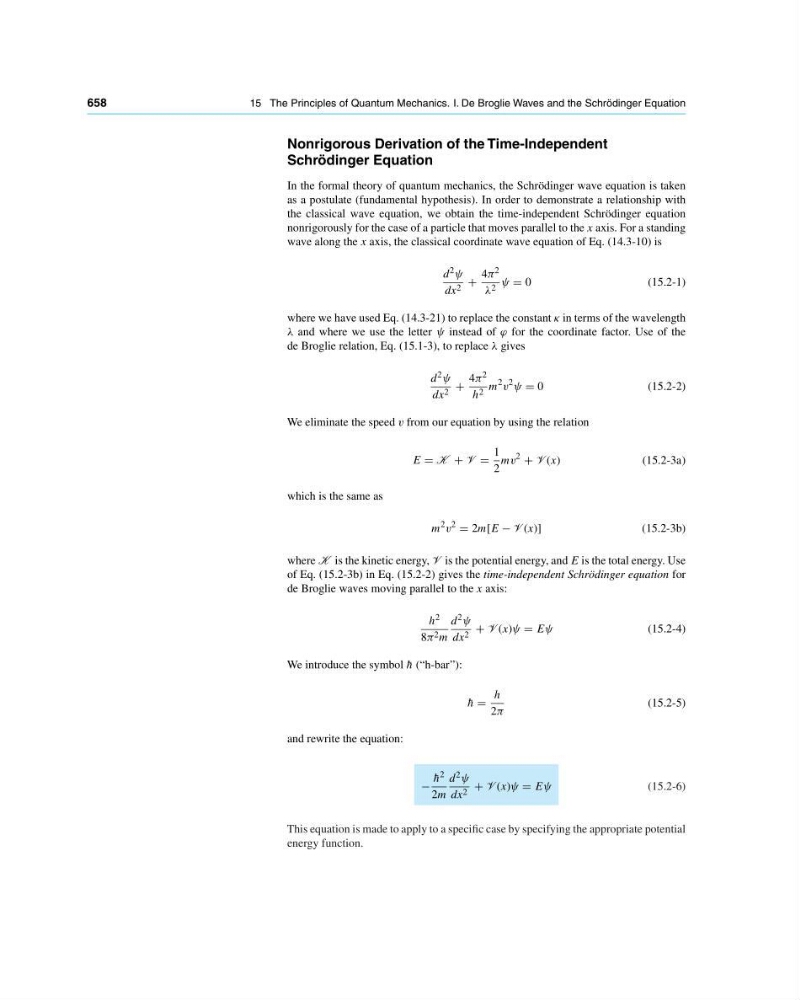
This equation is made to apply to a specific case by specifying the appropriate potential
energy function.