

646
14 Classical Mechanics and the Old Quantum Theory
The Wave–Particle Duality of Light
Since light exhibits a particle-like nature in some experiments and wave-like properties
in other experiments, we say that it exhibits a wave–particle duality. We cannot give
a simple answer to the question: “What is light really like?” We use the wave description when it explains a particular experiment, and use the particle description when it
explains another experiment.
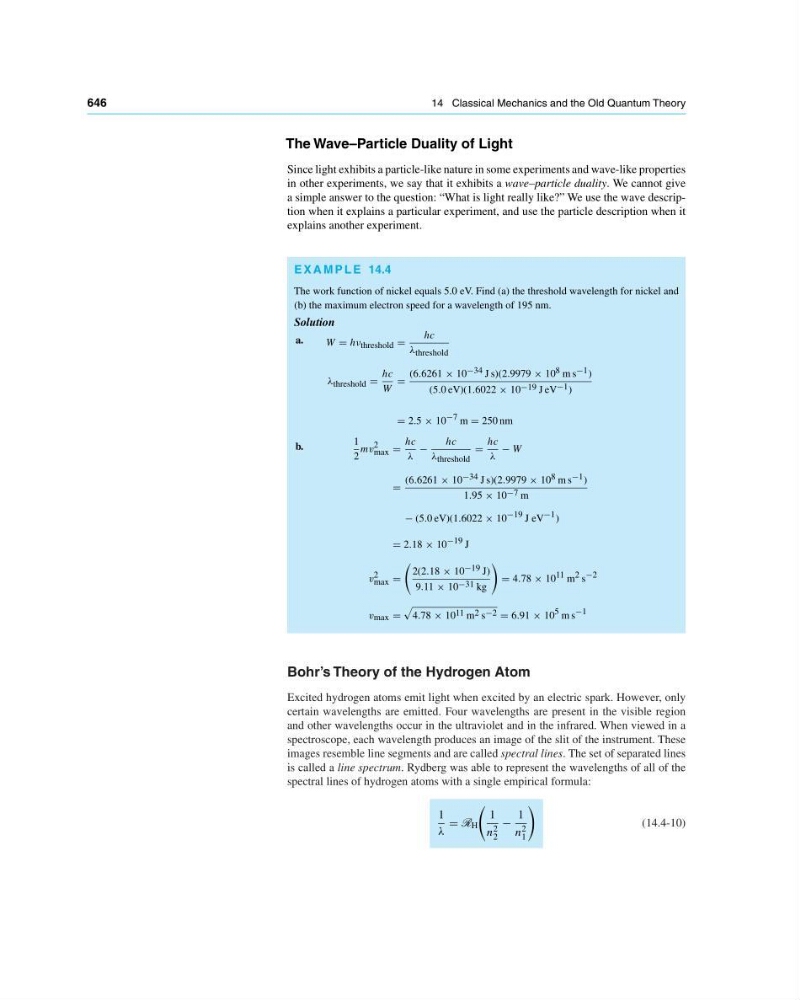
E X A M P L E 14.4
The work function of nickel equals 5.0 eV. Find (a) the threshold wavelength for nickel and
(b) the maximum electron speed for a wavelength of 195 nm.
Solution
a.
W hν threshold
hc
λ threshold
λ threshold
hc
W
(6.6261 × 10 −34 J s)(2.9979 × 10 8 m s −1 )
(5.0 eV)(1.6022 × 10 −19 J eV −1 )
2.5 × 10 −7 m 250 nm
b.
1
2
mv 2
max
hc
λ
−
hc
λ threshold
hc
λ
− W
(6.6261 × 10 −34 J s)(2.9979 × 10 8 m s −1 )
1.95 × 10 −7 m
− (5.0 eV)(1.6022 × 10 −19 J eV −1 )
2.18 × 10 −19 J
v 2
max
2(2.18 × 10 −19 J)
9.11 × 10 −31 kg
4.78 × 10 11 m 2 s −2
v max
4.78 × 10 11 m 2 s −2 6.91 × 10 5 m s −1
Bohr’s Theory of the Hydrogen Atom
Excited hydrogen atoms emit light when excited by an electric spark. However, only
certain wavelengths are emitted. Four wavelengths are present in the visible region
and other wavelengths occur in the ultraviolet and in the infrared. When viewed in a
spectroscope, each wavelength produces an image of the slit of the instrument. These
images resemble line segments and are called spectral lines. The set of separated lines
is called a line spectrum. Rydberg was able to represent the wavelengths of all of the
spectral lines of hydrogen atoms with a single empirical formula:
1
λ
R H
1
n 2
2
−
1
n 2
1
(14.4-10)