

14.4 The Old Quantum Theory
643
In 1900 Max Planck devised a new theory of black-body radiation that agreed with
experimental results. This theory is the first part of what we call the “old quantum
theory.” The following statements are a simplified version of the assumptions that led
to his result: 3
Max Planck, 1858–1947, received the
Nobel Prize in physics in 1918 for this
theory, although at first most physicists
were reluctant to believe that it was
correct.
1. The walls of the box contain oscillating electric charges. Each oscillator has a characteristic fixed frequency of oscillation, but many oscillators are present and many
frequencies are represented.
2. The standing waves in the box are equilibrated with the oscillators so that the average
energy of standing waves of a given frequency equals the average energy of the wall
oscillators of the same frequency.
3. The energy of an oscillator is quantized. That is, it is capable of assuming only one
of the values from the set:
E 0, hν, 2hν, 3hν, 4hν, . . . , nhν, . . .
(14.4-3)
where ν is the frequency of the oscillator and where h is a new constant, now known
as Planck’s constant. The quantity n, which can take on any non-negative integral
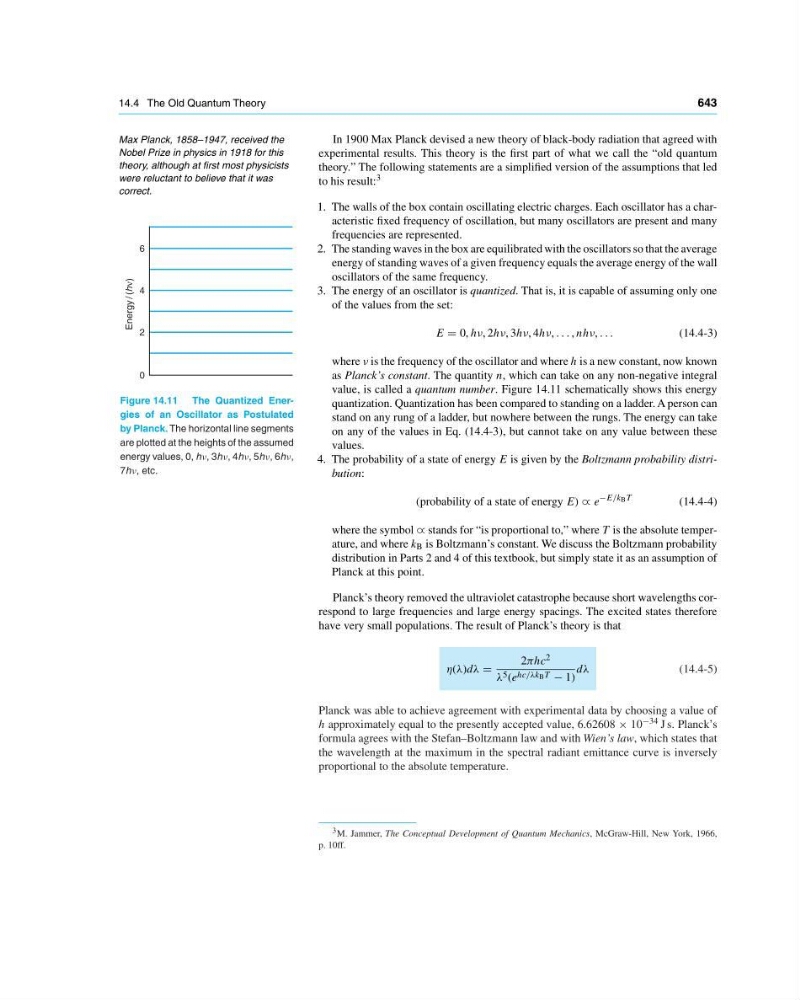
value, is called a quantum number. Figure 14.11 schematically shows this energy
quantization. Quantization has been compared to standing on a ladder. A person can
stand on any rung of a ladder, but nowhere between the rungs. The energy can take
on any of the values in Eq. (14.4-3), but cannot take on any value between these
values.
6
4
2
0
Energy / (hν)
Figure 14.11 The Quantized Energies of an Oscillator as Postulated
by Planck. The horizontal line segments
are plotted at the heights of the assumed
energy values, 0, hν, 3hν, 4hν, 5hν, 6hν,
7hν, etc.
4. The probability of a state of energy E is given by the Boltzmann probability distribution:
(probability of a state of energy E) ∝ e
−E/k B T
(14.4-4)
where the symbol ∝ stands for “is proportional to,” where T is the absolute temperature, and where k B is Boltzmann’s constant. We discuss the Boltzmann probability
distribution in Parts 2 and 4 of this textbook, but simply state it as an assumption of
Planck at this point.
Planck’s theory removed the ultraviolet catastrophe because short wavelengths correspond to large frequencies and large energy spacings. The excited states therefore
have very small populations. The result of Planck’s theory is that
η(λ)dλ
2πhc 2
λ 5 (e hc/λk B T − 1)
dλ
(14.4-5)
Planck was able to achieve agreement with experimental data by choosing a value of
h approximately equal to the presently accepted value, 6.62608 × 10 −34 J s. Planck’s
formula agrees with the Stefan–Boltzmann law and with Wien’s law, which states that
the wavelength at the maximum in the spectral radiant emittance curve is inversely
proportional to the absolute temperature.
3 M. Jammer, The Conceptual Development of Quantum Mechanics, McGraw-Hill, New York, 1966,
p. 10ff.