

14.2 Classical Mechanics
623
on the floor. The floor, which hardly moves at all, throws you into the air because of
Newton’s third law.
If a force on a particle depends only on its position, the force can be derived from
a potential energy. For the z component of such a force
F z −
∂V
∂z
x,y
(14.2-11)
where the potential energy is denoted by V . Similar equations apply for the x and y
directions. See Appendix E for further information. The derivative in Eq. (14.2-11)
is a partial derivative, which means that if you have a formula representing V , you
differentiate with respect to z in the usual way, treating any other independent variables
(x and y in this case) as though they were constants.
The total energy of a particle subject to a potential energy is the sum of its kinetic
energy K and its potential energy V :
E K + V
1
2
mv
2
+ V
(14.2-12)
The total energy of an object subject to a potential energy obeys the law of conservation of energy, which states that the total energy of the object is constant in time.
The Harmonic Oscillator
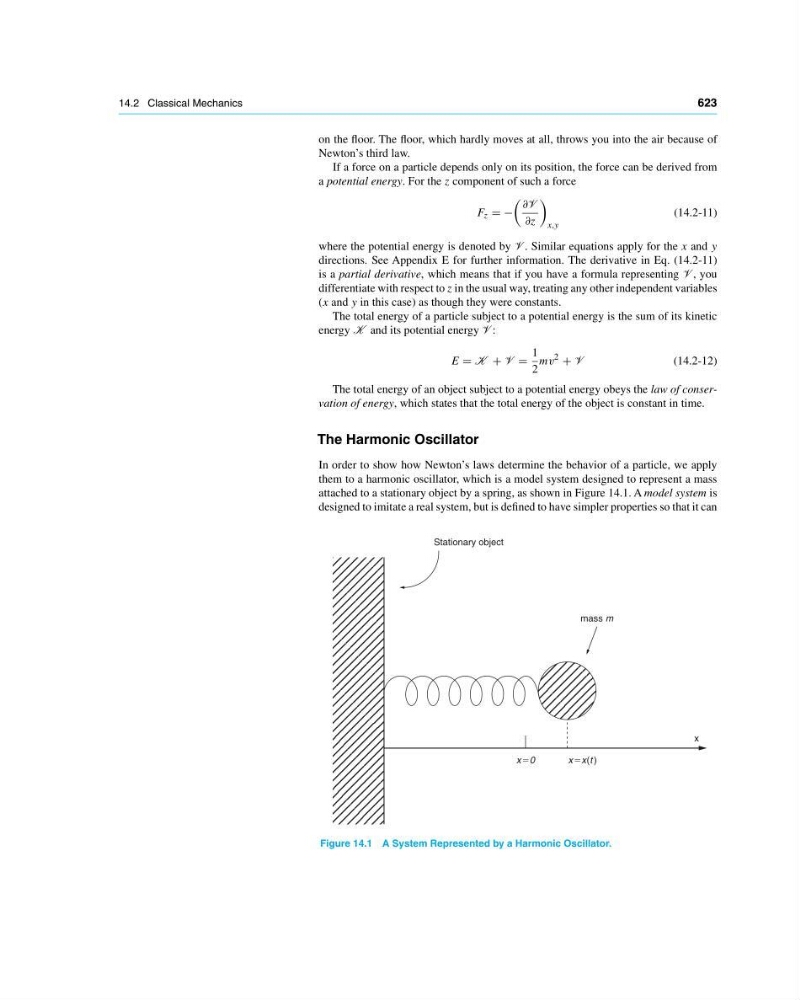
In order to show how Newton’s laws determine the behavior of a particle, we apply
them to a harmonic oscillator, which is a model system designed to represent a mass
attached to a stationary object by a spring, as shown in Figure 14.1. A model system is
designed to imitate a real system, but is defined to have simpler properties so that it can
x 50
x 5x(t )
Stationary object
mass m
x
Figure 14.1 A System Represented by a Harmonic Oscillator.