

13.6 Experimental Molecular Study of Chemical Reaction Mechanisms
613
0
5
Emission
intensity
v = 3→2
transitions
10
t /ms
15 20
P 3→2 (3)
P 3→2 (4)
P 3→2 (5)
P 3→2 (6)
P 3→2 (7)
0
5
v = 2→1
10
t /ms
15 20
P 2→1 (3)
P 2→1 (4)
P 2→1 (5)
P 2→1 (6)
P 2→1 (7)
P 2→1 (8)
P 2→1 (9)
0
5
v = 1→0
10
t /ms
15 20
P 1→0 (3)
P 1→0 (4)
P 1→0 (5)
P 1→0 (6)
P 1→0 (7)
P 1→0 (8)
P 1→0 (9)
P 1→0 (10)
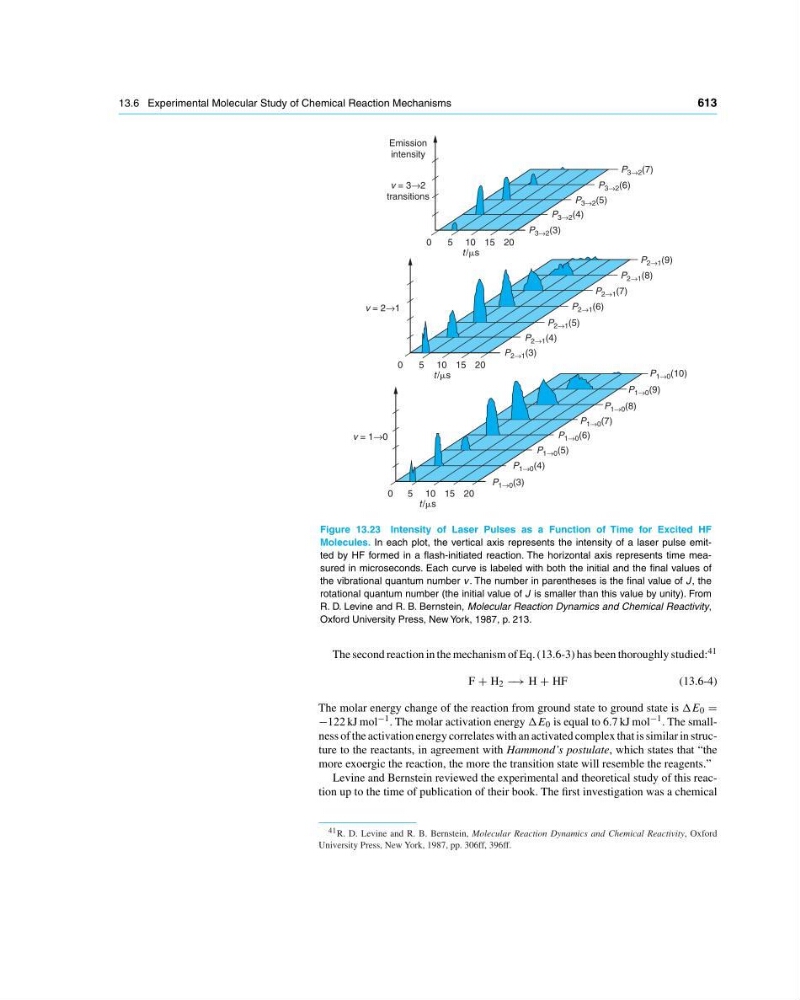
Figure 13.23 Intensity of Laser Pulses as a Function of Time for Excited HF
Molecules. In each plot, the vertical axis represents the intensity of a laser pulse emitted by HF formed in a flash-initiated reaction. The horizontal axis represents time measured in microseconds. Each curve is labeled with both the initial and the final values of
the vibrational quantum number v . The number in parentheses is the final value of J , the
rotational quantum number (the initial value of J is smaller than this value by unity). From
R. D. Levine and R. B. Bernstein, Molecular Reaction Dynamics and Chemical Reactivity,
Oxford University Press, New York, 1987, p. 213.
The second reaction in the mechanism of Eq. (13.6-3) has been thoroughly studied: 41
F + H 2 − → H + HF
(13.6-4)
The molar energy change of the reaction from ground state to ground state is ∆E 0
−122 kJ mol −1 . The molar activation energy ∆E 0 is equal to 6.7 kJ mol −1 . The smallness of the activation energy correlates with an activated complex that is similar in structure to the reactants, in agreement with Hammond’s postulate, which states that “the
more exoergic the reaction, the more the transition state will resemble the reagents.”
Levine and Bernstein reviewed the experimental and theoretical study of this reaction up to the time of publication of their book. The first investigation was a chemical
41 R. D. Levine and R. B. Bernstein, Molecular Reaction Dynamics and Chemical Reactivity, Oxford
University Press, New York, 1987, pp. 306ff, 396ff.