

13.5 Nonequilibrium Electrochemistry
605
nFk
◦ exp
(1 − α)nF
ϕ eq − ϕ ◦
RT
[R] b nFk
◦ exp
−
αnF
ϕ eq − ϕ ◦
RT
[O] b
(13.5-15)
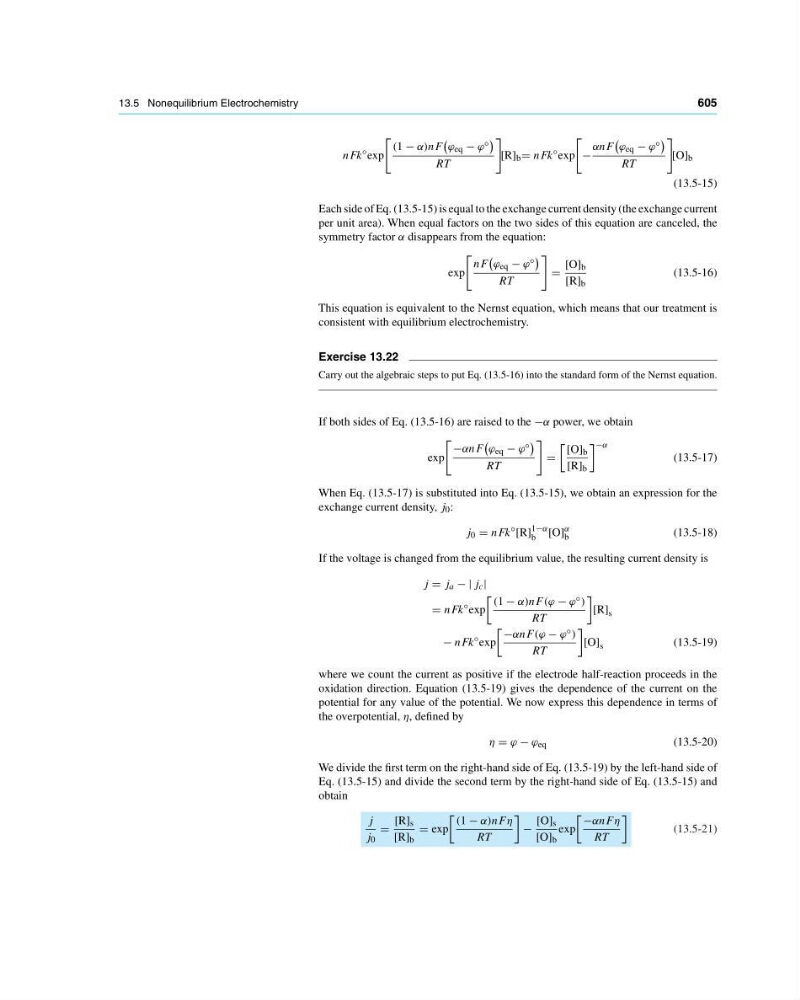
Each side of Eq. (13.5-15) is equal to the exchange current density (the exchange current
per unit area). When equal factors on the two sides of this equation are canceled, the
symmetry factor α disappears from the equation:
exp
nF
ϕ eq − ϕ ◦
RT
[O] b
[R] b
(13.5-16)
This equation is equivalent to the Nernst equation, which means that our treatment is
consistent with equilibrium electrochemistry.
Exercise 13.22
Carry out the algebraic steps to put Eq. (13.5-16) into the standard form of the Nernst equation.
If both sides of Eq. (13.5-16) are raised to the −α power, we obtain
exp
−αnF
ϕ eq − ϕ ◦
RT
[O] b
[R] b
−α
(13.5-17)
When Eq. (13.5-17) is substituted into Eq. (13.5-15), we obtain an expression for the
exchange current density, j 0 :
j 0 nFk
◦ [R]
1−α
b [O]
α
b
(13.5-18)
If the voltage is changed from the equilibrium value, the resulting current density is
j j a − | j c |
nFk
◦ exp
(1 − α)nF (ϕ − ϕ ◦ )
RT
[R] s
− nFk
◦ exp
−αnF (ϕ − ϕ ◦ )
RT
[O] s
(13.5-19)
where we count the current as positive if the electrode half-reaction proceeds in the
oxidation direction. Equation (13.5-19) gives the dependence of the current on the
potential for any value of the potential. We now express this dependence in terms of
the overpotential, η, defined by
η ϕ − ϕ eq
(13.5-20)
We divide the first term on the right-hand side of Eq. (13.5-19) by the left-hand side of
Eq. (13.5-15) and divide the second term by the right-hand side of Eq. (13.5-15) and
obtain
j
j 0
[R] s
[R] b
exp
(1 − α)nF η
RT
−
[O] s
[O] b
exp
−αnF η
RT
(13.5-21)