

13.5 Nonequilibrium Electrochemistry
599
κ (1.602 × 10 −19 C)
2(6.022 × 10 23 mol −1 )(997 kg m −3 )(0.0200 mol kg −1 )
(6.954 × 10 −10 C 2 N −1 m −2 )(1.3807 × 10 −23 J K −1 )(298.15 K)
1/2
4.64 × 10 8 m −1
Debye length
1
κ
2.15 × 10 −9 m 21.5 ˚
A
The electrical double layer resembles a capacitor, which is a pair of parallel conducting plates separated by a dielectric medium or a vacuum, and which can hold charges
of opposite sign on the two plates. Typical values of the capacitance of the electrical
double layer range from 10 to 40 µF cm −2 (microfarads per square centimeter). 30 The
farad is defined such that a voltage difference of 1 volt on a capacitor with capacitance
1 farad will produce a charge of 1 coulomb on each plate. It is a rather large unit, so
that the microfarad is the practical unit. The charge density (charge per unit volume)
ρ c is given by
ρ c F (z + c + + z − c − )
(13.5-4)
where z + and z − are the valences of the cation and anion, respectively, and c + and
c − are the concentrations of the cation and anion, respectively. In a neutral electrolyte
solution far from a charged surface, the charge density equals zero. The charge density
near a charged surface can be obtained by combining Eqs. (13.5-1), (13.5-2), and
(13.5-4).
E X A M P L E 13.8
Write the equation for the charge density in the Guoy–Chapman theory.
c + c +0 e −z + F ϕ/RT
c − c −0 e −z − F ϕ/RT
ϕ ϕ 0 e −κx
ρ c Fz + c +0 exp
−z + F ϕ 0 e −κx
RT
+ Fz − c −0 exp
−z − F ϕ 0 e −κx
RT
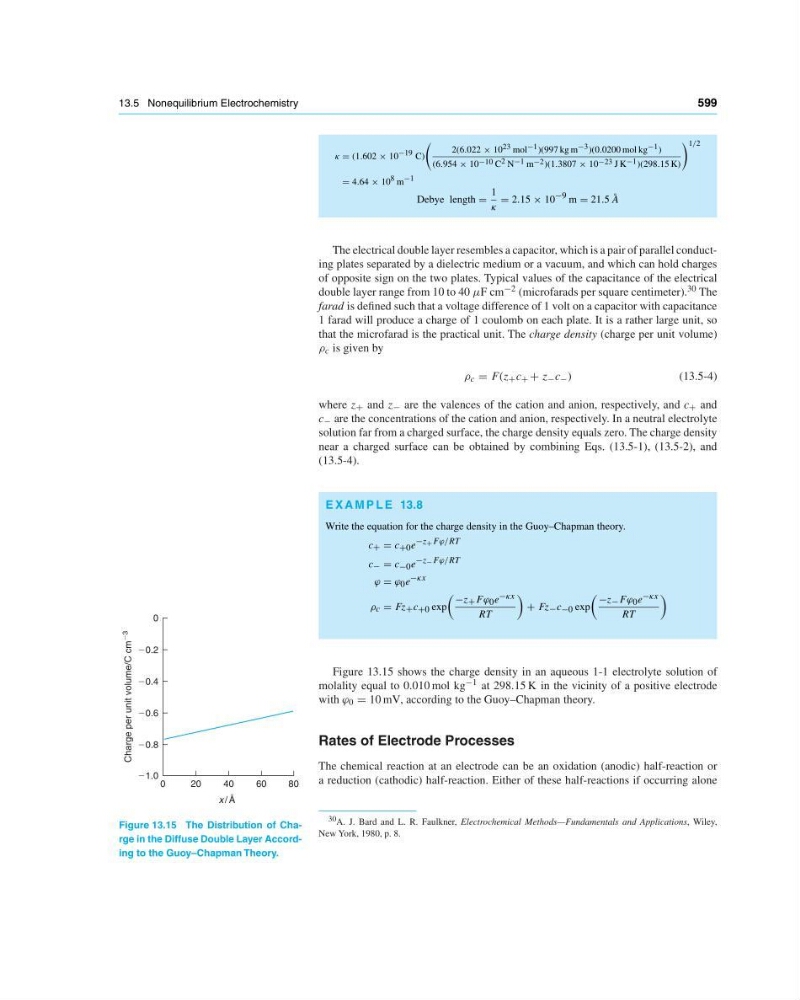
Figure 13.15 shows the charge density in an aqueous 1-1 electrolyte solution of
molality equal to 0.010 mol kg −1 at 298.15 K in the vicinity of a positive electrode
with ϕ 0 10 mV, according to the Guoy–Chapman theory.
0
20.2
20.4
20.6
20.8
21.0
0
2 0
4 0
6 0
8 0
x / Å
Charge per unit volume/C cm
23
Figure 13.15 The Distribution of Charge in the Diffuse Double Layer According to the Guoy–Chapman Theory.
Rates of Electrode Processes
The chemical reaction at an electrode can be an oxidation (anodic) half-reaction or
a reduction (cathodic) half-reaction. Either of these half-reactions if occurring alone
30 A. J. Bard and L. R. Faulkner, Electrochemical Methods—Fundamentals and Applications, Wiley,
New York, 1980, p. 8.