

594
13 Chemical Reaction Mechanisms II: Catalysis and Miscellaneous Topics
(b)
0.006
0.005
0.004
0.003
0.002
0.001
0
0
500
1000
Time, arbitrary units
0.6
W 1
W 100
W 500
W 1000
W
x
W
x
W 2
W 3
W 5
0.5
0.4
0.3
0.2
0.1
0
0
Time, arbitrary units
1
2
3
4
5
3
2
x
1
20 40
W
x 3 10
2
60 80100
(a)
140 160
4
p50.90
p50.95
p50.99
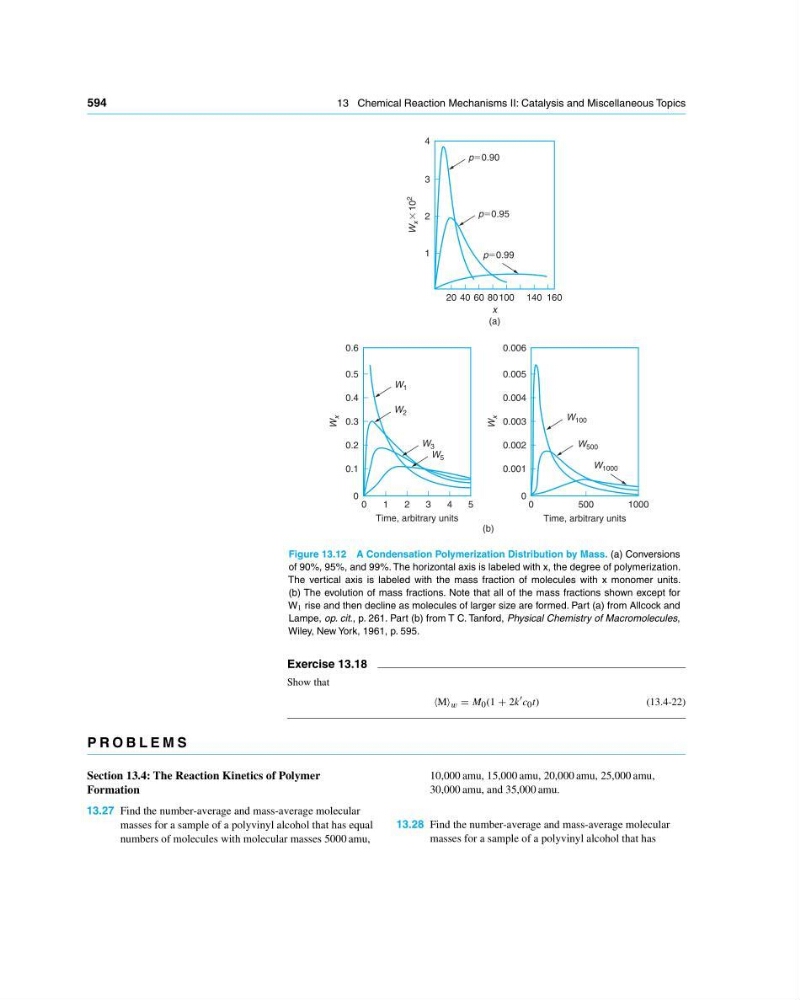
Figure 13.12 A Condensation Polymerization Distribution by Mass. (a) Conversions
of 90%, 95%, and 99%. The horizontal axis is labeled with x, the degree of polymerization.
The vertical axis is labeled with the mass fraction of molecules with x monomer units.
(b) The evolution of mass fractions. Note that all of the mass fractions shown except for
W 1 rise and then decline as molecules of larger size are formed. Part (a) from Allcock and
Lampe, op. cit., p. 261. Part (b) from T C. Tanford, Physical Chemistry of Macromolecules,
Wiley, New York, 1961, p. 595.
Exercise 13.18
Show that
M w M 0 (1 + 2k c 0 t)
(13.4-22)
P R O B L E M S
Section 13.4: The Reaction Kinetics of Polymer
Formation
13.27 Find the number-average and mass-average molecular
masses for a sample of a polyvinyl alcohol that has equal
numbers of molecules with molecular masses 5000 amu,
10,000 amu, 15,000 amu, 20,000 amu, 25,000 amu,
30,000 amu, and 35,000 amu.
13.28 Find the number-average and mass-average molecular
masses for a sample of a polyvinyl alcohol that has