

592
13 Chemical Reaction Mechanisms II: Catalysis and Miscellaneous Topics
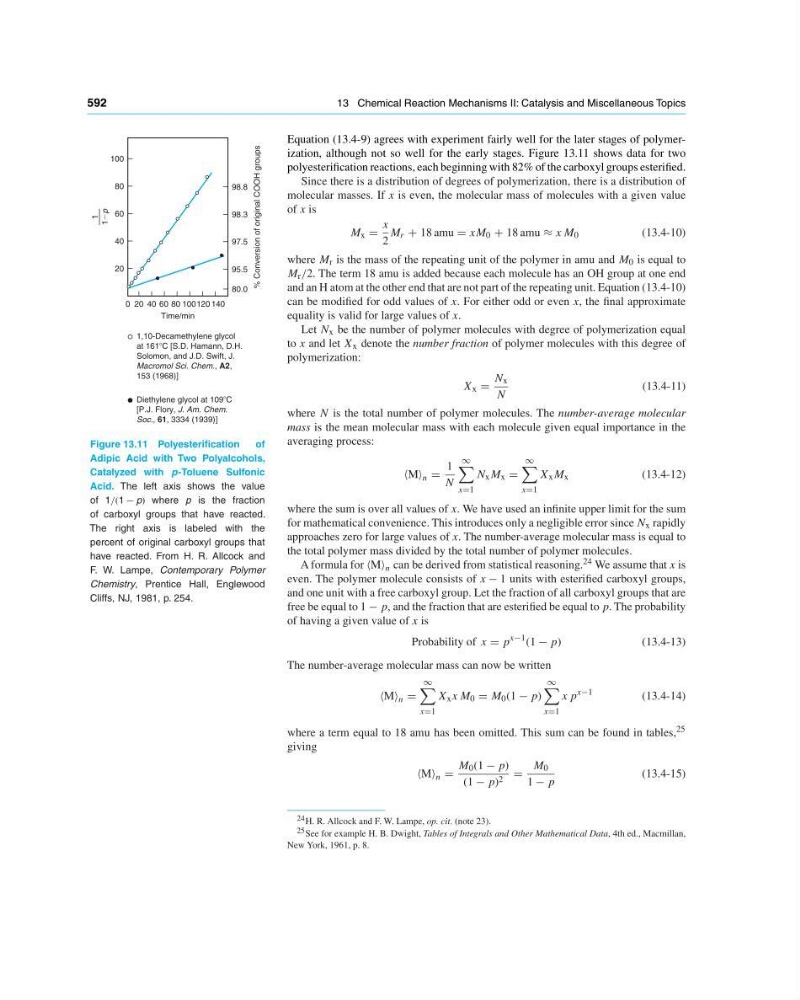
Equation (13.4-9) agrees with experiment fairly well for the later stages of polymerization, although not so well for the early stages. Figure 13.11 shows data for two
polyesterification reactions, each beginning with 82% of the carboxyl groups esterified.
0
100
98.8
98.3
97.5
95.5
80.0
80
60
40
20
20 40 60 80 100120 140
% Conversion of original COOH groups
1
12p
Time/min
1,10-Decamethylene glycol
at 1618C [S.D. Hamann, D.H.
Solomon, and J.D. Swift, J.
Macromol Sci. Chem., A2,
153 (1968)]
Diethylene glycol at 1098C
[P.J. Flory, J. Am. Chem.
Soc., 61, 3334 (1939)]
Figure 13.11 Polyesterification
of
Adipic Acid with Two Polyalcohols,
Catalyzed with p-Toluene Sulfonic
Acid. The left axis shows the value
of 1/(1 − p) where p is the fraction
of carboxyl groups that have reacted.
The right axis is labeled with the
percent of original carboxyl groups that
have reacted. From H. R. Allcock and
F. W. Lampe, Contemporary Polymer
Chemistry, Prentice Hall, Englewood
Cliffs, NJ, 1981, p. 254.
Since there is a distribution of degrees of polymerization, there is a distribution of
molecular masses. If x is even, the molecular mass of molecules with a given value
of x is
M x
x
2
M r + 18 amu xM 0 + 18 amu ≈ x M 0
(13.4-10)
where M r is the mass of the repeating unit of the polymer in amu and M 0 is equal to
M r /2. The term 18 amu is added because each molecule has an OH group at one end
and an H atom at the other end that are not part of the repeating unit. Equation (13.4-10)
can be modified for odd values of x. For either odd or even x, the final approximate
equality is valid for large values of x.
Let N x be the number of polymer molecules with degree of polymerization equal
to x and let X x denote the number fraction of polymer molecules with this degree of
polymerization:
X x
N x
N
(13.4-11)
where N is the total number of polymer molecules. The number-average molecular
mass is the mean molecular mass with each molecule given equal importance in the
averaging process:
M n
1
N
∞
x1
N x M x
∞
x1
X x M x
(13.4-12)
where the sum is over all values of x. We have used an infinite upper limit for the sum
for mathematical convenience. This introduces only a negligible error since N x rapidly
approaches zero for large values of x. The number-average molecular mass is equal to
the total polymer mass divided by the total number of polymer molecules.
A formula for M n can be derived from statistical reasoning. 24 We assume that x is
even. The polymer molecule consists of x − 1 units with esterified carboxyl groups,
and one unit with a free carboxyl group. Let the fraction of all carboxyl groups that are
free be equal to 1 − p, and the fraction that are esterified be equal to p. The probability
of having a given value of x is
Probability of x p
x−1 (1 − p)
(13.4-13)
The number-average molecular mass can now be written
M n
∞
x1
X x x M 0 M 0 (1 − p)
∞
x1
x p
x−1
(13.4-14)
where a term equal to 18 amu has been omitted. This sum can be found in tables, 25
giving
M n
M 0 (1 − p)
(1 − p) 2
M 0
1 − p
(13.4-15)
24 H. R. Allcock and F. W. Lampe, op. cit. (note 23).
25 See for example H. B. Dwight, Tables of Integrals and Other Mathematical Data, 4th ed., Macmillan,
New York, 1961, p. 8.