

574
13 Chemical Reaction Mechanisms II: Catalysis and Miscellaneous Topics
Adding Eqs. (13.1-30b) and (13.1-30c) gives an equation that is combined with Eq. (13.1-31)
and solved to give
[NO 3 ]
k 1 k 2
2k
1 k 3
[N 2 O 5 ][O 3 ]
1/3
(13.1-32)
Equation (13.1-32) is substituted into Eq. (13.1-31), which is substituted into Eq. (13.1-30a)
to give our solution:
rate −
1
2
d[O 3 ]
dt
k 3
k 1 k 2
2k
1 k 3
[N 2 O 5 ][O 3 ]
2/3
k app [N 2 O 5 ] 2/3 [O 3 ] 2/3
(13.1-33)
Exercise 13.8
Carry out the steps to obtain Eq. (13.1-33).
Catalysis in Solution
Various reactions are catalyzed by substances in the same phase as the reactants.
A number of reactions in aqueous solutions are catalyzed by acids or bases. In general
acid catalysis the rate depends on the concentration of unionized weak acid. In specific
hydrogen-ion catalysis the rate depends on the concentration of hydrogen ions. Acid
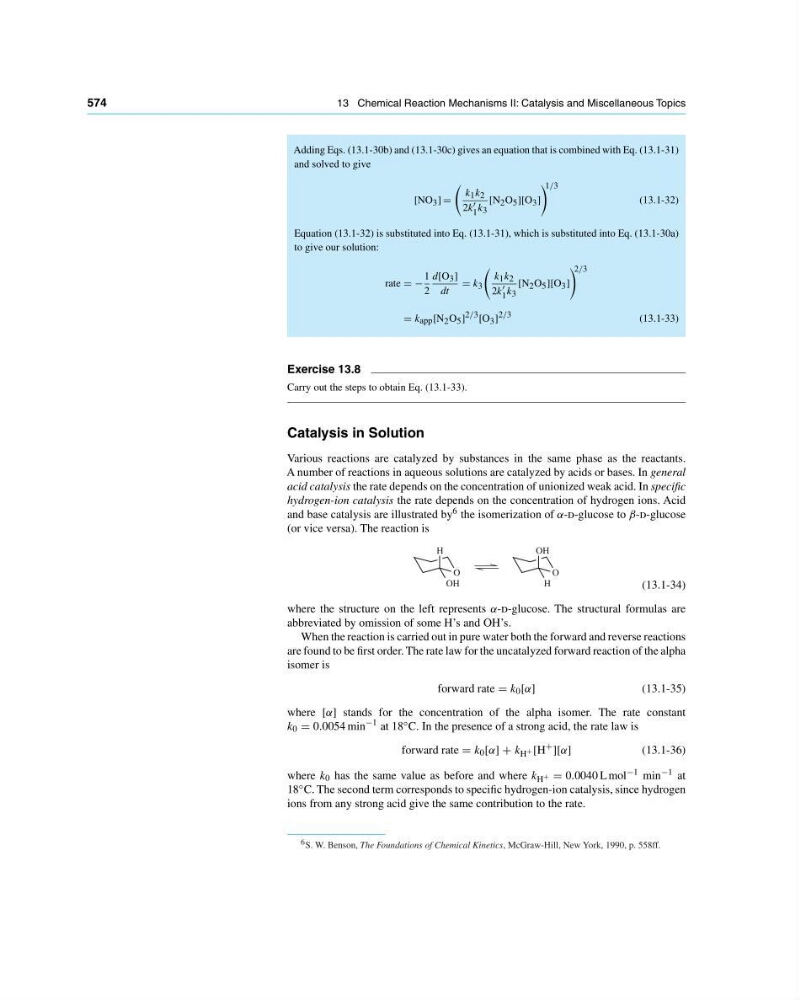
and base catalysis are illustrated by 6 the isomerization of α-d-glucose to β-d-glucose
(or vice versa). The reaction is
H
HO
O
HO
H
O
(13.1-34)
where the structure on the left represents α-d-glucose. The structural formulas are
abbreviated by omission of some H’s and OH’s.
When the reaction is carried out in pure water both the forward and reverse reactions
are found to be first order. The rate law for the uncatalyzed forward reaction of the alpha
isomer is
forward rate k 0 [α]
(13.1-35)
where [α] stands for the concentration of the alpha isomer. The rate constant
k 0 0.0054 min
−1 at 18 ◦ C. In the presence of a strong acid, the rate law is
forward rate k 0 [α] + k H + [H
+ ][α]
(13.1-36)
where k 0 has the same value as before and where k H + 0.0040 L mol −1 min −1 at
18 ◦ C. The second term corresponds to specific hydrogen-ion catalysis, since hydrogen
ions from any strong acid give the same contribution to the rate.
6 S. W. Benson, The Foundations of Chemical Kinetics, McGraw-Hill, New York, 1990, p. 558ff.