

572
13 Chemical Reaction Mechanisms II: Catalysis and Miscellaneous Topics
of sites with adsorbed A molecules and θ B is the fraction of sites with adsorbed B
molecules:
rate of adsorption of A k 1 [A](1 − θ A − θ B )
(13.1-21)
rate of adsorption of B k 2 [B](1 − θ A − θ B )
(13.1-22)
The rates of desorption are
rate of desorption of A k
1 θ A
(13.1-23)
rate of desorption of B k
2 θ B
(13.1-24)
When the rate of adsorption is equated to the rate of desorption for each substance
and the resulting equations are solved simultaneously for θ A and θ B , we obtain the
equilibrium relations:
θ A
K 1 [A]
1 + K 1 [A] + K 2 [B]
(13.1-25)
θ B
K 2 [B]
1 + K 1 [A] + K 2 [B]
(13.1-26)
where K 1 k 1 /k
1 and K 2 k 2 /k
2 .
Exercise 13.7
Verify Eqs. (13.1-25) and (13.1-26).
If step 3 in the Langmuir–Hinshelwood mechanism is rate-limiting both absorption
processes will be assumed to be at equilibrium. The rate law is
rate k 3 θ A θ B
k 3 K 1 K 2 [A][B]
(1 + K 1 [A] + K 2 [B])
2
(Langmuir–
Hinshelwood
mechanism)
(13.1-27)
0
[A]
Rate
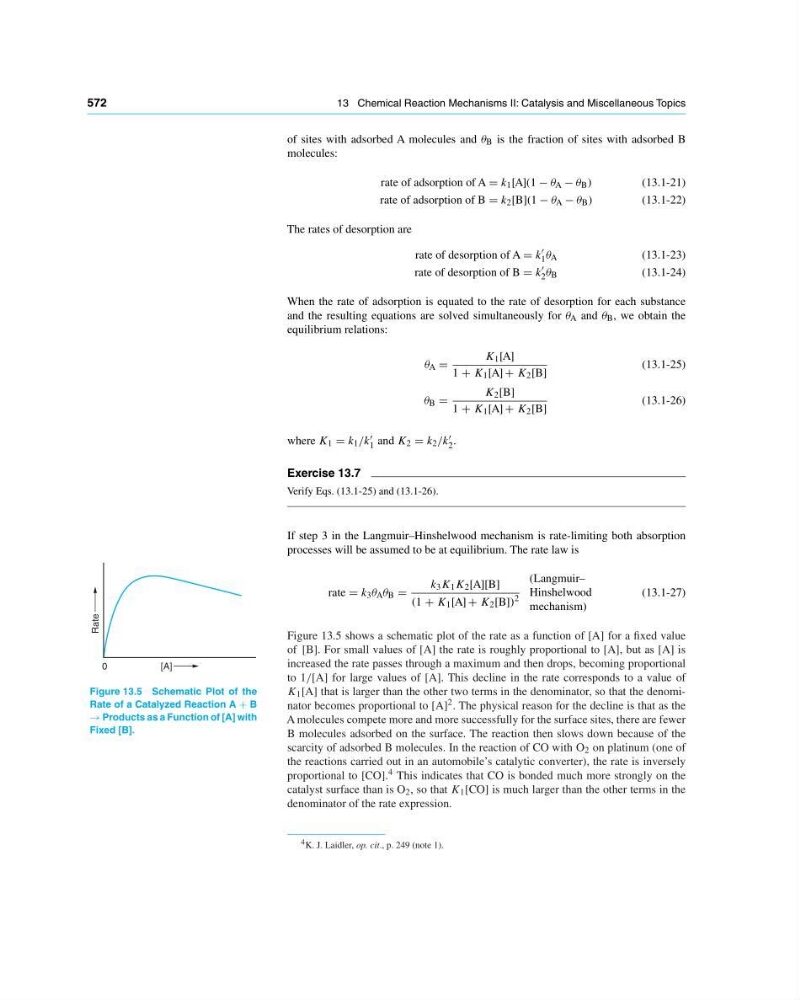
Figure 13.5 Schematic Plot of the
Rate of a Catalyzed Reaction A + B
→ Products as a Function of [A] with
Fixed [B].
Figure 13.5 shows a schematic plot of the rate as a function of [A] for a fixed value
of [B]. For small values of [A] the rate is roughly proportional to [A], but as [A] is
increased the rate passes through a maximum and then drops, becoming proportional
to 1/[A] for large values of [A]. This decline in the rate corresponds to a value of
K 1 [A] that is larger than the other two terms in the denominator, so that the denominator becomes proportional to [A] 2 . The physical reason for the decline is that as the
A molecules compete more and more successfully for the surface sites, there are fewer
B molecules adsorbed on the surface. The reaction then slows down because of the
scarcity of adsorbed B molecules. In the reaction of CO with O 2 on platinum (one of
the reactions carried out in an automobile’s catalytic converter), the rate is inversely
proportional to [CO]. 4 This indicates that CO is bonded much more strongly on the
catalyst surface than is O 2 , so that K 1 [CO] is much larger than the other terms in the
denominator of the rate expression.
4 K. J. Laidler, op. cit., p. 249 (note 1).