

548
12 Chemical Reaction Mechanisms I: Rate Laws and Mechanisms
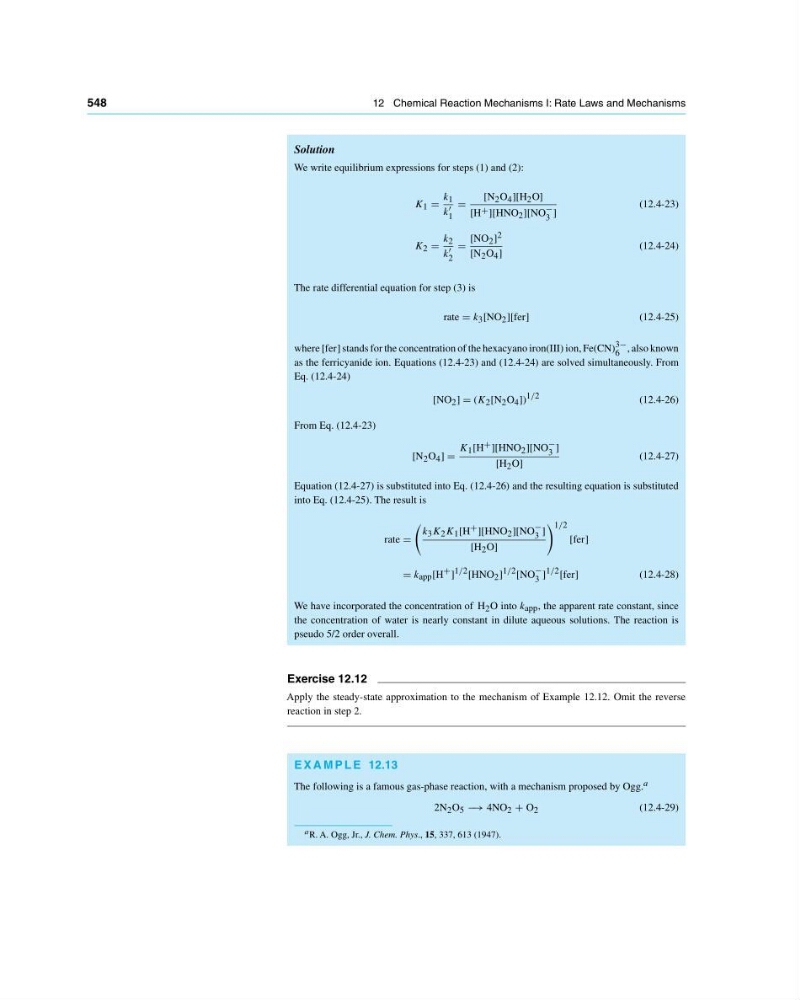
Solution
We write equilibrium expressions for steps (1) and (2):
K 1
k 1
k
1
[N 2 O 4 ][H 2 O]
[H + ][HNO 2 ][NO
−
3 ]
(12.4-23)
K 2
k 2
k
2
[NO 2 ] 2
[N 2 O 4 ]
(12.4-24)
The rate differential equation for step (3) is
rate k 3 [NO 2 ][fer]
(12.4-25)
where [fer] stands for the concentration of the hexacyano iron(III) ion, Fe(CN)
3−
6 , also known
as the ferricyanide ion. Equations (12.4-23) and (12.4-24) are solved simultaneously. From
Eq. (12.4-24)
[NO 2 ] (K 2 [N 2 O 4 ]) 1/2
(12.4-26)
From Eq. (12.4-23)
[N 2 O 4 ]
K 1 [H + ][HNO 2 ][NO
−
3 ]
[H 2 O]
(12.4-27)
Equation (12.4-27) is substituted into Eq. (12.4-26) and the resulting equation is substituted
into Eq. (12.4-25). The result is
rate
k 3 K 2 K 1 [H + ][HNO 2 ][NO
−
3 ]
[H 2 O]
1/2
[fer]
k app [H + ] 1/2 [HNO 2 ] 1/2 [NO
−
3 ] 1/2 [fer]
(12.4-28)
We have incorporated the concentration of H 2 O into k app , the apparent rate constant, since
the concentration of water is nearly constant in dilute aqueous solutions. The reaction is
pseudo 5/2 order overall.
Exercise 12.12
Apply the steady-state approximation to the mechanism of Example 12.12. Omit the reverse
reaction in step 2.
E X A M P L E 12.13
The following is a famous gas-phase reaction, with a mechanism proposed by Ogg. a
2N 2 O 5 − → 4NO 2 + O 2
(12.4-29)
a R. A. Ogg, Jr., J. Chem. Phys., 15, 337, 613 (1947).