

12.3 The Temperature Dependence of Rate Constants
539
The activation energies are somewhat smaller than for activation-limited reactions,
often near the values for the energies of activation for diffusion processes.
E X A M P L E 12.9
For the reaction
2I → I 2
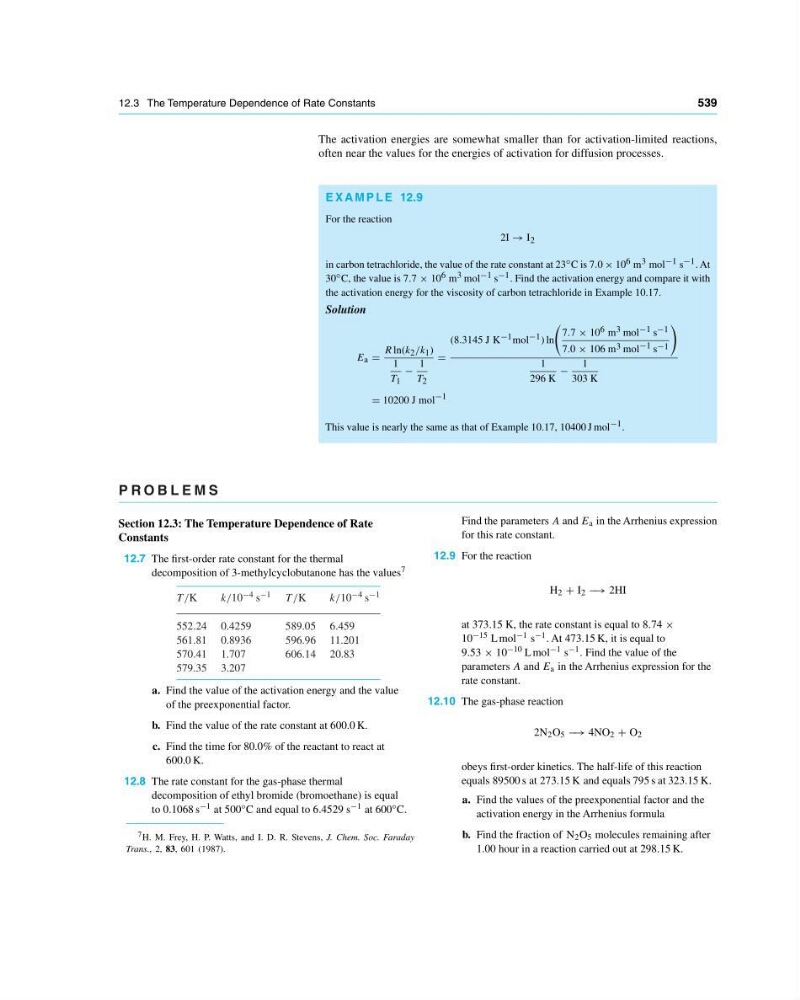
in carbon tetrachloride, the value of the rate constant at 23 ◦ C is 7.0 × 10 6 m 3 mol −1 s −1 . At
30 ◦ C, the value is 7.7 × 10 6 m 3 mol −1 s −1 . Find the activation energy and compare it with
the activation energy for the viscosity of carbon tetrachloride in Example 10.17.
Solution
E a
R ln(k 2 /k 1 )
1
T 1
−
1
T 2
(8.3145 J K −1 mol −1 ) ln
7.7 × 10 6 m 3 mol −1 s −1
7.0 × 10⁶ m 3 mol −1 s −1
1
296 K
−
1
303 K
10200 J mol −1
This value is nearly the same as that of Example 10.17, 10400 J mol −1 .
P R O B L E M S
Section 12.3: The Temperature Dependence of Rate
Constants
12.7 The first-order rate constant for the thermal
decomposition of 3-methylcyclobutanone has the values 7
T /K
k/10 −4 s −1 T /K
k/10 −4 s −1
552.24 0.4259
589.05 6.459
561.81 0.8936
596.96 11.201
570.41 1.707
606.14 20.83
579.35 3.207
a. Find the value of the activation energy and the value
of the preexponential factor.
b. Find the value of the rate constant at 600.0 K.
c. Find the time for 80.0% of the reactant to react at
600.0 K.
12.8 The rate constant for the gas-phase thermal
decomposition of ethyl bromide (bromoethane) is equal
to 0.1068 s −1 at 500 ◦ C and equal to 6.4529 s −1 at 600 ◦ C.
7 H. M. Frey, H. P. Watts, and I. D. R. Stevens, J. Chem. Soc. Faraday
Trans., 2, 83, 601 (1987).
Find the parameters A and E a in the Arrhenius expression
for this rate constant.
12.9 For the reaction
H 2 + I 2 − → 2HI
at 373.15 K, the rate constant is equal to 8.74 ×
10 −15 L mol −1 s −1 . At 473.15 K, it is equal to
9.53 × 10 −10 L mol −1 s −1 . Find the value of the
parameters A and E a in the Arrhenius expression for the
rate constant.
12.10 The gas-phase reaction
2N 2 O 5 − → 4NO 2 + O 2
obeys first-order kinetics. The half-life of this reaction
equals 89500 s at 273.15 K and equals 795 s at 323.15 K.
a. Find the values of the preexponential factor and the
activation energy in the Arrhenius formula
b. Find the fraction of N 2 O 5 molecules remaining after
1.00 hour in a reaction carried out at 298.15 K.