

530
12 Chemical Reaction Mechanisms I: Rate Laws and Mechanisms
Solution
k 4π(6.02 × 10 23 mol −1 )(4.2 × 10 −9 m 2 s −1 )(4.0 × 10 −10 m)
1.3 × 10 7 m 3 mol −1 s −1 1.3 × 10 10 L mol −1 s −1
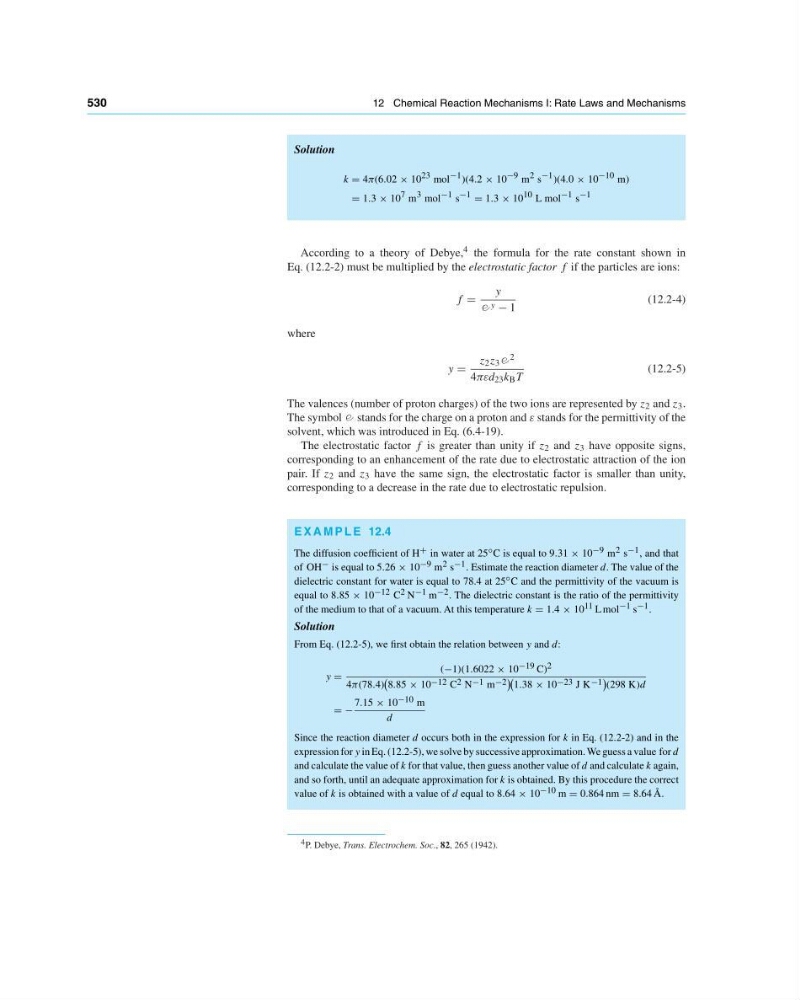
According to a theory of Debye, 4 the formula for the rate constant shown in
Eq. (12.2-2) must be multiplied by the electrostatic factor f if the particles are ions:
f
y
e y − 1
(12.2-4)
where
y
z 2 z 3 e 2
4πεd 23 k B T
(12.2-5)
The valences (number of proton charges) of the two ions are represented by z 2 and z 3 .
The symbol e stands for the charge on a proton and ε stands for the permittivity of the
solvent, which was introduced in Eq. (6.4-19).
The electrostatic factor f is greater than unity if z 2 and z 3 have opposite signs,
corresponding to an enhancement of the rate due to electrostatic attraction of the ion
pair. If z 2 and z 3 have the same sign, the electrostatic factor is smaller than unity,
corresponding to a decrease in the rate due to electrostatic repulsion.
E X A M P L E 12.4
The diffusion coefficient of H + in water at 25 ◦ C is equal to 9.31 × 10 −9 m 2 s −1 , and that
of OH − is equal to 5.26 × 10 −9 m 2 s −1 . Estimate the reaction diameter d. The value of the
dielectric constant for water is equal to 78.4 at 25 ◦ C and the permittivity of the vacuum is
equal to 8.85 × 10 −12 C 2 N −1 m −2 . The dielectric constant is the ratio of the permittivity
of the medium to that of a vacuum. At this temperature k 1.4 × 10 11 L mol −1 s −1 .
Solution
From Eq. (12.2-5), we first obtain the relation between y and d:
y
(−1)(1.6022 × 10 −19 C) 2
4π(78.4)
8.85 × 10 −12 C 2 N −1 m −2
1.38 × 10 −23 J K −1
(298 K)d
−
7.15 × 10 −10 m
d
Since the reaction diameter d occurs both in the expression for k in Eq. (12.2-2) and in the
expression for y in Eq. (12.2-5), we solve by successive approximation. We guess a value for d
and calculate the value of k for that value, then guess another value of d and calculate k again,
and so forth, until an adequate approximation for k is obtained. By this procedure the correct
value of k is obtained with a value of d equal to 8.64 × 10 −10 m 0.864 nm 8.64 ˚
A.
4 P. Debye, Trans. Electrochem. Soc., 82, 265 (1942).