

526
12 Chemical Reaction Mechanisms I: Rate Laws and Mechanisms
where d 12 is the collision diameter for substance 1 and substance 2, and where µ 12
is the reduced mass of molecules of mass m 1 and m 2 , defined in Eq. (9.8-27) and in
Appendix B:
µ 12
m 1 m 2
m 1 + m 2
or
1
µ 12
1
m 1
+
1
m 2
(12.1-7)
We can now summarize our results for both types of bimolecular processes in gaseous
reactions: A gaseous bimolecular elementary process is second order overall, and for
a two-substance reaction it is first order in each substance.
Exercise 12.2
Show that Eq. (12.1-6) is correct.
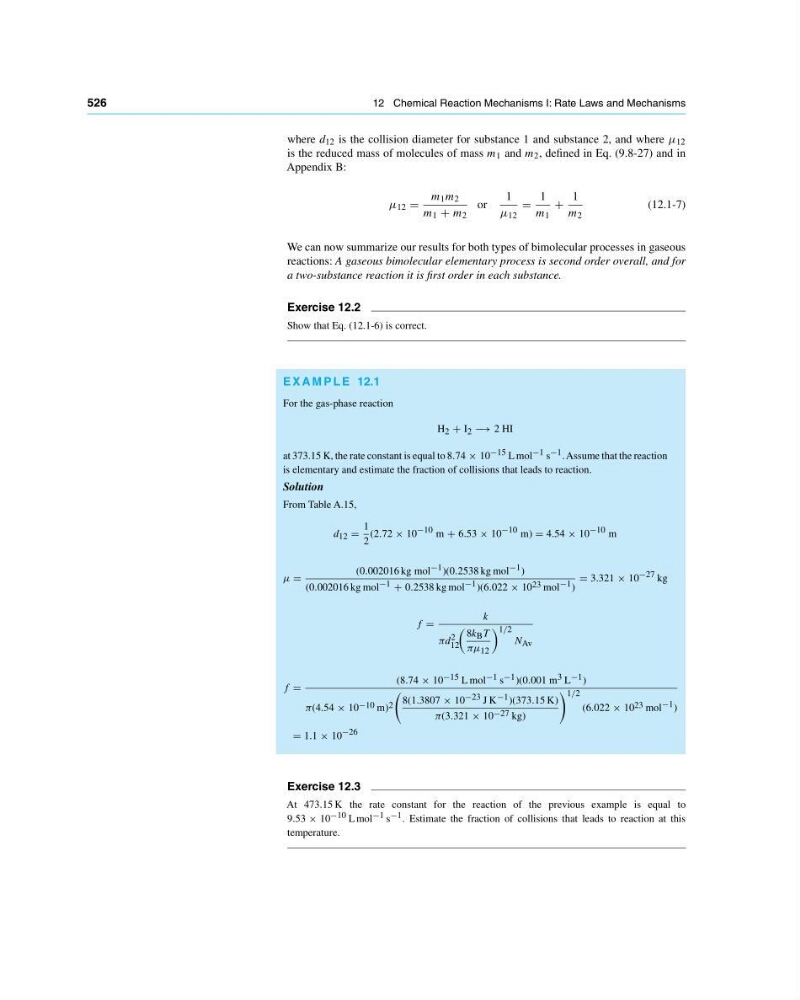
E X A M P L E 12.1
For the gas-phase reaction
H 2 + I 2 − → 2 HI
at 373.15 K, the rate constant is equal to 8.74 × 10 −15 L mol −1 s −1 . Assume that the reaction
is elementary and estimate the fraction of collisions that leads to reaction.
Solution
From Table A.15,
d 12
1
2
(2.72 × 10 −10 m + 6.53 × 10 −10 m) 4.54 × 10 −10 m
µ
(0.002016 kg mol −1 )(0.2538 kg mol −1 )
(0.002016 kg mol −1 + 0.2538 kg mol −1 )(6.022 × 10 23 mol −1 )
3.321 × 10 −27 kg
f
k
πd 2
12
8k B T
πµ 12
1/2
N Av
f
(8.74 × 10 −15 L mol −1 s −1 )(0.001 m 3 L −1 )
π(4.54 × 10 −10 m) 2
8(1.3807 × 10 −23 J K −1 )(373.15 K)
π(3.321 × 10 −27 kg)
1/2
(6.022 × 10 23 mol −1 )
1.1 × 10 −26
Exercise 12.3
At 473.15 K the rate constant for the reaction of the previous example is equal to
9.53 × 10 −10 L mol −1 s −1 . Estimate the fraction of collisions that leads to reaction at this
temperature.