

11.5 A Simple Reaction Mechanism: Two Consecutive Steps
511
The solution of this equation is carried out in Appendix B for the case that no B or F
is present at time t 0. The solution is
[B] t
k 1 [A] 0
k 2 − k 1
(e
−k 1 t
− e
−k 2 t )
(11.5-6)
If k 1 k 2 , the solution in Eq. (11.5-6) cannot be used. See Problem 11.34 for the
solution in this case.
Exercise 11.20
Substitute the function of Eq. (11.5-6) into the original differential equation of Eq. (11.5-5) and
show that it satisfies this equation.
The concentration of F is obtained from
[F] [A] 0 − [A] − [B]
(11.5-7)
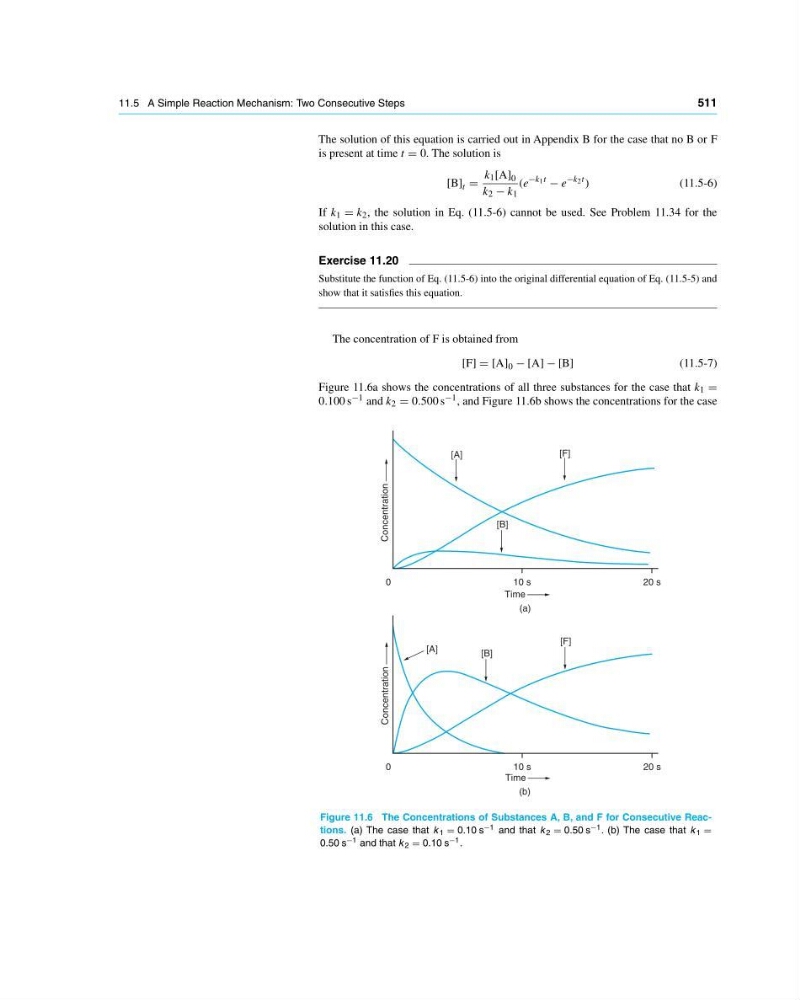
Figure 11.6a shows the concentrations of all three substances for the case that k 1
0.100 s −1 and k 2 0.500 s −1 , and Figure 11.6b shows the concentrations for the case
Concentration
Concentration
Time
[A]
[B]
10 s
0
0
(a)
20 s
Time
(b)
[B]
[F]
[A]
[F]
10 s
20 s
Figure 11.6 The Concentrations of Substances A, B, and F for Consecutive Reactions. (a) The case that k 1 0.10 s −1 and that k 2 0.50 s −1 . (b) The case that k 1
0.50 s −1 and that k 2 0.10 s −1 .