

34
1 The Behavior of Gases and Liquids
The reduced temperature is the ratio of the temperature to the critical temperature:
T r
T
T c
(1.4-14)
Using the definitions in Eqs. (1.4-12), (1.4-13), and (1.4-14) and the relations in Eqs.
(1.4-5) and (1.4-6) we obtain for a fluid obeying the van der Waals equation of state:
P
aP r
27b 2 , V m 3bV r , T
8aT r
27Rb
When these relations are substituted into Eq. (1.3-1), the result is
P r +
3
V 2
r
V r −
1
3
8T r
3
(1.4-15)
Exercise 1.14
Carry out the algebraic steps to obtain Eq. (1.4-15).
In Eq. (1.4-15), the parameters a and b have canceled out. The van der Waals equation
of state thus conforms to the law of corresponding states. The same equation of state
without adjustable parameters applies to every substance that obeys the van der Waals
equation of state if the reduced variables are used instead of P, V m , and T . The other
two-parameter equations of state also conform to the law of corresponding states.
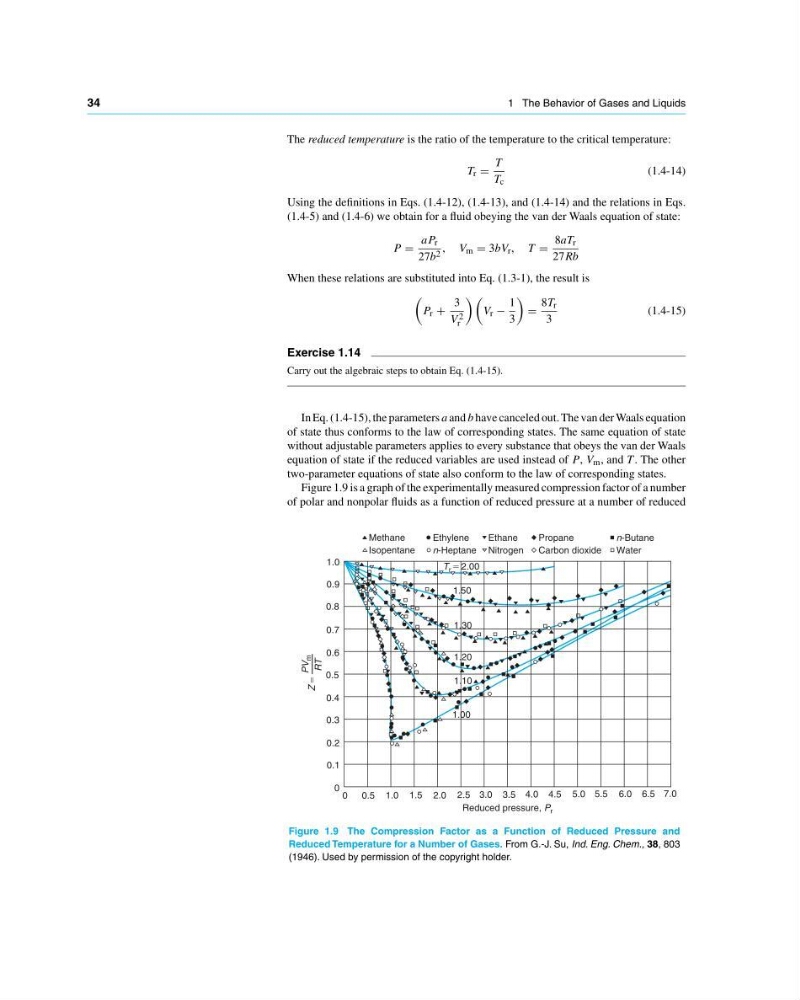
Figure 1.9 is a graph of the experimentally measured compression factor of a number
of polar and nonpolar fluids as a function of reduced pressure at a number of reduced
Methane
Isopentane
1.0
0.9
0.8
0.7
0.6
0.5
0.4
0.3
0.2
0.1
0
0
0.5 1.0 1.5 2.0 2.5 3.0 3.5 4.0 4.5 5.0 5.5 6.0 6.5 7.0
Reduced pressure, P r
T r ϭ 2.00
1.50
1.30
1.20
1.10
1.00
Ethylene
n-Heptane
n-Butane
Ethane
Nitrogen
Propane
Carbon dioxide
Water
Z
ϭ
PV
m
RT
Figure 1.9 The Compression Factor as a Function of Reduced Pressure and
Reduced Temperature for a Number of Gases. From G.-J. Su, Ind. Eng. Chem., 38, 803
(1946). Used by permission of the copyright holder.
1 The Behavior of Gases and Liquids
The reduced temperature is the ratio of the temperature to the critical temperature:
T r
T
T c
(1.4-14)
Using the definitions in Eqs. (1.4-12), (1.4-13), and (1.4-14) and the relations in Eqs.
(1.4-5) and (1.4-6) we obtain for a fluid obeying the van der Waals equation of state:
P
aP r
27b 2 , V m 3bV r , T
8aT r
27Rb
When these relations are substituted into Eq. (1.3-1), the result is
P r +
3
V 2
r
V r −
1
3
8T r
3
(1.4-15)
Exercise 1.14
Carry out the algebraic steps to obtain Eq. (1.4-15).
In Eq. (1.4-15), the parameters a and b have canceled out. The van der Waals equation
of state thus conforms to the law of corresponding states. The same equation of state
without adjustable parameters applies to every substance that obeys the van der Waals
equation of state if the reduced variables are used instead of P, V m , and T . The other
two-parameter equations of state also conform to the law of corresponding states.
Figure 1.9 is a graph of the experimentally measured compression factor of a number
of polar and nonpolar fluids as a function of reduced pressure at a number of reduced
Methane
Isopentane
1.0
0.9
0.8
0.7
0.6
0.5
0.4
0.3
0.2
0.1
0
0
0.5 1.0 1.5 2.0 2.5 3.0 3.5 4.0 4.5 5.0 5.5 6.0 6.5 7.0
Reduced pressure, P r
T r ϭ 2.00
1.50
1.30
1.20
1.10
1.00
Ethylene
n-Heptane
n-Butane
Ethane
Nitrogen
Propane
Carbon dioxide
Water
Z
ϭ
PV
m
RT
Figure 1.9 The Compression Factor as a Function of Reduced Pressure and
Reduced Temperature for a Number of Gases. From G.-J. Su, Ind. Eng. Chem., 38, 803
(1946). Used by permission of the copyright holder.