

508
11 The Rates of Chemical Reactions
We can express [B] in terms of [A]. Assume that initially only substance A is present
so that [A] 0 0 and [B] 0 0:
[B] [A] 0 − [A] and [B] eq [A] 0 − [A] eq
so that
[B] − [B] eq [A] 0 −[A] − ([A] 0 − [A] eq ) − [A] + [A] eq
(11.4-9)
When this relation is substituted into Eq. (11.4-8), we obtain
−
d[A]
dt
(k f + k r )([A] − [A] eq )
(11.4-10a)
Since [A] eq is a constant for any particular initial condition, we can replace d[A]/dt
by d([A] − [A] eq )/dt.
−
d
[A] − [A] eq
dt
(k f + k r )([A] − [A] eq )
(11.4-10b)
Equation (11.4-10b) is the same as Eq. (11.2-2) except for the symbols used, and the
solution is obtained by transcribing Eq. (11.2-5) with appropriate changes in symbols:
[A] t − [A] eq ([A] 0 − [A] eq )e
−(k f +k r )t
(11.4-11)
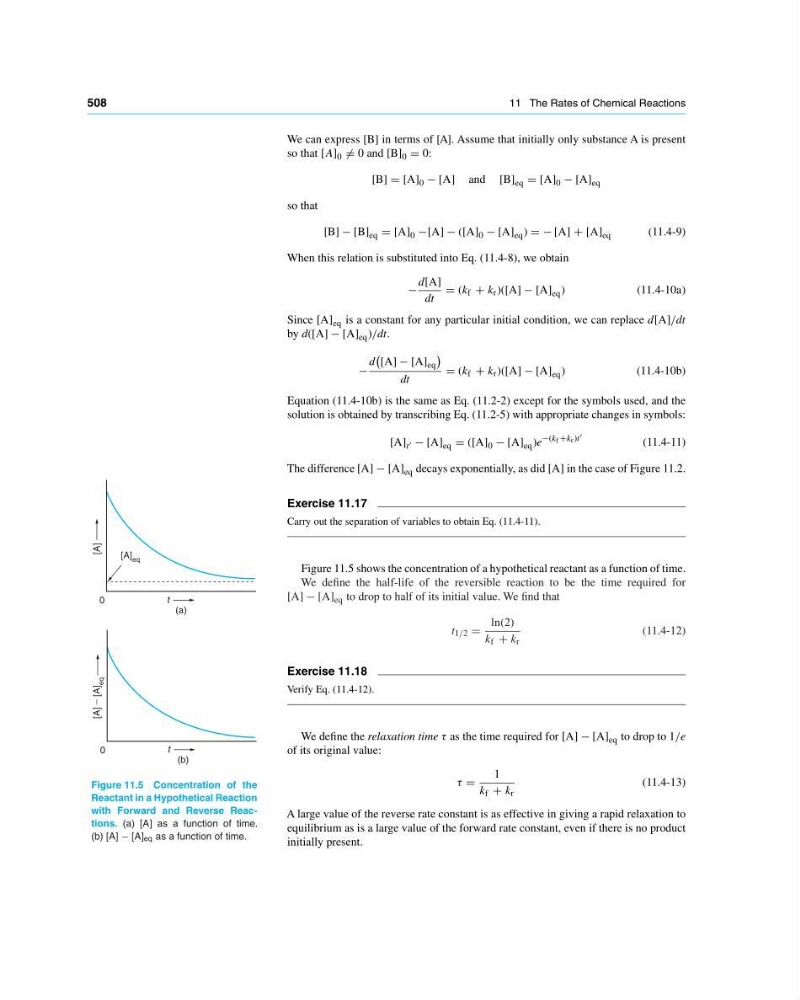
The difference [A] − [A] eq decays exponentially, as did [A] in the case of Figure 11.2.
Exercise 11.17
Carry out the separation of variables to obtain Eq. (11.4-11).
Figure 11.5 shows the concentration of a hypothetical reactant as a function of time.
0
t
(a)
[A]
[A] eq
0
t
(b)
[A]
2 [A]
eq
Figure 11.5 Concentration of the
Reactant in a Hypothetical Reaction
with Forward and Reverse Reactions. (a) [A] as a function of time.
(b) [A] − [A] eq as a function of time.
We define the half-life of the reversible reaction to be the time required for
[A] − [A] eq to drop to half of its initial value. We find that
t 1/2
ln(2)
k f + k r
(11.4-12)
Exercise 11.18
Verify Eq. (11.4-12).
We define the relaxation time τ as the time required for [A] − [A] eq to drop to 1/e
of its original value:
τ
1
k f + k r
(11.4-13)
A large value of the reverse rate constant is as effective in giving a rapid relaxation to
equilibrium as is a large value of the forward rate constant, even if there is no product
initially present.