

506
11 The Rates of Chemical Reactions
to obtain the result
kt
1
[B] 0 − [A] 0
1
[A]
−
1
[A] 0
+
1
([B] 0 − [A] 0 ) 2 ln
[B] 0 [A]
[A] 0 [B]
11.22 For the reaction
aA + bB + cC − → products
assume that the rate law is third order overall:
rate −
1
a
d[A]
dt
k f [A][B][C]
Integrate the rate law for the case of a stoichiometric
mixture, such that
[A] : [B] : [C] a : b : c
11.23 For the reaction of the previous problem, integrate the
rate law for the case of a nonstoichiometric mixture,
using the method of partial fractions.
11.24 For the hypothetical reaction
A + 2B + 2C − → products
assume that the following initial-rate data were obtained:
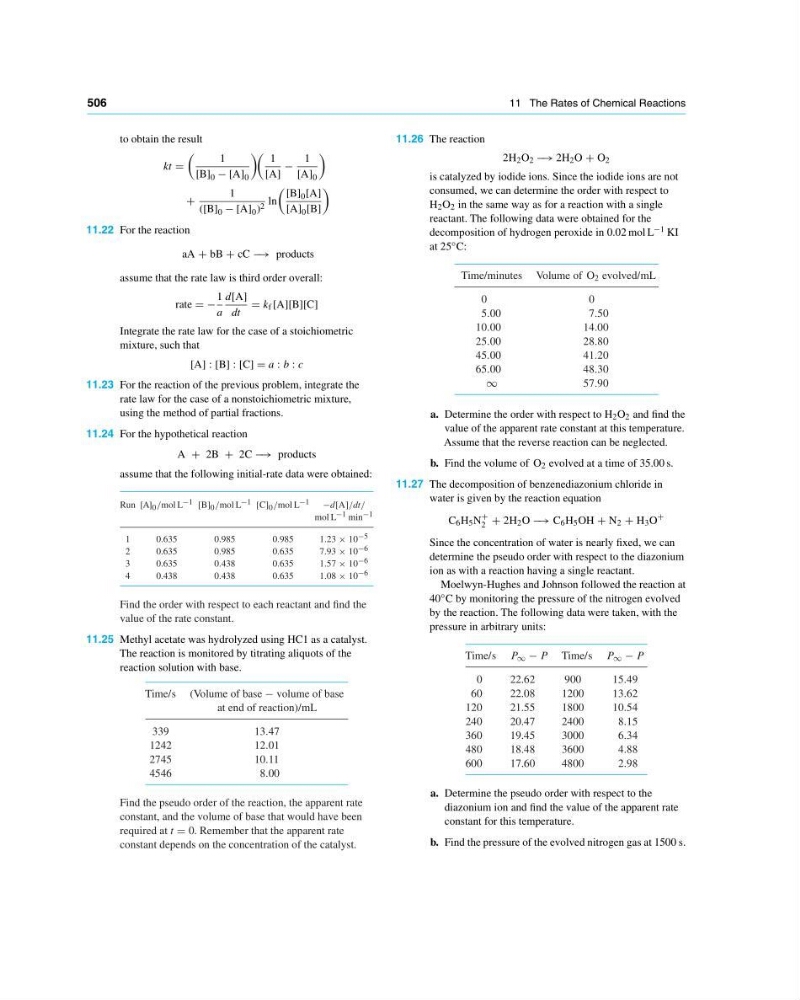
Run [A] 0 /mol L −1 [B] 0 /mol L −1 [C] 0 /mol L −1 −d[A]/dt/
mol L −1 min −1
1
0.635
0.985
0.985
1.23 × 10 −5
2
0.635
0.985
0.635
7.93 × 10 −6
3
0.635
0.438
0.635
1.57 × 10 −6
4
0.438
0.438
0.635
1.08 × 10 −6
Find the order with respect to each reactant and find the
value of the rate constant.
11.25 Methyl acetate was hydrolyzed using HC1 as a catalyst.
The reaction is monitored by titrating aliquots of the
reaction solution with base.
Time/s (Volume of base − volume of base
at end of reaction)/mL
339
13.47
1242
12.01
2745
10.11
4546
8.00
Find the pseudo order of the reaction, the apparent rate
constant, and the volume of base that would have been
required at t 0. Remember that the apparent rate
constant depends on the concentration of the catalyst.
11.26 The reaction
2H 2 O 2 − → 2H 2 O + O 2
is catalyzed by iodide ions. Since the iodide ions are not
consumed, we can determine the order with respect to
H 2 O 2 in the same way as for a reaction with a single
reactant. The following data were obtained for the
decomposition of hydrogen peroxide in 0.02 mol L −1 KI
at 25 ◦ C:
Time/minutes Volume of O 2 evolved/mL
0
0
5.00
7.50
10.00
14.00
25.00
28.80
45.00
41.20
65.00
48.30
∞
57.90
a. Determine the order with respect to H 2 O 2 and find the
value of the apparent rate constant at this temperature.
Assume that the reverse reaction can be neglected.
b. Find the volume of O 2 evolved at a time of 35.00 s.
11.27 The decomposition of benzenediazonium chloride in
water is given by the reaction equation
C 6 H 5 N
+
2 + 2H 2 O − → C 6 H 5 OH + N 2 + H 3 O
+
Since the concentration of water is nearly fixed, we can
determine the pseudo order with respect to the diazonium
ion as with a reaction having a single reactant.
Moelwyn-Hughes and Johnson followed the reaction at
40 ◦ C by monitoring the pressure of the nitrogen evolved
by the reaction. The following data were taken, with the
pressure in arbitrary units:
Time/s P ∞ − P Time/s P ∞ − P
0
22.62
900
15.49
60
22.08
1200
13.62
120
21.55
1800
10.54
240
20.47
2400
8.15
360
19.45
3000
6.34
480
18.48
3600
4.88
600
17.60
4800
2.98
a. Determine the pseudo order with respect to the
diazonium ion and find the value of the apparent rate
constant for this temperature.
b. Find the pressure of the evolved nitrogen gas at 1500 s.