

11.2 Forward Reactions with One Reactant
493
b. Find the half-life of the reaction of the previous example if the initial concentration is equal
to 0.1000 mol L −1 .
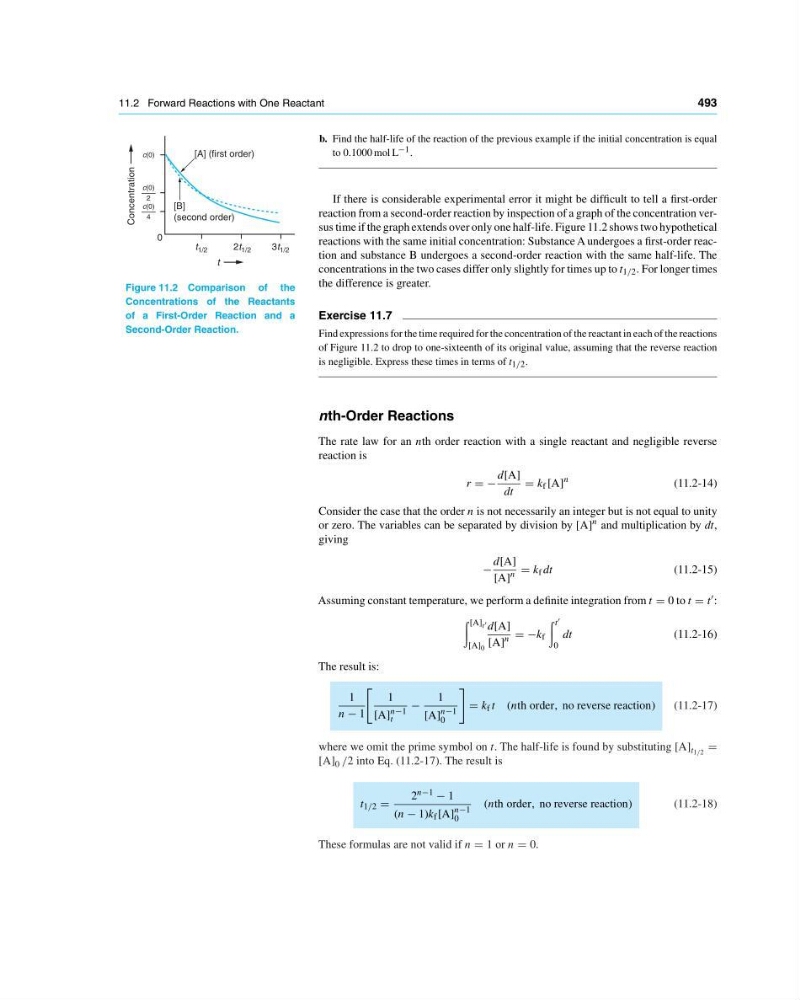
If there is considerable experimental error it might be difficult to tell a first-order
reaction from a second-order reaction by inspection of a graph of the concentration versus time if the graph extends over only one half-life. Figure 11.2 shows two hypothetical
reactions with the same initial concentration: Substance A undergoes a first-order reaction and substance B undergoes a second-order reaction with the same half-life. The
concentrations in the two cases differ only slightly for times up to t 1/2 . For longer times
the difference is greater.
[A] (first order)
[B]
(second order)
c(0)
c(0)
c(0)
0
t 1/2
2t 1/2
3t 1/2
Concentration
2
4
t
Figure 11.2 Comparison of the
Concentrations of the Reactants
of a First-Order Reaction and a
Second-Order Reaction.
Exercise 11.7
Find expressions for the time required for the concentration of the reactant in each of the reactions
of Figure 11.2 to drop to one-sixteenth of its original value, assuming that the reverse reaction
is negligible. Express these times in terms of t 1/2 .
nth-Order Reactions
The rate law for an nth order reaction with a single reactant and negligible reverse
reaction is
r −
d[A]
dt
k f [A]
n
(11.2-14)
Consider the case that the order n is not necessarily an integer but is not equal to unity
or zero. The variables can be separated by division by [A]
n and multiplication by dt,
giving
−
d[A]
[A]
n k f dt
(11.2-15)
Assuming constant temperature, we perform a definite integration from t 0 to t t :
[A] t
[A] 0
d[A]
[A]
n −k f
t
0
dt
(11.2-16)
The result is:
1
n − 1
1
[A]
n−1
t
−
1
[A]
n−1
0
k f t (nth order, no reverse reaction)
(11.2-17)
where we omit the prime symbol on t. The half-life is found by substituting [A] t 1/2
[A] 0 /2 into Eq. (11.2-17). The result is
t 1/2
2 n−1 − 1
(n − 1)k f [A]
n−1
0
(nth order, no reverse reaction)
(11.2-18)
These formulas are not valid if n 1 or n 0.