

11.2 Forward Reactions with One Reactant
491
Solution
k
ln(2)
t 1/2
ln(2)
7.1 × 10 8 yr
9.8 × 10 −10 yr −1
τ
1
k
1
9.8 × 10 −10 yr −1 1.02 × 10 9 yr
Exercise 11.3
Find the time required for a sample of 235 U to decay to 10.0% of its original amount.
Second-Order Reactions
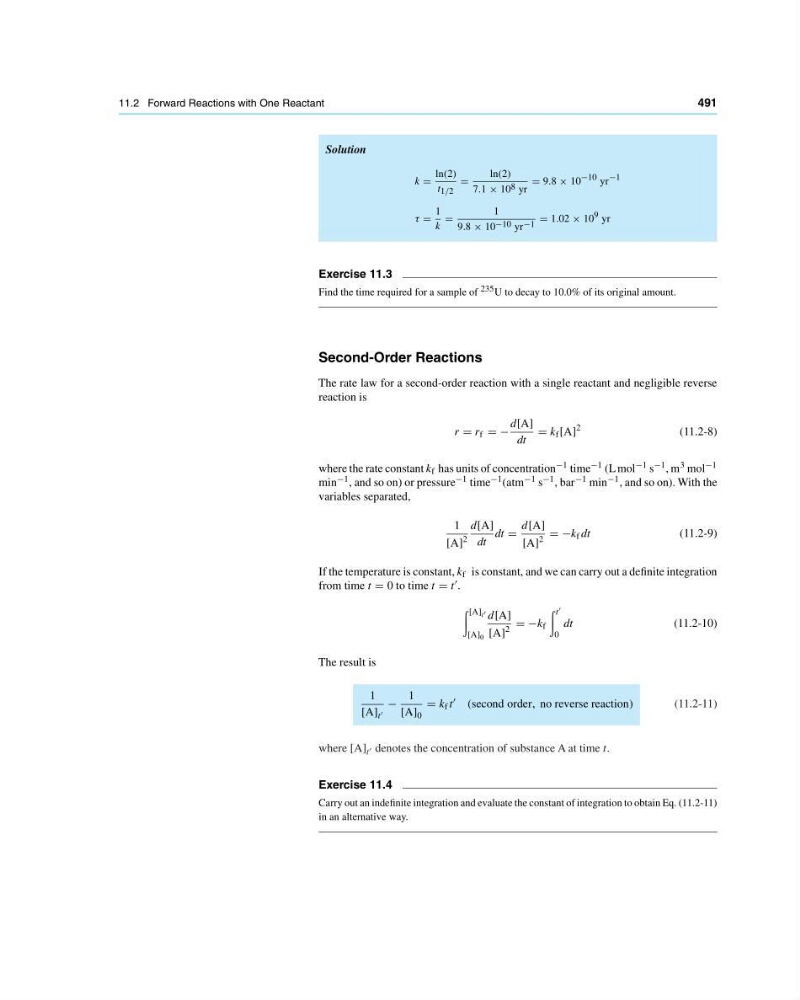
The rate law for a second-order reaction with a single reactant and negligible reverse
reaction is
r r f −
d[A]
dt
k f [A]
2
(11.2-8)
where the rate constant k f has units of concentration −1 time −1 (L mol −1 s −1 , m 3 mol −1
min −1 , and so on) or pressure −1 time −1 (atm −1 s −1 , bar −1 min −1 , and so on). With the
variables separated,
1
[A]
2
d[A]
dt
dt
d [A]
[A]
2
−k f dt
(11.2-9)
If the temperature is constant, k f is constant, and we can carry out a definite integration
from time t 0 to time t t .
[A] t
[A] 0
d [A]
[A]
2
−k f
t
0
dt
(11.2-10)
The result is
1
[A] t
−
1
[A] 0
k f t (second order, no reverse reaction)
(11.2-11)
where [A] t denotes the concentration of substance A at time t.
Exercise 11.4
Carry out an indefinite integration and evaluate the constant of integration to obtain Eq. (11.2-11)
in an alternative way.