

32
1 The Behavior of Gases and Liquids
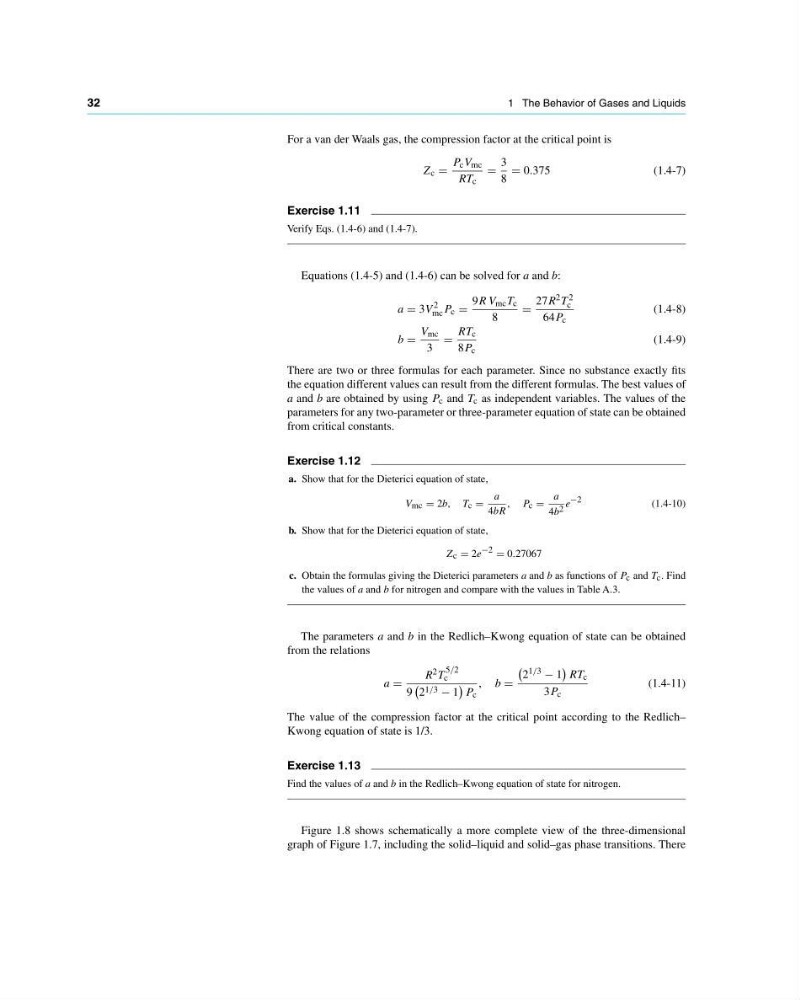
For a van der Waals gas, the compression factor at the critical point is
Z c
P c V mc
RT c
3
8
0.375
(1.4-7)
Exercise 1.11
Verify Eqs. (1.4-6) and (1.4-7).
Equations (1.4-5) and (1.4-6) can be solved for a and b:
a 3V
2
mc P c
9R V mc T c
8
27R 2 T 2
c
64P c
(1.4-8)
b
V mc
3
RT c
8P c
(1.4-9)
There are two or three formulas for each parameter. Since no substance exactly fits
the equation different values can result from the different formulas. The best values of
a and b are obtained by using P c and T c as independent variables. The values of the
parameters for any two-parameter or three-parameter equation of state can be obtained
from critical constants.
Exercise 1.12
a. Show that for the Dieterici equation of state,
V mc 2b, T c
a
4bR
, P c
a
4b 2 e −2
(1.4-10)
b. Show that for the Dieterici equation of state,
Z c 2e −2 0.27067
c. Obtain the formulas giving the Dieterici parameters a and b as functions of P c and T c . Find
the values of a and b for nitrogen and compare with the values in Table A.3.
The parameters a and b in the Redlich–Kwong equation of state can be obtained
from the relations
a
R 2 T
5/2
c
9
2 1/3 − 1
P c
, b
2 1/3 − 1
RT c
3P c
(1.4-11)
The value of the compression factor at the critical point according to the Redlich–
Kwong equation of state is 1/3.
Exercise 1.13
Find the values of a and b in the Redlich–Kwong equation of state for nitrogen.
Figure 1.8 shows schematically a more complete view of the three-dimensional
graph of Figure 1.7, including the solid–liquid and solid–gas phase transitions. There
1 The Behavior of Gases and Liquids
For a van der Waals gas, the compression factor at the critical point is
Z c
P c V mc
RT c
3
8
0.375
(1.4-7)
Exercise 1.11
Verify Eqs. (1.4-6) and (1.4-7).
Equations (1.4-5) and (1.4-6) can be solved for a and b:
a 3V
2
mc P c
9R V mc T c
8
27R 2 T 2
c
64P c
(1.4-8)
b
V mc
3
RT c
8P c
(1.4-9)
There are two or three formulas for each parameter. Since no substance exactly fits
the equation different values can result from the different formulas. The best values of
a and b are obtained by using P c and T c as independent variables. The values of the
parameters for any two-parameter or three-parameter equation of state can be obtained
from critical constants.
Exercise 1.12
a. Show that for the Dieterici equation of state,
V mc 2b, T c
a
4bR
, P c
a
4b 2 e −2
(1.4-10)
b. Show that for the Dieterici equation of state,
Z c 2e −2 0.27067
c. Obtain the formulas giving the Dieterici parameters a and b as functions of P c and T c . Find
the values of a and b for nitrogen and compare with the values in Table A.3.
The parameters a and b in the Redlich–Kwong equation of state can be obtained
from the relations
a
R 2 T
5/2
c
9
2 1/3 − 1
P c
, b
2 1/3 − 1
RT c
3P c
(1.4-11)
The value of the compression factor at the critical point according to the Redlich–
Kwong equation of state is 1/3.
Exercise 1.13
Find the values of a and b in the Redlich–Kwong equation of state for nitrogen.
Figure 1.8 shows schematically a more complete view of the three-dimensional
graph of Figure 1.7, including the solid–liquid and solid–gas phase transitions. There